

Hackers can be a strange folk. Our idea of beauty, for instance, can be rather odd. This week, Hackaday saw a few projects that were not just functional – the aesthetics were the goal. I don’t think we’ll be taking over the fine art world any time soon, but I’m absolutely convinced that the same muse that guides the hand that holds the paintbrush sometimes also guides the hand holding the soldering iron.
Take “circuit sculpture”, for instance. Heck, we even give it an art-inspired name that classifies it correctly. This week’s project that got me thinking about the aesthetics of hand-bent wire circuits was this marvelous clock build, but the works of Mohit Bhoite or Kelly Heaton are also absolute must-sees in this category.
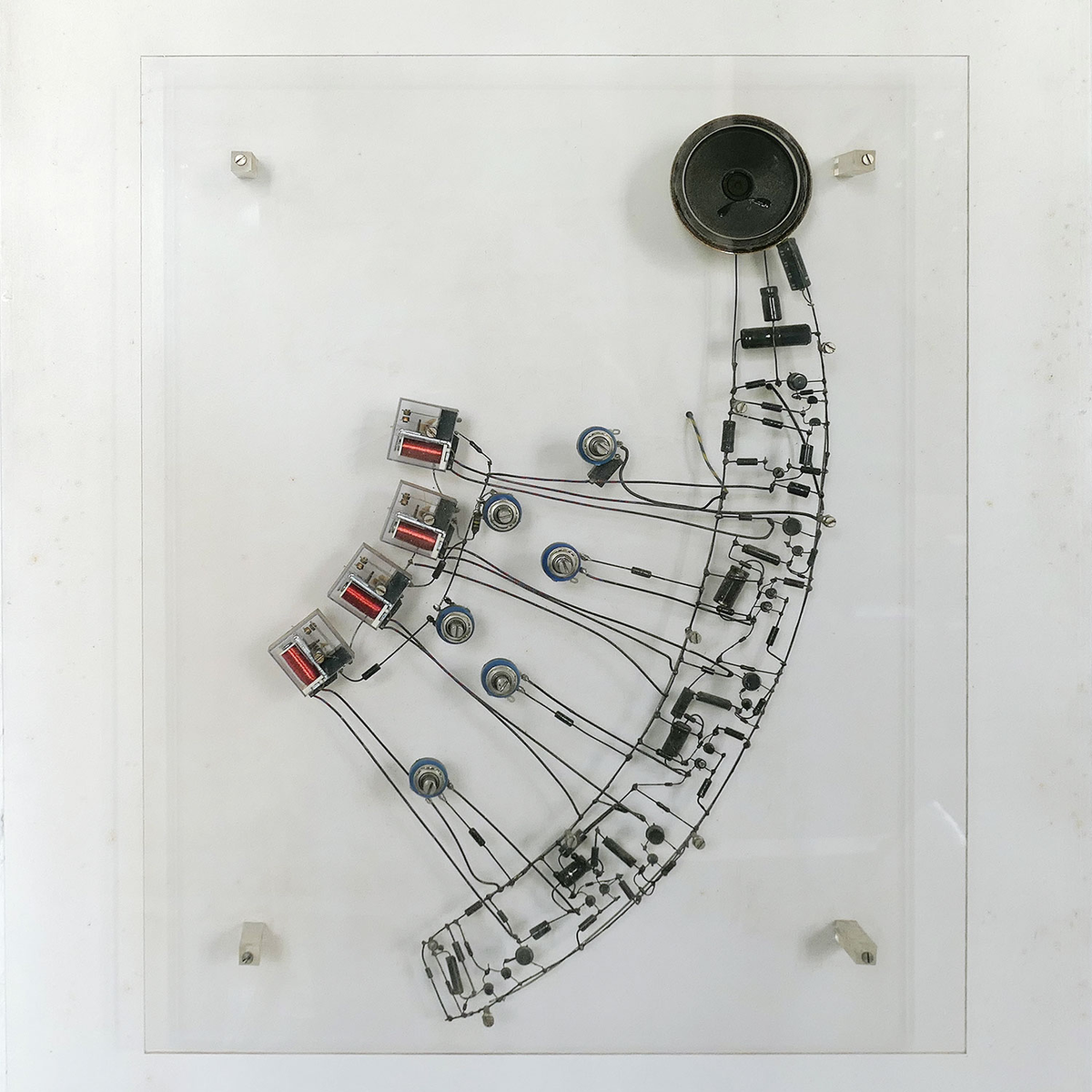 Outside of the Hackaday orbit, one of my all-time favorite artists in this genre was Peter Vogel, who made complex audience-reactive sound sculptures that looked as good as they sound.
Is a wireframe animated moving jellyfish art? It was certainly intended to be beautiful, and I personally find it so. Watch some of the video clips attached to the project to get a better sense of it.
In the sculpture world, there is a sub-genre of kinetic art pieces where the work itself is secondary to the beauty of the motions that the pieces pull off. Think ballet, but mechanical. Perhaps my absolute favorite of these artists is Arthur Ganson. If you haven’t seen his work before, check out “Thinking Chair” for the beauty of movement, but don’t miss “Machine with Concrete” if you’re feeling more conceptual.
If you’re willing to buy an insane geartrain as art, what about these 3D printed wire strippers? Is this “art”? It’s clear that they were designed with real intent and attention to the aesthetics of the final form, and am I wrong for finding the way they move literally beautiful?
What’s your favorite offbeat hacker artform?












I’ve been working in art and tech for years, and it’s about intention and reception. If you say it’s art, then it’s art – whether it not it’s good art is a whole other question.
One factor is intentionally denying high functionality – if a thing has friction built in or is using less optimized method to do a thing, then it’s probably art.
Like, for instance, the recently opened show at the New Museum in NYC titled “New Humans: Memories of the Future” has a Minsky box in the show, commonly known as a Useless Machine (the box that turns itself off when it’s on switch is toggled). It’s a simple marker project, but it’s a perfect example of a hacker project a that is art.
“…One factor is intentionally denying high functionality – if a thing has friction built in or is using less optimized method to do a thing, then it’s probably art….”
Or… it might be the product of a self-described “artist” who doesn’t understand engineering principles and doesn’t really know what he’s doing. I see no requirement that the “artful” or aesthetically beautiful must be, by definition, technologically lacking/inferior.
If you ever have opportunity to visit Dearborn, Michigan, make a point to visit the Henry Ford Museum. Walk the railroad gallery where you step up to, and climb on their massive steam locomotives. Study how the machines function and were built to optimize every aspect of their operation, and then tell me they aren’t, at the same time, breathtakingly beautiful.
The next gallery over they have exhibits of massive steam-engine powered industrial dynamos–again, optimized per best engineering practice of the day, yet you see in their frame castings gothic arches, floral patterns, and other nods to architectural aesthetics.
“Well, those are antiques,” you might counter. Fine… decap the latest offering from Intel or AMD and throw it under a microscope. The image you capture will compete favorably with a third the modern “art” crap hanging on the walls of your typical museum.
As a person with a genuine appreciation of art and beautiful things, it frustrates me that real creativity and artistic ability has become conflated with simply being an load or obnoxious… and that mediocrity (even incompetence) is now routinely misidentified as artistic genius.
“…One factor is intentionally denying high functionality – if a thing has friction built in or is using less optimized method to do a thing, then it’s probably art….”
Or… it might be the product of a self-described “artist” who doesn’t understand engineering principles and doesn’t really know what he’s doing. I see no requirement that the “artful” or aesthetically beautiful must be, by definition, technologically lacking/inferior.
If you ever have opportunity to visit Dearborn, Michigan, make a point to visit the Henry Ford Museum. Walk the railroad gallery where you step up to, and climb on their massive steam locomotives. Study how the machines function and were built to optimize every aspect of their operation, and then tell me they aren’t, at the same time, breathtakingly beautiful.
The next gallery over they have exhibits of massive steam-engine powered industrial dynamos–again, optimized per best engineering practice of the day, yet you see in their frame castings gothic arches, floral patterns, and other nods to architectural aesthetics.
“Well, those are antiques,” you might counter. Fine… decap the latest offering from Intel or AMD and throw it under a microscope. The image you capture will compete favorably with a third the modern “art” crap hanging on the walls of your typical museum.
As a person with a genuine appreciation of art and beautiful things, it frustrates me that real creativity and artistic ability has become conflated with simply being an load or obnoxious… and that mediocrity (even incompetence) is now routinely misidentified as artistic genius.
Definitely agree. Not everything made has to be intentionally flawed to be literal art or inspire others. Old machines are great for that. Anyone looked at the inner workings of a mechanical hand watch lately?
Also been working in art and tech for years. (Currently building a museum-grade prop for the Museum of Wonder and Awe outside Chicago.)
A friend of mine once quipped “art is anything that doesn’t have a purpose”, and I’ve found that definition to work pretty well. It even allows us to separate the artistic elements of an item from the functional ones. You can consider a door as a utilitarian slab, but it can also have decorative value: ornamental knocker, window placement and design, color and hinge construction, and so on.
Under this definition, the “useless box” would be a completely artistic project, while a good looking LED clock would be a mixture of both.
Vilayanur Ramachandran (cognitive neuroscientist) believes that the “feeling” of art comes from the sense of similarity to something that’s real without the real detail. So for example the Rodin sculpture “The Burghers of Calais” is a set of human forms, indistinct and without close detail, but each statue strongly implies an emotional state of one of the people. It is this “calling up an impression of something high level without showing the low-level details” that Dr. Ramachandran thinks is the artistic “feel” of a work of art.
https://en.wikipedia.org/wiki/The_Burghers_of_Calais
This definition works well for a lot of art, and (for example) explains why some people don’t like photography as an art form, but I’m not convinced it covers everything.
I much prefer my friend’s definition: art is anything (or any aspect of something) that doesn’t have a purpose.
I love stuff being done for arts sake. It’s a great way to exercise skill, accidentally gain ones you wouldn’t normally, and enjoy what you are doing.
Right now especially there is a push to churn out high volume low effort learn nothing know nothing projects. It’s nearly valueless to share. People put it out there as os’s, or blog posts, or YouTubers, but there is no story too it, no lessons learned, no triumph, and no personality. It may as well have been bought rather then built.
A lot of geeks don’t like it, but much of what we do is closer to an art or craft than it is a discipline. Be wise when outsourcing your craft.