For Art’s Sake

Hackers can be a strange folk. Our idea of beauty, for instance, can be rather odd. This week, Hackaday saw a few projects that were not just functional – the aesthetics were the goal. I don’t think we’ll be taking over the fine art world any time soon, but I’m absolutely convinced that the same muse that guides the hand that holds the paintbrush sometimes also guides the hand holding the soldering iron.

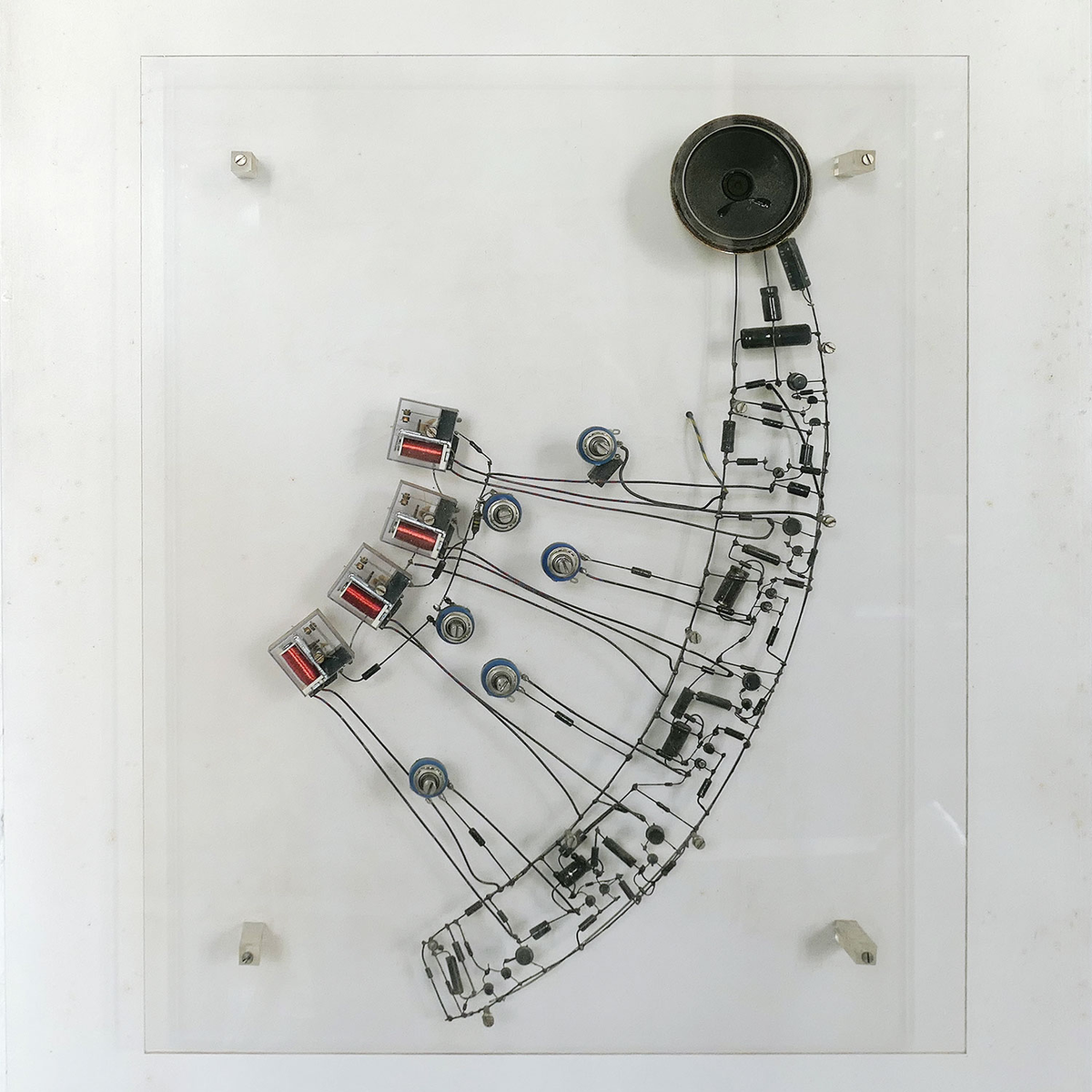
Take “circuit sculpture”, for instance. Heck, we even give it an art-inspired name that classifies it correctly. This week’s project that got me thinking about the aesthetics of hand-bent wire circuits was this marvelous clock build, but the works of Mohit Bhoite or Kelly Heaton are also absolute must-sees in this category.

Outside of the Hackaday orbit, one of my all-time favorite artists in this genre was Peter Vogel, who made complex audience-reactive sound sculptures that looked as good as they sound.

Is a wireframe animated moving jellyfish art? It was certainly intended to be beautiful, and I personally find it so. Watch some of the video clips attached to the project to get a better sense of it.

In the sculpture world, there is a sub-genre of kinetic art pieces where the work itself is secondary to the beauty of the motions that the pieces pull off. Think ballet, but mechanical. Perhaps my absolute favorite of these artists is Arthur Ganson. If you haven’t seen his work before, check out “Thinking Chair” for the beauty of movement, but don’t miss “Machine with Concrete” if you’re feeling more conceptual.

If you’re willing to buy an insane geartrain as art, what about these 3D printed wire strippers? Is this “art”? It’s clear that they were designed with real intent and attention to the aesthetics of the final form, and am I wrong for finding the way they move literally beautiful?

What’s your favorite offbeat hacker artform?

Always Something New Under The Sun

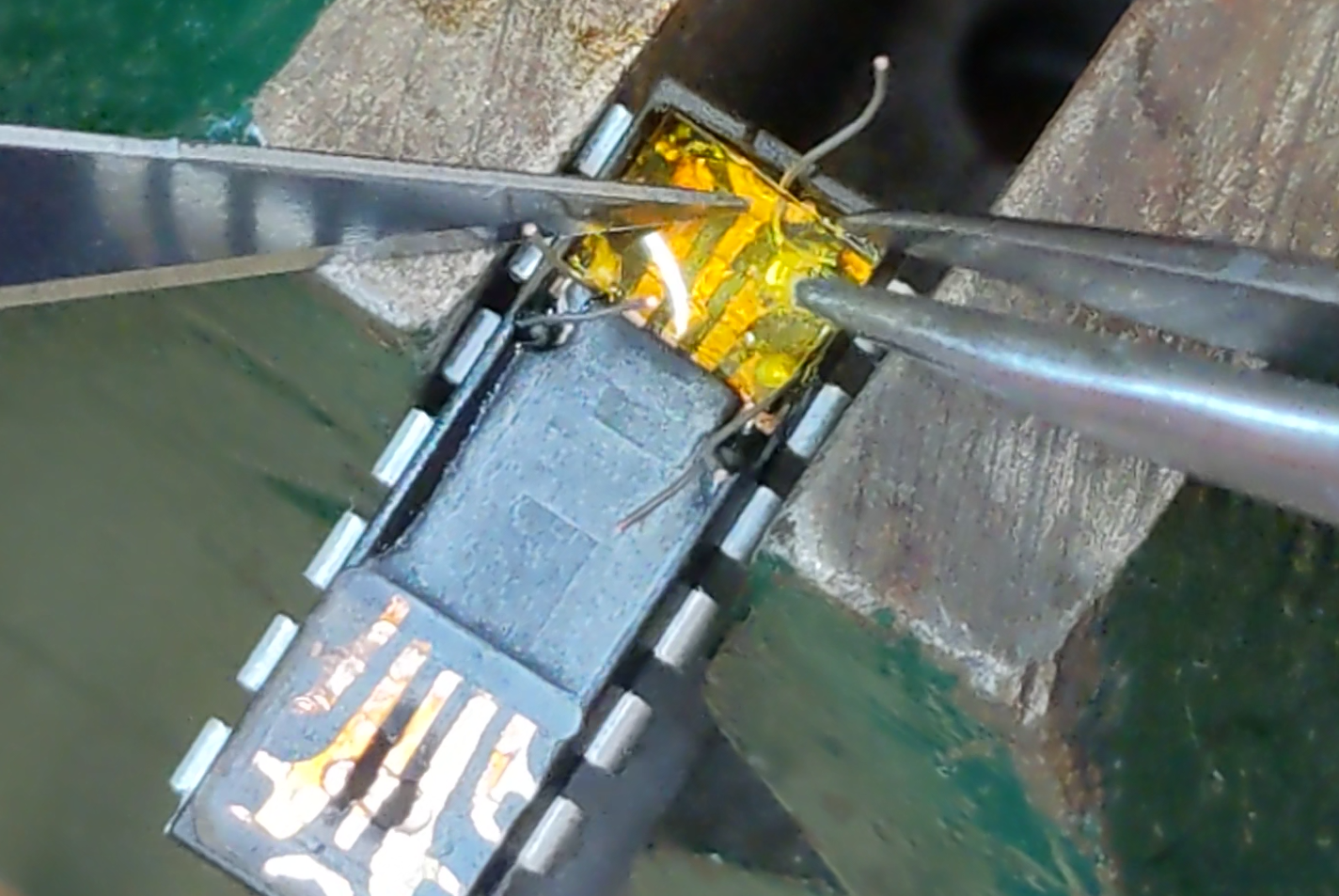
Some of the entries we got into the Tiny Games Contest have been really mind-blowing. Just as you think you’ve seen it all, for instance, alnwlsn comes along and mills the DIP-package ATtiny84 and embeds a complete Simon game in the space normally wasted by all that plastic overmolding. It’s the tiniest, and most gonzo, circuit-sculpture Simon we’ve ever seen.

Soldering fine wires to the leadframe of an ATtiny84 in a DIP-14 package.Now, our judges are hard at work ranking all 80 of the entries, and we have a fantastic range of entries all around, so I’m not calling any winners yet. But have you ever seen a project milled into a chip before? Nope, me neither.

What’s amazing is that this happens every time we run a contest. The second you put limitations on a project, there’s always someone out there who says “Hold my beer” and blows the limits out of the water. Indeed, the frequency with which we see someone pull off the impossible on Hackaday makes me wish I were buying more lottery tickets. You all really are stupendous.

We hope that feats like this are as inspirational to you as they are to us. No idea is too bonkers to not at least give it a try. Who knows, it might work! And when it does, please write it up and let us know. Keep the cycle of inspiration going!

99% Partspiration

Thomas Edison once said that genius was 1% inspiration and 99% perspiration. That doesn’t leave much room for partspiration.

I’m working on a top-secret project, and had to place a parts order on AliExpress with a minimum order quantity of five in order to get decent shipping times. No big deal, financially, and it’s always great to have spares as backup for the ones you fry.

But as I started lighting up the little round smartwatch displays to put them through their paces, I started thinking of all sorts of ways that I could use something like this. I had no idea how easy to drive they were, or frankly, how good they looked in person. When you get a round display in your hands, you find that you need dial indicators everywhere.

And then my son came by and said “Oh neat. I want one!” and started thinking up all sorts of gizmos that I could put them in. Two of them would make awesome eyes, and he’s been on a chameleon kick – the animal, you know. So we’re looking for chameleon eye animations online.

And all of a sudden, I have more projects lined up than I have remaining screens. I’m calling this phenomenon “partspiration”. You know, when you figure out how to use something and then you see uses for it everywhere? Time to place another Ali order.

Gearing Up for the Hackaday Prize

And don’t forget, we just started the next round of the Hackaday Prize: Gearing Up. In this challenge round we want to see your best DIY tools, jigs, and workflow accelerators. Custom reflow plates, home-built power supplies, or even software tools – as long as it helps you get the job done, it has a place here. You’ve got until Aug. 8 to get your entry finished, but head on over to Hackaday.io and get started now.

Badminton Inspired Heat Shield Aims To Fly This Year

Badminton is not a sport that most of us think about often, and extremely rarely outside of every four years at the summer Olympics and maybe at the odd cookout or beach party here or there. But the fact that it’s a little bit unique made it the prime inspiration for this new heat shield design, which might see a space flight and test as early as a year from now.

The inspiration comes from the shuttlecock, the object which would otherwise be a ball in any other sport. A weighted head, usually rubber or cork, with a set of feathers or feather-like protrusions mounted to it, contributes to its unique flight characteristics when hit with a racquet. The heat shield, called Pridwen and built by Welsh company Space Forge, can be folded before launch and then expanded into this shuttlecock-like shape once ready for re-entry. It’s unlikely this will protect astronauts anytime soon, though. The device is mostly intended for returning materials from the Moon or from asteroids, or for landing spacecrafts on celestial bodies with atmospheres like Mars or Venus.

With some testing done already, Space Forge hopes this heat shield will see a space flight before the close of 2023. That’s not the end of the Badminton inspiration either, though. It’s reported that this device can slow a re-entering craft so much that it can be caught in a net. Not exactly the goal when playing the sport, but certainly a welcome return home for whichever craft might use this system. Of course, getting down from space is only half the battle. Take a look at this other unique spacecraft that goes up in a fairly non-traditional way instead.

Honor Your Hacker Heroes

We recently ran an article on a sweet percussion device made by minimal-hardware-synth-madman [Gijs Gieskes]. Basically, it amplifies up an analog meter movement and plays it by slamming it into the end stops. Rhythmically, and in stereo. It’s got that lovely thud, plus the ringing of the springs. It takes what is normally a sign that something’s horribly wrong and makes a soundtrack out of it. I love it.

[Gijs] has been making electro-mechanical musical hacks for about as long as I’ve been reading Hackaday, if not longer. We’ve written up no fewer than 22 of his projects, and the first one on record is from 2005: an LSDJ-based hardware sequencer. All of his projects are simple, but each one has a tremendously clever idea at its core that comes from a deep appreciation of everything going on around us. Have you noticed that VU meters make a particular twang when they hit the walls? Sure you have. Have you built a percussion instrument out of it? [Gijs] has!

Maybe it’s a small realization, and it’s not going to change the world by itself, but I’ve rebuilt more than a couple projects from [Gijs]’ repertoire, and each one has made my life more fun. And if you’re a regular Hackaday reader, you’ve probably seen hundreds or thousands of similar little awesome ideas played out, and maybe even taken some of them on as your own as well. When they accumulate up, I believe they can change the world, at least in the sense of filling up a geek’s life. I hope that feeling comes across when we write up a project. Those of you out there hacking, we salute you!

Inspiring Hacks, Unfinished Hacks

We got a tip this week, and the tipster’s comments were along the lines of “this doesn’t look like it’s a finished work yet, but I think it’s pretty cool anyway”. And that was exactly right. The work in question is basically attaching a simple webcam to a CNC router and then having at it with OpenCV, and [vector76]’s application was cutting out freeform hand-drawn curves from wood. To amuse his daughter.

But there’s no apology necessary for presenting a work in progress. Unfinished hacks are awesome! They leave room for further improvement and interpretation. They are like an unfinished story, inviting the hacker to dream up their own end. At least that’s how this one worked on me.

My mind went racing — adding smart and extensible computer vision to a CNC router enables not only line tracing, but maybe smarter edge finding, broken tool detection, and who knows what else. With the software end so flexible these days, and the additional hardware demands so minimal, it’s an invitation. It’s like Pavlov ringing that bell, and I’m the dog-hacker. Or something.

So remember this when you get half done with a project, get to a workable first-stage demo, but you haven’t chased down each and every possibility. Leaving something up to other hackers’ imagination can be just as powerful. Your proof of concept doesn’t have to be the mother of all demos — sometimes just a working mouse will suffice.

Finding The Right Hack Is Half The Battle

Sometimes you just get lucky. I had a project on my list for a long time, and it was one that I had been putting off for a few months now because I loathed one part of what it entailed — sensitive, high-accuracy analog measurement. And then, out of the blue I stumbled on exactly the right trick, and my problems vanished in thin air. Thanks, Internet of Hackers!

The project in question is a low-vacuum regulator for “bagging” fiberglass layups. What I needed was some way to read a pressure sensor and turn on and off a vacuum pump accordingly. The industry-standard vacuum gauges are neat devices, essentially a tiny little strain gauge on a membrane between the vacuum side and the atmosphere side, in a package the size of a dime. (That it’s a strain gauge is foreshadowing, but I didn’t know that at the time.) I bought one for $15 ages ago, and it sat on my desk, awaiting its analog circuitry.

See, the MPX2100 runs on 12 V and puts out a signal around 40 mV on top of a 6 V offset. That voltage level is inconvenient for modern 3.3 V microcontroller ADCs, and the resolution would get clobbered by the 6 V signal if I just put a voltage divider on it. This meant whipping together some kind of instrument amplifier circuit to null out the 6 V and amplify the 40 mV for the ADC. The circuits I found online all called for 1% resistors in values I didn’t have, and mildly special op-amps. No fun, for me at least. So there it sat.

Picture of sketchy-looking vacuum apparatus.
Cut the blue wire or the red wire? HX711 module and pressure sensor on the left.

Until I ran into this project that machetes through the analog jungle with one part, and it happened to be one I had on hand. A vacuum pressure sensor is a strain gauge, set up like a Wheatstone bridge, just like you would use for weighing something with a load cell. The solution? A load-cell ADC chip, the HX711, found in every cheap scale or online for under a buck. The only other trick was finding a low-voltage pressure sensor to work with it, but that turns out to be easy as well, and I had one delivered in two days.

In all, this project took months of foot-dragging, but only a few clicks and five minutes of soldering once I got the right idea. The industrial applications and manufacturers’ app notes all make sense if you are making hundreds or millions of these devices, where the one-time cost of prototyping up the hard bits gets amortized, but the hacker solution of using a weight-scale chip was just the ticket for a one-off. That just goes to show how useful sharing our tips and tricks can be — you won’t get this from the industry. So send us your success stories, and your useful failures too, and Read More Hackaday!