
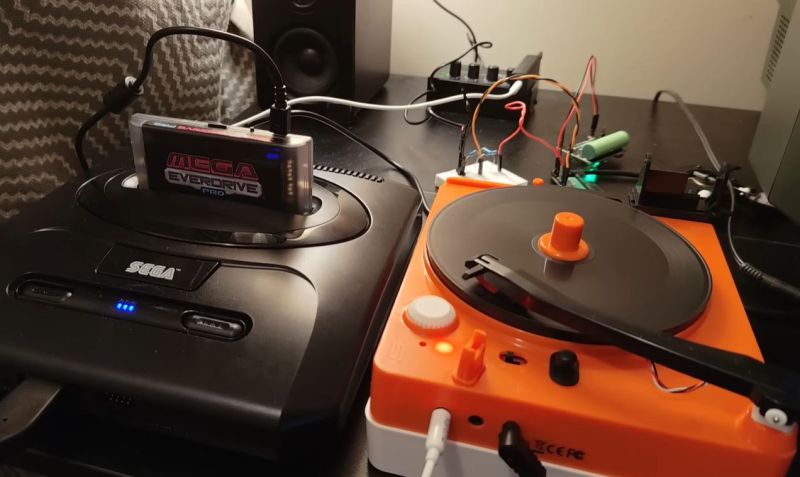
Recently [Throaty Mumbo] took a poke at another daft idea, in the form of loading Sega Genesis games off vinyl records. Although a whacky idea, it’s made possible through the use of a Mega Everdrive Pro and its ability to load games via its USB port, a feature mostly intended for on-the-fly game development without swapping SD cards.
For a few decades in home computing, the loading of software from cassette tapes and similar media was very common. This was due to the low-cost nature of this ubiquitous technology compared to alternatives like cartridges and floppy disks. Even if it was famously unreliable and slow, this accessibility made it a very popular choice. This is where home game consoles were different, as they generally used very fast cartridges, but what if you merge these two worlds?
As demonstrated, a Pico 2 board with its RP2350 MCU is used to convert the audio signal containing the binary data into data for transmission via USB to the Everdrive cartridge. After confirming that it works with a tape drive, he drags in a plastic-y PO-80 5″ record cutter and player, where the mono audio limitation is not a problem.
Unfortunately, this PO-80 turns out to be exactly the kind of toy it looks like, with [Throaty Mumbo] unable to cut and play back a record that gets a clean enough signal to the Pico 2 board, though with a better player and likely record cutter it should work fine. After all, some magazines back in the day came with plastic ‘vinyl’ records that contained programs you could load from your record player.
Although technically a failure, it does demonstrate that if you are very patient, you can totally load Sega Genesis ROMs off a tape or record at a blistering couple of kB/s, tops.












Swedish synthpop group Adolphson & Falk put an Atari 600 XL program on their 1984 album “Över tid och rum”.
Weirder was Information Society, who released “300BPS, 8, N, 1”. Those were the modem settings you needed to pre-set before playing the song to your modem. It was a short, rambling story about the band in South Africa.
Weird. Why no radio teletype (RTTY) recording at 45,45 Baud (5 Bit Baudot code)?
Someone should think that RTTY was very well known in the 70s/80s.
There were many radio amateurs and shortwave listeners who used it.
News agencies used it, too and everyone could read it on shortwave.
In computer and electronic hobbyist magazines such as Elector there had been many articles about RTTY and how to receive it.
There also had been multimode TNCs and standalone RTTY decoders who supported Baudot code.
By comparison, these US Bell modems were rather obscure, I think.
Still got a copy of the Pete Shelly XL1 vinyl from 1983,
which has a track with a program for the ZX Spectrum.
AFAIK he was one of the very first to do this…
Nice idea, but it was very frustrating trying to get the thing to load ;^)
Wait for it (playing the record :)
Enjoyed it a lot :)
The album “Tubular bells” had a short message encoded in tarbell tape format in one of the cuts.
I remember it because I used my Imsai 8080 tarbell tape interface to decode the ascii message. Sadly, I don’t remember what the message said. Something about the moon I think.
They need to made a hand cranked version for the times when mains power fails.
There is a microcontroller that can run a simple operating environment and LISP interpreter on a good intention’s worth of electricity. The Sparkfun Artemis module runs at only 96Mhz, but only consumes .6mA at full speed. Using a crank to charge a supercapacitor and turn the mechanics for a tape drive is entirely doable. The Potatop (https://hackaday.com/2023/03/06/low-power-challenge-the-potatop-runs-lisp-for-months-without-recharging/) pairs it with the ever-popular Sharp Memory Display (the one in the Playdate), which also sips power.
So, yes, if cassettes were still a thing you could easily get, a crank-powered machine with software on cassette is doable – those displays aren’t cheap, but it’s doable.
It’s pretty easy to convert an old cordless drill with a brushed motor into a hand cranked generator that will produce 10-20 watts. With that much power you wouldn’t even need a particularly low power display.
I think I referenced the album as Tubular Bells incorrectly. I think it was an album by Tomita. Sorry.
Curious, I asked Grok. Answer took 16 seconds:
The album in question is likely Isao Tomita’s The Bermuda Triangle (1979), not Mike Oldfield’s Tubular Bells (1973).
On The Bermuda Triangle, Tomita intentionally embedded short ASCII text messages as audio data using the Tarbell cassette interface format (a Manchester-encoded binary protocol from the mid-1970s for storing computer data on audio tapes, common with early S-100 bus systems like the Altair 8800).
The data is hidden in sound effects on the tracks (notably “The Mysterious Electric Waves” / track 10 on some releases).
Liner notes explain how to recover it: Feed the audio signal from the record into a microcomputer programmed for the Tarbell system.
Decoded messages (from Side A and related sources):
“THIS IS THE BERMUDA TRIANGLE, OVER.”
“SLOW DOWN.”
“TARGET 50 MILES OFF SOUTH FLORIDA, A GIANT PYRAMID AT OCEAN BOTTOM.”
I think the point of the Flexidiscs was for the user to copy the record to tape and use the tape copy to load the program. Flexidiscs were literally meant to be disposable and they didn’t last as long as a ‘proper’ vynil record.
So, cheap mass produced Flexidisc for distribution, more expensive cassette as the daily driver.
As far as this video goes, the record cutter does not supply enough audio ‘bandwidth’ to allow for proper distinct milliseconds long ‘blips’ of audio that represent the 1s and 0s. So these bits get muddled together. To grossly oversimplify things a bit:
The cart expects:
101010101010
But what’s recorded on the record is more like:
111001110111 despite attempting to record 101010101010
And that’s even before the flutter that happens when both recording and playing back the record (doubled up flutter).
So, no, this cutter/player has no chance of sucessfuly recording and playing back data with a much higher baud rate than say the WWV time signal (ouch!)