Solar Balconies Take Europe By Storm

Solar power has been around for a long time now. Once upon a time, it was mostly the preserve of research projects and large-scale municipal installations. Eventually, as the technology grew ever cheaper, rooftop solar came along, and cashed-up homeowners rushed to throw panels on their homes to slash their power bills and even make money in some cases.

Those in apartments or rented accommodations had largely been left out of the solar revolution. That was, until the advent of balcony solar. Popular in Germany, but little known in the rest of the world, the concept has brought home power generation to a larger market than ever.

Continue reading “Solar Balconies Take Europe By Storm”

User Repair Of A Not User-Repairable Victron CCGX Issue

Power banks come in many sizes, and those that target construction sites are probably among the largest. The massive four ton unit based around lead-acid batteries which the [Buy it Fix it] YouTube channel got handed is a good example. Inside it are Victron CCGX inverters among a lot of other Victron electronics, with the control panel for the system throwing up an error that was deemed to be not user-serviceable. Naturally, this makes for a good challenge.

The exact error as thrown up on the central control panel is error #42, indicating a storage corruption issue on the device. According to the manual this means an issue with the internal flash memory that stores settings, serial numbers and WiFi credentials, requiring it to be shipped back to the manufacturer.

To further diagnose the issue, this Color Control unit was taken out of the power bank and coaxed onto a repair bench. This device has a whole host of Ethernet, CAN and other buses on the back, along with a USB host feature, but using the latter to reflash the firmware made no difference. Fortunately it’s just an embedded Linux system running on the System-on-Module and gaining remote SSH access was a snap due to easy root access.

Interestingly, running a diagnostic on the flash IC showed it to be still in good condition. Instead an ECC issue was logged that caused it to be marked as bad. This seems to have been due to the flash IC requiring 4 bits of ECC per 528 bytes, but the software using only a single bit. After reformatting and clearing the error it seems to have fixed the issue. Apparently it was just a weird configuration error that soft-bricked the device, raising the question of how that happened.

Continue reading “User Repair Of A Not User-Repairable Victron CCGX Issue”

Electric Jeep With Modified Prius Hardware

On the list of cars widely regarded as the most reliable vehicles ever built, up there with the Toyota Land Cruiser, the Honda Civic, and the Mercedes W123 diesels, is the unassuming Toyota Prius. Although it adds a bit of complexity with its hybrid drivetrain, its design eliminates a number of common wear items and also tunes it for extreme efficiency, lengthening its life and causing minimal mechanical stress. The Prius has a number of other tricks up its sleeve as well, which is why parts of its hybrid systems are often used in EV conversions like [Jeremy]’s electric CJ-5 Jeep.

Inside the Prius inverter is a buck/boost converter used for stepping up the battery voltage to power the inverter and supply power to the electric motor. [Jeremy]’s battery is much higher voltage than the stock Prius battery pack, though, which means he can bypass the converter and supply energy from his battery directly to the inverter. Since the buck/boost converter isn’t being used, he can put it to work doing other things. In this case, he’s using it as a charger. Sending the AC from a standard EV charging cord through a rectifier and then to this converter allows the Prius hardware to charge the Jeep’s battery, without adding much in the way of extra expensive electronics.

There are some other modifications to the Prius equipment in this Jeep, though, namely that [Jeremy] is using an open-source controller as the brain of this conversion. Although this video only goes into detail on some of the quirks of the Prius hardware, he has a number of other videos documenting his journey to convert this antique Jeep over to a useful electric farm vehicle which are worth checking out as well. There are plenty of other useful things that equipment from hybrid and electric vehicles can do beyond EV conversions as well, like being used for DIY powerwalls.

Continue reading “Electric Jeep With Modified Prius Hardware”

Teardown Of A 5th Generation Prius Inverter

The best part about BEV and hybrid cars is probably the bit where their electronics are taken out for a good teardown and comparison with previous generations and competing designs. Case in point: This [Denki Otaku] teardown of a fifth-generation Prius inverter and motor controller, which you can see in the video below. First released in 2022, this remains the current platform used in modern Prius hybrid cars.

Compared to the fourth-generation design from 2015, the fifth generation saw about half of its design changed or updated, including the stack-up and liquid cooling layout. Once [Otaku] popped open the big aluminium box containing the dual motor controller and inverters, we could see the controller card, which connects to the power cards that handle the heavy power conversion. These are directly coupled to a serious aluminium liquid-cooled heatsink.

At the bottom of the Prius sandwich is the 12VDC inverter board, which does pretty much what it says on the tin. With less severe cooling requirements, it couples its heat-producing parts into the aluminium enclosure from where the liquid cooling loop can pick up that bit of thermal waste. Overall, it looks like a very clean and modular design, which, as noted in the video, still leaves plenty of room inside the housing.

Regardless of what you think of the Prius on the road, you have to admit it’s fun to hack.

Continue reading “Teardown Of A 5th Generation Prius Inverter”

Arduino Saves Heat Pump

For home HVAC systems, heat pumps seem to be the way of the future. When compared to electric heating they can be three to four times more efficient, and they don’t directly burn fossil fuels. They also have a leg up over standard air conditioning systems since they can provide both cooling and heating, and they can even be used on water heating systems. Their versatility seems unmatched, but it does come at a slight cost of complexity as [Janne] learned while trying to bring one back to life.

The heat pump here is a Samsung with some physical damage, as well as missing the indoor half of the system. Once the damage to the unit was repaired and refilled with refrigerant, [Janne] used an Optidrive E3 inverter controlled by an Arduino Mega to get the system functional since the original setup wouldn’t run the compressor without the indoor unit attached. The Arduino manages everything else on the system as well including all of the temperature sensors and fan motor control.

With everything up and running [Janne] connected the system to a swimming pool, which was able to heat the pool in about three hours using 60 kWh of energy. The system is surprisingly efficient especially compared to more traditional means of heating water, and repairing an old or damaged unit rather than buying a new one likely saves a significant amount of money as well. Heat pump projects are getting more common around here as well, and if you have one in your home take a look at this project which adds better climate control capabilities. to a wall mount unit.

Satisfy Your High-Voltage Urges With This Printable Flyback Transformer

Sick of raiding old TVs and CRT monitors for flyback transformers to feed your high-voltage addiction? Never fear; if you’re careful, a 3D-printed flyback might be just the thing you’re looking for.

To be fair, it’s pretty easy to come by new flyback transformers, so building your own isn’t strictly necessary. But [SciTubeHD] was in the market for a particularly large flyback, in a good-natured effort to displace [Jay Bowles] from his lofty perch atop the flyback heap. And it’s also true that this project isn’t entirely 3D-printed, as the split core of the transformer was sourced commercially. The secondary coil, though, was where most of the effort went, with a secondary form made from multiple snap-together discs epoxied together for good measure. The secondary has about a kilometer of 30-gauge magnet wire while the primary holds just ten turns of 8-gauge wire covered with silicone high-voltage insulation.

To decrease the likelihood of arcing, the transformer was placed in a plastic container filled with enough mineral oil liquid dielectric to cover the secondary. After degassing in a vacuum chamber for a day, [SciTubeHD] hooked the primary to a couple of different but equally formidable-looking full-bridge inverters for testing. The coil was capable of some pretty spicy arcs — [SciTubeHD] measured 20 amps draw at 35 volts AC input, so this thing isn’t to be trifled with. STL files for the core parts are coming up soon; we trust schematics for the power supply will be available, too.

Continue reading “Satisfy Your High-Voltage Urges With This Printable Flyback Transformer”

The Trashiest Of Mains Inverters

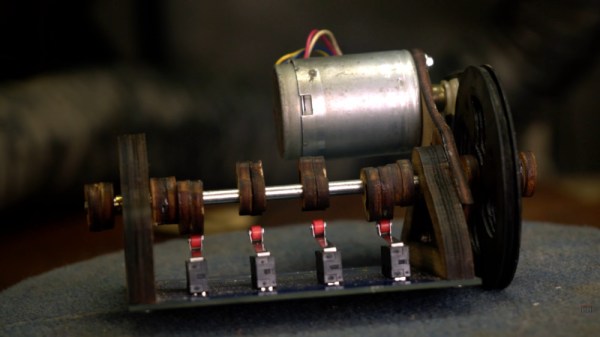
Switch-mode technology has made inverters which take a low DC voltage and turn it into a usable mains voltage within the reach of everybody. But still, there might be moments when a mains supply is needed and you’re not lucky enough to have AliExpress at your fingertips, and for that, here’s [Rulof] with a mains inverter that is simultaneously awful and awesome. He’s made a rotary converter, from trash and off the shelf parts.

While a switch-mode converter operates using PWM at many times the output frequency for efficiency, we’re guessing that most readers will be familiar enough with how AC works to see how a low frequency converter turns DC into AC. A set of switches repeatedly flip the polarity, and the resulting square wave is fed into a transformer to step up to the final voltage. The switches can be mechanical as with old-style converters that used vibrating reeds or rotary armatures, or they can be electronic using power transistors. In this case they are a set of microswitches actuated by a set of cams on a shaft driven by a small motor, and the transformer comes from a surplus UPS.

We’re guessing that the frequency will be only a few Hz and the microswitches will suffer from switching such an inductive load, but as you can see in the video below the break it does light a mains bulb, and we’re guessing it would be enough to activate most wall-wart switching power supplies. We’re not so sure though about his use of the IEC sockets from the UPS to carry 12 volts, as the current may be a little much for them.

Meanwhile if you thirst for more of this kind of thing, we have you covered.

Continue reading “The Trashiest Of Mains Inverters”