
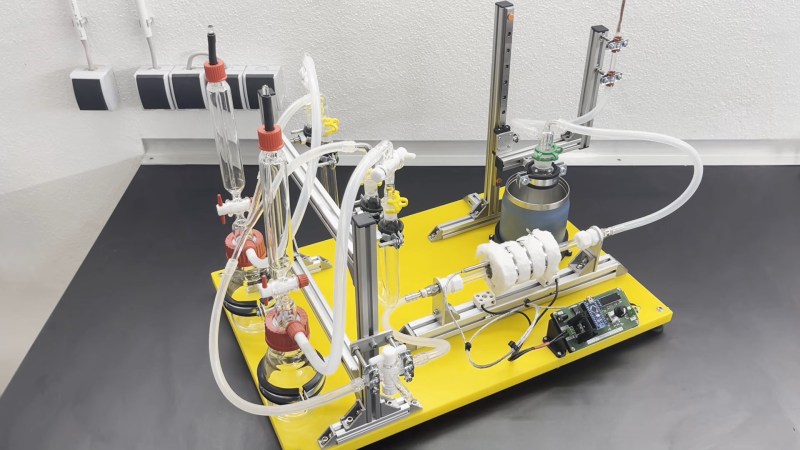
Plastics, oil, petrol– the modern world is entirely dependent on hydrocarbons. The good sources are slowly running low and supply is increasingly complicated by geopolitical factors we really don’t want to get into, but hey! It’s just hydrogen and carbon, right like it says in the name. How hard could it be to roll your own at home. Well, if you’ve got a lab like [Marb]’s Lab on YouTube, it might just be doable, as he demonstrates in his latest video.
The Fischer-Tropsch reaction was discovered back in 1925 in Germany by a couple of gents named Fischer and Tropsch. In the unpleasantness that followed later, Germany made good use of their process on an industrial scale, since they had ample coal and no oil on hand. Coal-rich South Africa has also made us of it, particularly during the Apartheid-era trade restrictions. Every so often the idea of industrializing the process comes up in the USA, but there’s still enough oil there it doesn’t make sense economically.
Those nations all have something in common: they’re all coal-rich countries, and that makes sense because coal is easily converted to carbon monoxide and hydrogen– a combo known as syngas– and it just so happens that those are the feedstock for this reaction. The actual chemistry going on inside is quite complex, but conceptually it is pretty simple: hydrogen and carbon monoxide mix over a hot metal catalyst, and combine to form various hydrocarbons.
In [Marb]’s glassware-based demonstration, the catalyst is Cobalt (III) Oxide on silica gel– a lovely, cancer-causing substance that must be prepared for each use, as it lasts but 24 hours before further oxidization ruins it. That’s in spite of purging the system with argon– a necessary step if one does not wish to explode. The yield isn’t amazing, and [Marb] isn’t sure exactly what mix of hydrocarbons he has created– although they smell like gasoline and burn like the dickens, so mission accomplished.
This might seem like the furthest thing from green, but if you use solar power to run the process and something like woodgas– which is syngas by any other name– as a feed-stock, then you’ve got a carbon neutral energy storage medium.
Thanks to [Markus Bindhammer] for the tip!












And you don’t necessarily need coal feedstock. I mean, it’s super convenient: South Africa’s SASOL plants burned it for the energy and used it for feedstock to produce motor fuel. Because the coal is so cheap, the resulting liquid fuel is not outrageously expensive.
But, in principle, you can make liquid fuels from nothing but thin air and sunshine: The water vapor and carbon dioxide in air provide all the hydrogen and carbon you need, and sunshine provides the thermal and electrical energy.
Yep, not efficient, and very capital intensive, but it’s FREE ENERGY!
It’s not “free energy” because it consumes hydrogen stored in the sun. Once it runs over and our star enters red giant phase its joever for humans unless we relocate to Mars.
Actually the Sun is irresponsibly polluting the solar system and further with its disgusting light. It’s virtuous of us to recycle it where we can.
Yeah Im pretty sure humanity has more pressing concerns over the next 5 billion years. We will be long gone long before it goes red giant
Would be a good sci fi short story if one day the xeeblexorps came by earth and handed us a utility bill for the hydrogen fusion plant they built in the neighborhood 4 billion years ago. Pay up or we’ll turn it off
Nope. Mars ain’t gonna do it. It will also get roasted, then subsequently consumed by sol.
Pluto might make it, then if ppl live there then they can call themselves Plutonians.
To paraphrase, free energy is only free if your time has no value.
Not really. It’s free if I don’t pay money for it.
That’s okay, Paul, I thought it was funny, even if the too-serious crowd was, um, too serious.
Actuallyy this home-sun-to-fuel-in-a-terrarium (what was it called?) is it’s own whole category. Pops up all few years with a little breakthrough.
Very roughly, with direct synthesis you’d get about a tenth of a milliliter of liquid fuel per hour per square meter of solar collection area.
In the US that would be about a half gallon per day per acre.
For comparison, you get about twenty times that much in ethanol from corn, though that requires substantial additional external inputs from fossil fuels for fertilizer and processing, so it’s tough to make a direct comparison. In the end it might be very similar net yield.
Long term, you could spend a small area on charging batteries from solar, and spend the rest of the acre on food or on something that you can turn into biochar (if you want to go carbon negative). Turns out that the supply of fossil fuels isn’t the issue in the long run, it’s the results of the simple accumulation of co2 leading to global warming, as has been understood for 120 years at least.
Batteries are a terrible way to transport energy around though. They are bulky and heavy and only provide electricity. Synthetic storable liquid fuels are far more energy-dense and more versatile.
so when it comes to feedstocks, what makes sense? i’ve been toying around with setting up something a bit bigger than this for a while now, using plastic waste – but the moral implications keep nagging at me. at the end of the day, the plastic started its life as a byproduct of fuel refinement from the same crude oil that i would be trying to avoid using in the first place.
as seemingly incongruous as it sounds, perhaps the best thing to do in the longrun may be to leave waste plastic as it is. failing some revolutionary new process, recycling requires a higher energy input than just starting from virgin materials, and use as a fuel either directly or indirectly will release carbon that would otherwise have been sequestered. there is the whole issue of microplastics and waste-related problems, but those are separate issues from the carbon cycle.
biomass makes the most sense in my mind, but the devil is always in the details – does anyone know of any pilot or to-scale projects that make use of particular materials / material types? there’s plenty of energy in plants – we just need to do it in a way that makes sense, not like that corn-ethanol bullshit we seem to think is going to save americans from ourselves.
Honestly, i’d rather burn plastic in a waste power plant. At least they have good filters and the plastic doesn’t cause further harm in the environment, aside from the CO2. Not a option for a lot of people of course.
But turning plastics into fuel? I hope you have a good way to filter only the hydrocarbons out of the toxic mix.
Yes waste plastics in the ground might just count as a decent carbon sequestration method, though likely to cause other ecological harms. However if you didn’t burn your waste derived stuff you’d end up burning something else, no? So if you are planning to do it for any sane reason, like an excess of not recycled plastics in the area its probably more moral than any other way of getting hydrocarbon fuels in bulk reasonably affordably (as long as you do it properly!). As when considering the Extracting, refining and transporting oil products there is a huge cost ecologically and carbon cycle wise, the mileage on that fuel and thus the fuel spent to transport it rather adds up, where bypassing basically everything but the refining step reusing waste on your doorstep…
So anything that lets you take waste that is already in your local area and not need to dig up more fossil some significant distance away is a win. At least as long as you are around as careful or better than the usual refineries with the containments – and with plastic as a feed stock I’d suggest that will actually be easier as your containments might be higher in proportion, having been put their deliberately, but also rather less varied I’d suggest – consistently just x and y rather than half an alphabet worth of whatever was around this source of crude. So filtering out those specific problems aught to be more efficient and easier I’d think. Though I don’t know of any good resources that have seriously tried it, as turning waste plastic back into good new plastic tends to get more attention.
I agree. Either recycling at the polymer level or material level also makes more sense to me than breaking them down to C-H-O and starting from scratch again. You might be able to make biodegradable plastic from pine needles but next time you need something you’ll be out gathering more pine needles.
Plastics that don’t degrade are a recycling opportunity if managed correctly. Materials in nondegrading plastics are refined, concentrated and stable. I know people who would take up torches and pitchforks over this but the ideal plastic would NOT be biodegradable but WOULD be recyclable. This is a problem where the philosophy, “Take a problem. Make it worse. Call it a feature,” is valid.
In other words, the quest for biodegradable plastics isn’t bad but it might not be the ecological panacea we want in the long term.
Plastics are easy to convert into diesel. Just use a big distill and done. Especially with softer plastics.
A very beautiful proof of concept project and I love your molecular analysis “I don’t know what it is but it burns like the dickens”. I am motivated to do this experiment but I am affraid I would use too little of the not so fee argon & turn it all into a burn-ward experiment !
First learned of Fischer-Tropsch Synthesis in organic chemistry class almost 60 years ago. Fascinating project and demonstration.
You can use Divinylbenzene from a watersoftener doped with Nickel and run alternating electrical currents on biomass to desired ‘hydrocarbon’ chain length.
But … I don’t want carbon chains … I want desktop cold fusion reactor that breeds its fuel and generates electricity while at it …
We should look into creative ways to dispose of garbage and turn it into something useful. researched and tested on smaller scale. Lets pay people prize money for who comes up with best ideas and inventions, no corporation allowed to enter. But are politicians to corrupt in the west
“no corporation allowed to enter.” Sole proprietorships, partnerships, criminal mobs, dictatorships are all acceptable. Drug cartels and insane asylum residents are particularly welcome. But organizations in the form of corporations are far too evil. Phooey!
I would personally prefer to use an iron catalyst, for several reasons. If you pack the column with iron oxide powder and heat it, the hydrogen reduces it to sponge iron, which while a bit less efficient than cobalt, is still quite active and tolerates a wider range of CO to H ratios. Notably, iron oxide and iron powder aren’t carcinogens. The catalyst bed can be regenerated by burning off contaminants in air, then re-reduced to iron. So, overall safer, easier to tune the process, and less screwing around with replacing poisoned catalyst.
Oh I was wondering what replacement materials could be used that weren’t carcinogenic. That iron could later be used for other stuff.