
Everything on the electromagnetic spectrum has some properties of both waves and particles, but it’s difficult to imagine a radio wave, for example, behaving like a particle. The main evidence for a particle-like nature is quantization, the bundling of electromagnetic energy into discrete packets. One way around this is to theorize that quantization is due to the specific interaction between the electromagnetic field and matter, not intrinsic to the field itself. To investigate this theory, [Huygens Optics] conducted several experiments with gamma rays, including Compton scattering.
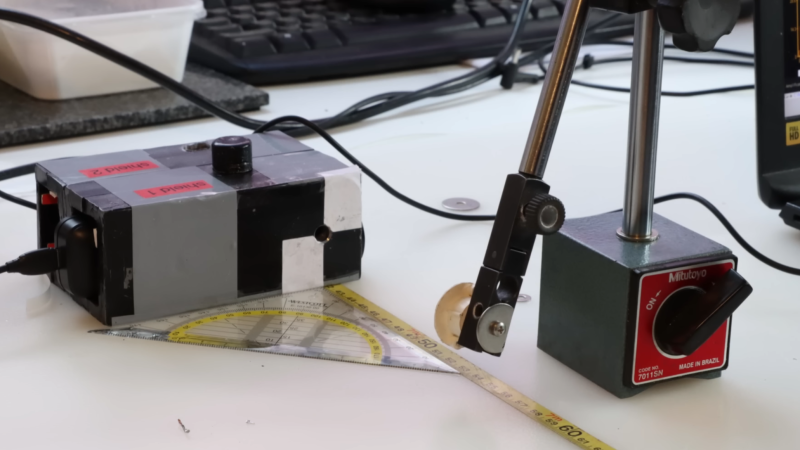
For these experiments, he used a Radiacode 110 X-ray and gamma ray detector, which uses a photodetector to detect radiation’s passage through a scintillation crystal. By summing the energy contained in the light emitted by one ray, it can measure the ray’s energy and, over time, create an energy spectrum. [Huygens Optics] used the americium capsule from an old smoke detector as a radiation source, and cast a lead enclosure to shield the Radiacode from most background radiation, with a small opening for measurements.
First, he tested whether the inverse-square law held true for gamma radiation by measuring radiation at varying distances from the source, which it did. The second experiment was more complicated and measured the temporal correlation between ray detections. For this, he used a second-order correlation function to correlate observations from two Radiacodes. Since there was no included software for time detections, he opened the devices and found a test pad which produced a pulse when a detection was made, then used an Arduino to time these. There was no correlation between rays emitted by the americium source, but interestingly, there was a strong correlation in background radiation due to cosmic ray-induced radiation showers.
For a final experiment, [Huygens Optics] demonstrated Compton scattering, the scattering caused by a ray knocking outer electrons away from atoms. The energy of the emitted radiation depends on the angle of incidence. As the angle between the radiation source and a block of graphite increased, the radiation observed behind the graphite shifted to lower energies, as expected.
None of these experiments was absolutely conclusive, but the Compton scattering in particular was strong evidence that quantization is innate to the electromagnetic field. If you’re interested in more, we’ve covered similar questions before.












“Every instrument that has been designed to be sensitive enough to detect weak light has always ended up discovering the same thing: light is made of particles.”—Richard Feynman
While Huygens Optics is located in Europe, those people in the U.S. interested in replicating the experiments above should be aware of U.S. regulations on the use of radioactive materials.
According to the U.S. Nuclear Regulatory Commission (NRC), citizens who use smoke detectors containing Am-241 for the purpose of detecting smoke are exempt from NRC licensing requirements.
However, a specific NRC license is required for a person to disassemble, remove, and/or use the Am-241 source for other purposes or repair or in manufacturing. Similar exemptions and licensing requirements exist in regulations for radioactive materials in Agreement States.
On that note, there are many easily accessible projects which uses nuclear radiation source as a random number generator.
Like this for instance https://hackaday.com/2015/08/16/hackaday-prize-entry-nuclear-powered-random-number-generator/
So what you are saying is that us citizens need to smoke while doing your scatter experiments? Expensive habit but better than doing hard time for learning about the universe we live in.
You Can Also Not Cross The Street Without a License.
You can however completely ignore the constitution when for instance within Washington city limits.
Anyway, long story short: Don’t publish your results when in the US in such a way that haters can call the cops when doing experiments, got ya.
I don’t know if I’m asking the right question or it might be nonsense due to lack of sufficient knowledge in the field.
Suppose we have three antennas at 2.4GHz terminated by perfect load.
One is perfectly matched antenna so that all the received electromagnetic is converted to electrical energy and entirely dissipated by the load.
One is perfectly mismatched antenna that reflects all the energy and no energy reaches load for being dissipated.
One is partially matched antenna such that only half of the energy is reflected and the remaining half is dissipated by load.
This mismatched antenna might consume half of the energy of each supposedly quantized “packet” of energy while each reflected packet of energy contains half of the initial energy and thus indicative of not being quantized.
What if we reduce the size of this antenna to do the same thing at 440THz or red light?
This is a tricky question but I will trry.
As wavelengths get longer metals become closer to perfect conductors. So at red light we would see more losses, and at 440THz we would absorb more, typically as heat. You can see evidence for this by looking at the extinction coefficient vs the refractive index of metals across wavelengths. This has a lot to do with quantum mechanics being but I digress because there’s a lot going on and it’s not the most relevant thing to consider, except for noise/heat and the extremes like the photoelectric effect.
Antennas work based on their geometry. So a radio antenna will have no real effect from visible light, and same for THz light. So what’s happening is light excites a wave like motion of electrons along the antennas surface or “skin”. The electronics reads that out as a change in voltage/current. So if the antenna doesn’t remotely match the wavelength if light you can assume no real effect. Typically an antennas size is about a quarter of the wavelength if light to be as efficient as possible.
Now let’s assume the geometry of the antenna is changing in accordance with the wavelength of light. For shorter wavelengths like visible light you run into real problems with the electronics. The electric wave generated from a tiny antenna will be oscillating so fast I don’t even think current electronics can be built to tolerate them, that’s down to dielectrics, band gaps, and again quantum mechanics. For radio and THz that issue isn’t as relevant.
Not sure if I answered your question, but in general, using grossly mismatched antennas to wavelengths of incident radiation will not be interesting from an electrical perspective. If you do match the light to the antenna you realize pretty quickly that some circuits are easy and others are impossible.
Those radiacode gamma ray detectors are so cool. Credit to huygens optics here, this is really fun stuff. I am a little jealous. No amount of reading or watching replaces the intuition you get by doing hands on experiments like this
I’ve never been sold on light, etc. as a particle. Every particle effect somehow involves interacting with electrons which are known to move between quantised states. It seems to me that we’re just observing quantised light – electron interaction rather than particles.
You are not alone, and there are many scientific papers exploring many different theories. So its not just us crazies on the internet. Hard science is being done. Most of us crazies don’t have emotional involvement, but logic says it cannot be quantized, or rather, that the quantization happens at the detector.
Yeah i’m not sure what the best explanation is, but my mind is always on the fact that photons are just interactions between distant electrons. Or maybe electrons are just interactions between different photons! Any way you parse it, the set of possible interactions defines our understanding of it. There’s no way to know the thing itself separate from understanding the interactions it’s capable of. It’s a deep and probably unsolvable ambiguity. I wouldn’t trust anything coming down on one side or the other of the quantized particle-field vs quantized interaction question.
““It doesn’t make a difference how beautiful your guess is. It doesn’t make a difference how smart you are…If it disagrees with experiment, it’s wrong.”
― Richard Feynman, The Feynman Lectures on Physics