
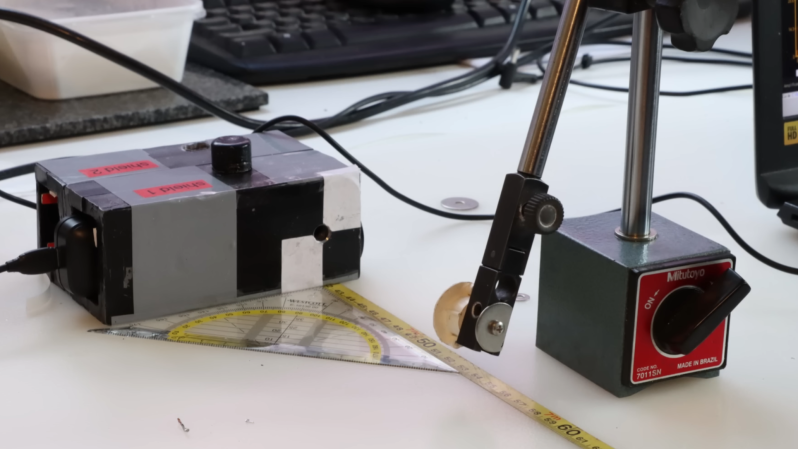
A lead box with a small aperture sits on a desk. A ruler leads away from it. A small disk on a stand is held in front of the aperture.

Testing The Wave-Particle Duality With Gamma Rays

Everything on the electromagnetic spectrum has some properties of both waves and particles, but it’s difficult to imagine a radio wave, for example, behaving like a particle. The main evidence for a particle-like nature is quantization, the bundling of electromagnetic energy into discrete packets. One way around this is to theorize that quantization is due to the specific interaction between the electromagnetic field and matter, not intrinsic to the field itself. To investigate this theory, [Huygens Optics] conducted several experiments with gamma rays, including Compton scattering.

For these experiments, he used a Radiacode 110 X-ray and gamma ray detector, which uses a photodetector to detect radiation’s passage through a scintillation crystal. By summing the energy contained in the light emitted by one ray, it can measure the ray’s energy and, over time, create an energy spectrum. [Huygens Optics] used the americium capsule from an old smoke detector as a radiation source, and cast a lead enclosure to shield the Radiacode from most background radiation, with a small opening for measurements.

Continue reading “Testing The Wave-Particle Duality With Gamma Rays”
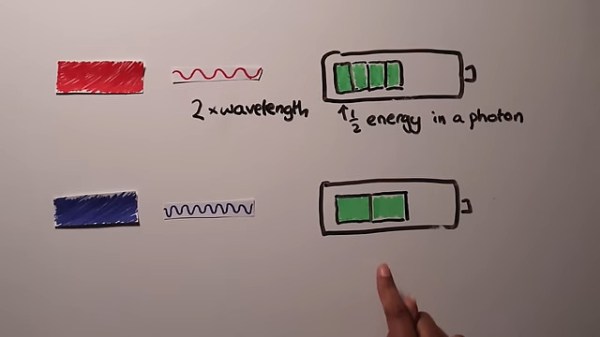
A finger points at a diagram of a battery with two green bars. Above it is another battery with four smaller green bars with a similar area to the first battery's two. The bottom batter is next to a blue box with a blue wave emanating from it and the top battery has a red box with a red wave emanating from it. Below the red wave is written "2x wavelength" and below the top battery is "1/2 energy in a photon."

What Are Photons, Anyway?

Photons are particles of light, or waves, or something like that, right? [Mithuna Yoganathan] explains this conundrum in more detail than you probably got in your high school physics class.

While quantum physics has been around for over a century, it can still be a bit tricky to wrap one’s head around since some of the behaviors of energy and matter at such a small scale aren’t what we’d expect based on our day-to-day experiences. In classical optics, for instance, a brighter light has more energy, and a greater amplitude of its electromagnetic wave. But, when it comes to ejecting an electron from a material via the photoelectric effect, if your wavelength of light is above a certain threshold (bigger wavelengths are less energetic), then nothing happens no matter how bright the light is.

Scientists pondered this for some time until the early 20th Century when Max Planck and Albert Einstein theorized that electromagnetic waves could only release energy in packets of energy, or photons. These quanta can be approximated as particles, but as [Yoganathan] explains, that’s not exactly what’s happening. Despite taking a few classes in quantum mechanics, I still learned something from this video myself. I definitely appreciate her including a failed experiment as anyone who has worked in a lab knows happens all the time. Science is never as tidy as it’s portrayed on TV.

If you want to do some quantum mechanics experiments at home (hopefully with more luck than [Yoganathan]), then how about trying to measure Planck’s Constant with a multimeter or LEGO? If you’re wondering how you might better explain electromagnetism to others, maybe this museum exhibit will be inspiring.

Continue reading “What Are Photons, Anyway?”







