
Everything on the electromagnetic spectrum has some properties of both waves and particles, but it’s difficult to imagine a radio wave, for example, behaving like a particle. The main evidence for a particle-like nature is quantization, the bundling of electromagnetic energy into discrete packets. One way around this is to theorize that quantization is due to the specific interaction between the electromagnetic field and matter, not intrinsic to the field itself. To investigate this theory, [Huygens Optics] conducted several experiments with gamma rays, including Compton scattering.
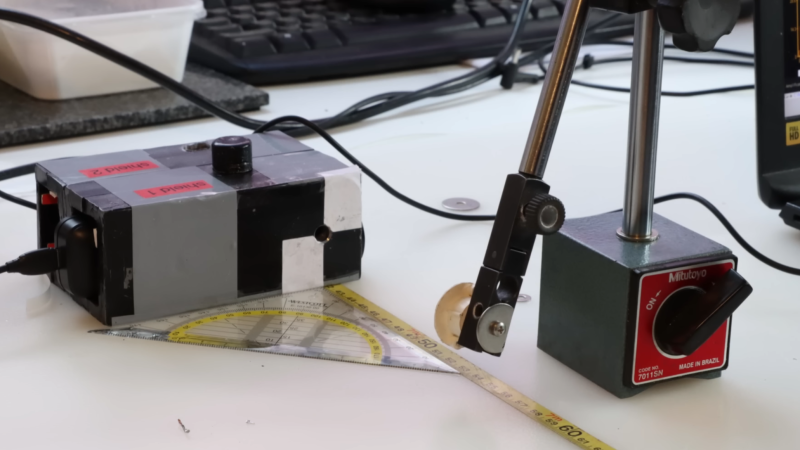
For these experiments, he used a Radiacode 110 X-ray and gamma ray detector, which uses a photodetector to detect radiation’s passage through a scintillation crystal. By summing the energy contained in the light emitted by one ray, it can measure the ray’s energy and, over time, create an energy spectrum. [Huygens Optics] used the americium capsule from an old smoke detector as a radiation source, and cast a lead enclosure to shield the Radiacode from most background radiation, with a small opening for measurements.
First, he tested whether the inverse-square law held true for gamma radiation by measuring radiation at varying distances from the source, which it did. The second experiment was more complicated and measured the temporal correlation between ray detections. For this, he used a second-order correlation function to correlate observations from two Radiacodes. Since there was no included software for time detections, he opened the devices and found a test pad which produced a pulse when a detection was made, then used an Arduino to time these. There was no correlation between rays emitted by the americium source, but interestingly, there was a strong correlation in background radiation due to cosmic ray-induced radiation showers.
For a final experiment, [Huygens Optics] demonstrated Compton scattering, the scattering caused by a ray knocking outer electrons away from atoms. The energy of the emitted radiation depends on the angle of incidence. As the angle between the radiation source and a block of graphite increased, the radiation observed behind the graphite shifted to lower energies, as expected.
None of these experiments was absolutely conclusive, but the Compton scattering in particular was strong evidence that quantization is innate to the electromagnetic field. If you’re interested in more, we’ve covered similar questions before.












“Every instrument that has been designed to be sensitive enough to detect weak light has always ended up discovering the same thing: light is made of particles.”—Richard Feynman
While Huygens Optics is located in Europe, those people in the U.S. interested in replicating the experiments above should be aware of U.S. regulations on the use of radioactive materials.
According to the U.S. Nuclear Regulatory Commission (NRC), citizens who use smoke detectors containing Am-241 for the purpose of detecting smoke are exempt from NRC licensing requirements.
However, a specific NRC license is required for a person to disassemble, remove, and/or use the Am-241 source for other purposes or repair or in manufacturing. Similar exemptions and licensing requirements exist in regulations for radioactive materials in Agreement States.
On that note, there are many easily accessible projects which uses nuclear radiation source as a random number generator.
Like this for instance https://hackaday.com/2015/08/16/hackaday-prize-entry-nuclear-powered-random-number-generator/
So what you are saying is that us citizens need to smoke while doing your scatter experiments? Expensive habit but better than doing hard time for learning about the universe we live in.
You Can Also Not Cross The Street Without a License.
You can however completely ignore the constitution when for instance within Washington city limits.
Anyway, long story short: Don’t publish your results when in the US in such a way that haters can call the cops when doing experiments, got ya.
I don’t know if I’m asking the right question or it might be nonsense due to lack of sufficient knowledge in the field.
Suppose we have three antennas at 2.4GHz terminated by perfect load.
One is perfectly matched antenna so that all the received electromagnetic is converted to electrical energy and entirely dissipated by the load.
One is perfectly mismatched antenna that reflects all the energy and no energy reaches load for being dissipated.
One is partially matched antenna such that only half of the energy is reflected and the remaining half is dissipated by load.
This mismatched antenna might consume half of the energy of each supposedly quantized “packet” of energy while each reflected packet of energy contains half of the initial energy and thus indicative of not being quantized.
What if we reduce the size of this antenna to do the same thing at 440THz or red light?
This is a tricky question but I will trry.
As wavelengths get longer metals become closer to perfect conductors. So at red light we would see more losses, and at 440THz we would absorb more, typically as heat. You can see evidence for this by looking at the extinction coefficient vs the refractive index of metals across wavelengths. This has a lot to do with quantum mechanics being but I digress because there’s a lot going on and it’s not the most relevant thing to consider, except for noise/heat and the extremes like the photoelectric effect.
Antennas work based on their geometry. So a radio antenna will have no real effect from visible light, and same for THz light. So what’s happening is light excites a wave like motion of electrons along the antennas surface or “skin”. The electronics reads that out as a change in voltage/current. So if the antenna doesn’t remotely match the wavelength if light you can assume no real effect. Typically an antennas size is about a quarter of the wavelength if light to be as efficient as possible.
Now let’s assume the geometry of the antenna is changing in accordance with the wavelength of light. For shorter wavelengths like visible light you run into real problems with the electronics. The electric wave generated from a tiny antenna will be oscillating so fast I don’t even think current electronics can be built to tolerate them, that’s down to dielectrics, band gaps, and again quantum mechanics. For radio and THz that issue isn’t as relevant.
Not sure if I answered your question, but in general, using grossly mismatched antennas to wavelengths of incident radiation will not be interesting from an electrical perspective. If you do match the light to the antenna you realize pretty quickly that some circuits are easy and others are impossible.
Hi, Thomas –
Your question may demonstrate “a lack of sufficient knowledge in the field,” but that doesn’t make it a dumb question!
Let me give a try at answering it. But before I do, let me remind you that “wave” and “particle” are classical physics terms that don’t correspond to the actual quantum reality. Light (and, for that matter, particles like electrons) can behave like one or the other, depending upon how you look at them. A photon isn’t quite what we usually think of as a particle, although it’s convenient to do so.
We normally treat microwave radiation as waves because the energy of an individual photon is so small that we rarely are looking at one. There are experiments that do look at individual microwave photons (and the only reason the maser even works is because microwaves are photons). But big receiving antennas, no, they’re just dealing in huge collections of photons.
In those terms, what’s going on with your mismatched antenna is that instead of having a 100% chance of absorbing a photon like your perfect antenna, it only has a 50% chance. Half the photons that hit it get absorbed, the other half bounce off. If you were to put a photon-level–sensitive detector in the path of the reflected beam, you’d get half as many counts per minute as you would from a fully reflected beam. But each individual photon would have the same energy.
This is a hard experiment to do with microwave photons, because their energy is so low, but it’s an easy one to do with visible light photons (which have millions of times more energy). Most high school labs could do it. All you need is a avalanche photodiode or a photomultiplier tub— that is, a detector that is sensitive enough to respond to individual visible light photons. Then you get yourself a sheet of black absorber, a nice shiny mirror, and a half-silvered mirror. I think you can see how that would be the visible light analog of your microwave antenna experiment.
The only trick to making this work is to make sure your light is dim enough that the count rate isn’t so high that it swamps the detector. That’s not a very hard trick. Once you’ve done that, you’ll see exactly the result I described: the “half–reflected” photons will have the same energy as the mirrored ones, but you’ll only count half as many of them per second.
Was that clear? I hope I answered your question.
pax / Ctein
(please excuse any word-salad. Apple Dictate’s fault)
Those radiacode gamma ray detectors are so cool. Credit to huygens optics here, this is really fun stuff. I am a little jealous. No amount of reading or watching replaces the intuition you get by doing hands on experiments like this
I’ve never been sold on light, etc. as a particle. Every particle effect somehow involves interacting with electrons which are known to move between quantised states. It seems to me that we’re just observing quantised light – electron interaction rather than particles.
You are not alone, and there are many scientific papers exploring many different theories. So its not just us crazies on the internet. Hard science is being done. Most of us crazies don’t have emotional involvement, but logic says it cannot be quantized, or rather, that the quantization happens at the detector.
Yeah i’m not sure what the best explanation is, but my mind is always on the fact that photons are just interactions between distant electrons. Or maybe electrons are just interactions between different photons! Any way you parse it, the set of possible interactions defines our understanding of it. There’s no way to know the thing itself separate from understanding the interactions it’s capable of. It’s a deep and probably unsolvable ambiguity. I wouldn’t trust anything coming down on one side or the other of the quantized particle-field vs quantized interaction question.
““It doesn’t make a difference how beautiful your guess is. It doesn’t make a difference how smart you are…If it disagrees with experiment, it’s wrong.”
― Richard Feynman, The Feynman Lectures on Physics
Hi, Rich –
Well, that’s not the way it really works. I mean, you’re correct that light isn’t a particle… but it’s not a wave either. As I wrote Thomas, it depends on how you look at it. (Literally!)
For that matter, electrons are not particles. Nor are they waves. Depending on what you are doing with them, they take on one aspect or the other… And sometimes both. For example, in electron guns like you’d find an old CRT, a modern x-ray tube, or a particle accelerator they do indeed behave as particles. But in a transmission electron microscope, they behave as waves, subject to the laws of imaging, refraction and diffraction just as in a light microscope. And when they are bound to an atom, they are neither – they are a probability distribution, variously called an orbital or an electron cloud. (Which, amazingly enough, we’ve been able to image, and if you had asked me 30 years ago if that were possible, I would’ve said flat out not.)
You can’t explain the photoelectric effect without invoking photons. In fact, Einstein got the Nobel prize for being able to explain it by proposing that light was quantized as photons. (Ironically, this is what led to the development of quantum mechanics, which Einstein hated and was convinced must be wrong, on philosophical and aesthetic grounds. Well, no — he was the one who was wrong.)
In the classic photoelectric effect light is interacting with the free electrons in a metal. These exist in a continuum – their energy is not quantized, it can take on any value. For that matter, there are interactions that occur between photons and electrons in free space where, again, the electrons do not have quantized energy states. (Also, there are ways to interact with photons that don’t invoke electrons. It’s pretty exotic stuff, but it’s real.) “Quantized states” is not an explanation.
As a further example of the weirdness of the world… light passing through an ordinary camera lens behaves like waves. This is true even if you reduce the light intensity so much that only one photon would be passing through the lens at any moment. Note that this involves the light interacting with the electrons in the glass (that’s the only way that light interacts with most materials, by engaging with the electrons). And those electrons are bound in quantized states. Yet the light resolutely behaves as if it were a wave front moving through the lens.
Ah, but the picture [ahem!] changes when the light reaches the camera sensor. There, each bit’o’light (that’s a technical term) interacts with one and only one pixel. The light is acting like a particle. This is also one reason why very low light photographs get noisy. It’s called counting statistics – each pixel only receives a handful of photons, but the number it receives is random (following what’s called a Poisson distribution). Some pixels collect more photons than others, so they are not all recording equal, uniform brightnesses. It’s fundamental — you can do things to make the readout electronics less noisy, but you can’t make the counting statistics less noisy.
Yes, they are physicist exploring alternate theories. That’s one of the things we do — we come up with theories! But a theory isn’t worth anything unless it conforms to experimental reality (and it tells us something we didn’t know before). So far, none of them do. Not one. Eventually, there will be one, because we know our physics model is incomplete. But it won’t be one that does away with the “wave/particle, duality” or “spooky action at a distance” because those have been demonstrated, convincingly, to be real things. It will have to incorporate them.
(please excuse any word-salad. Apple Dictate’s fault)
pax / Ctein