
It is an old trope in submarine movies. A sonar operator strains to hear things in the ocean but dares not “ping” for fear of giving away the boat’s location. Radar has a similar problem. If you want to find an airplane, for example, you typically send a signal out and wait for it to bounce off the airplane. The downside is that the airplane now knows exactly where your antenna is and, these days, may be carrying missiles to home in on it. In a recent post, [Jehan] explains how radar, like sonar, can be passive.
Even if you aren’t worried about a radar-homing missile taking out your antenna, passive radar has other advantages. You don’t need an expensive transmitter or antenna, a simple SDR can pull it off. You don’t need a license for the frequencies you want to use, either. You are just listening.
The key is that radar uses two different effects. One is how long it takes for the echo to return. The other is how much the Doppler effect shifts the frequency. Suppose you are using an FM radio station as a passive radar “exciter.” You can pick up the signal directly and also detect the same signal bouncing off the target. You can compare these two and determine the delay added by the reflection and the Doppler shift.
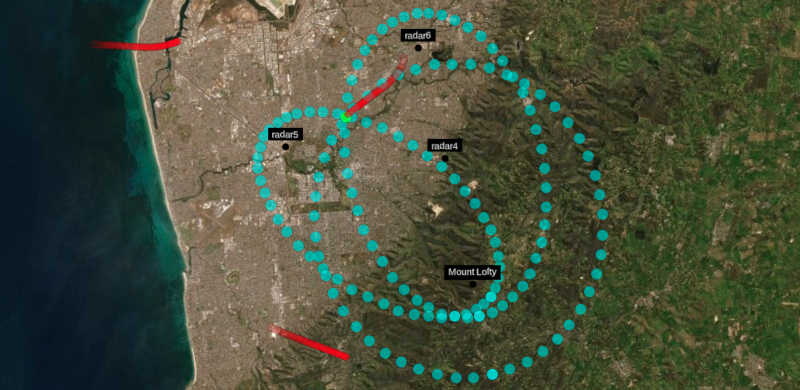
This does have one limitation. In a regular radar installation, you know that a certain signal delay means the target is somewhere on a circle a fixed distance from your antenna. With passive radar, you wind up with an ellipse instead of a circle. You can’t “scan” a passive signal like you do an active one, either.
But all is not lost. Similar to stellar navigation, you just need to get multiple ellipses by using different broadcast stations. With two stations, you’ll probably narrow the position down to two points where the ellipses intersect. Three different fixes are often enough to get a particular point.
Build your own? Of course. Don’t forget that the best transmitter to use might not be on the ground.
Title image from the post sourced from https://github.com/30hours/3lips.












Similar to stellar navigation…. you mean celestial navigation.