
Friends, there will likely come a time in your life when you have trouble sleeping. When this happens, it may behoove you to do some writing, any kind of writing. But consider that a physical journal will force you to turn past pages you’ve already filled, which may leave you deflated if you happen to read them.
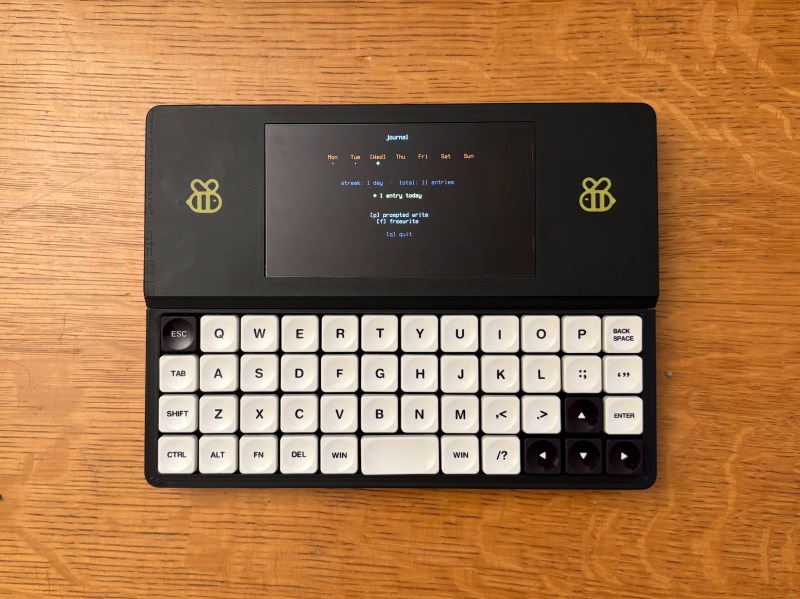
So the answer lies in a sort of journalistic deposit box. That’s basically what we have here. [Simon Shimel]’s Bee Write Back writerdeck was inspired by sleepless nights, so you know it’s effective. The form factor is so great for [Simon], in fact, that he has developed more apps and functions for it, including a Claude client.
Inside is a Raspberry Pi Zero 2w, and input comes from an Air40 keyboard with quite awesome low-profile key caps. The display is a 5.5″ AMOLED, which leaves just enough room for a pair of the cutest bees ever. Be sure to check out the short video below for the build guide to accompany the build guide (PDF), and head over to GitHub for the full details.
Want to go even smaller and BYOK? Here’s a cheap writerdeck with an e-ink display.
Thanks to [Kaushlesh Chandel] for the tip!










That’s a nice little machine. Though it does inspire me to grab one of my old Psions and use it for the same purpose!
Very accurate and professional 3D Printing, almost as good as injection molding. Very nice build. Was expecting to see the guy soldering the 48 key-switches on, but even that was just press-fit.
Man if it was clamshell I would love this
write decks are for weak people NOT STRONG ENOUGH to avoid switching to NSFW pages as e. g. hackday. LOL
People who find solutions to problems they experience are not weak people. Not experiencing a problem doesn’t make you superior to people who do experience the problem.
I love when people build the tools they want and this looks like a well engineered project.
Personally, I don’t understand the appeal of this form factor though, especially for writing.
Any thoughts?
I too enjoy when people build their own tools. I feel like it’s really central to the hacking ethos.
Thoughts on the form factor: I suppose one thing it has going for it is simplicity, it should be fairly robust. Personally I’d prefer a clamshell design, but that’s because I’d want to carry it around and not destroy the screen, I’m sure the creator has identified their needs and doesn’t intend to carry their deck around.
Yeah you put your finger on why this sort of hack always upsets me. Personally, i’m not sure about the form factor…depends on your habits, i suppose, whether you use it in bed or at a desk or whatever. Hard for me to put myself in the shoes of someone using a flat keyboard-tablet like this.
But i know there’s no one in the world who, in 2026, says, “the market has so many great options, but if only there was one that didn’t have suspend-to-RAM / instant-resume”. No one who is trying to meet their own needs wants to suffer a boot process every time they are inspired to record a few words. The raspberry pi is completely unsuited for this task. RP2040 Pico, ESP32, etc, these are great for this task, if writing is really what you want. But raspberry pi is all downside.
Hi Foldi-one! I’ll save myself the trouble of responding and say that you haven’t used the technique that you insist isn’t so bad. No one has in 20 years. It’s obsolete and awful. No one wants fast boot to mythical bespoke stateful apps after the whole world has switched to effortless suspend-to-RAM. Thanks for contributing!
I’d need a wider format keyboard. Trying to use the smaller for factor setups make me crank my wrists out at an odd angle. bet the case could be altered to support a split board with the halves angled a bit.
Reminds me of a Make magazine had an article way back in the day (18 years maybe?) on a keyboard built for their left hand. They used combinations of buttons mounted on a conformal base that was molded to the shape of their hand at rest. For example to get a capital letter “A” they tapped a combination of fingers. The digit 9 was a different combo. Apparently it made for an interesting midi instrument too.
Anyway. It’d make for a neat peripheral for this writerdeck.
Just an anecdote about small keyboards… I had 12″ laptops for years and then i had one 14″ laptop, and i switched back to 12″ and it immediately killed my wrists. I measured the key pitch and all my old 12″ laptops were 19mm, but the new one was 18mm, so i figured that was the problem. I bought another 14″ laptop and i’m happy again. But the 14″ laptop actually has 18mm key pitch too! So i am not really sure but i think the problem i have now with 12″ laptops is not the small key pitch but rather the fact that the trackpad area is so small and the keyboard sits closer to my belly, which makes the awkward angle. It might matter, too, that at 12″, a keyboard is kind of forced to be distressingly off-center to accomodate all the non-alpha keys around the perimeter.
Not sure if that would matter for this form factor, which would seem to be pretty awkward for lap usage too.