
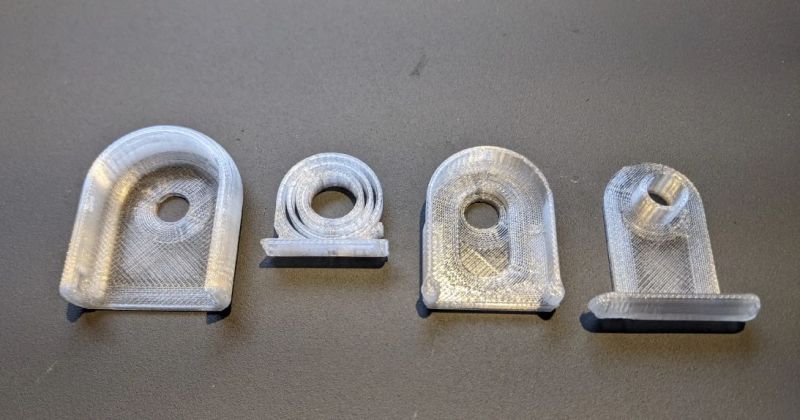
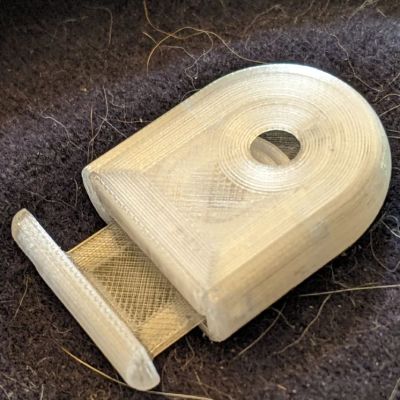
 Springs are great, but making them out of plastic tends to come with some downsides, for fairly obvious reasons. Creating a compliant mechanism that can be 3D printed and yet which doesn’t permanently deform or wear out after a few uses is therefore a bit of a struggle. The compliant toggle mechanism that [neotoy] designed is said to have addressed those issues, with the model available on Printables for anyone to give a shake.
The model in question is a toggle, which is the commonly seen plastic or metal device that clamps down on e.g. rope or cord and requires you to push on it to have it release said clamping force. Normally these use a metal spring inside, but this version is fully 3D printable and thus forms a practical way to test this particular compliant mechanism with a variety of materials.
The internal spring is a printed spiral spring, with the example in the video printed in PETG. You can of course also print it in other materials for different durability and springiness properties. As noted in the video, PLA makes for a very poor spring material, so you probably want to skip that one.
We covered compliant mechanisms in the past for purposes like blasters, including some that you can only see under a microscope.












Leave it stressed for a few days and I guarantee (*) that it will lose its tension.
(*) no guarantee implied
Someone with more material knowledge then me once told me that plastic always permanently deforms under tension, no exceptions, you can slow it, but never prevent it. Metal does not have this issue (they need some minimal deformation before they permanently can deform) which is why springs are generally made out of that.
There are (at least) two different phenomena going on: elastic deformation vs plastic deformation: the range of stress where the material returns to its original shape when the stress is removed, vs the range where the deformation is permanent, and some plastics have a decent elastic deformation range; and also creep, which is what happens when a material is under stress for an extended period, and that’s where plastics really are pretty terrible. To be fair, lots of metals also creep, and everything does when it gets hot enough. Jet engine design is primarily driven by trying to figure out how to keep ultra high melting point metals from creeping too fast.
This is a good example of how youtube videos are often low quality due to intrinsic features of the monetization model.
If i’m going to call a compliant plastic mechanism ‘reliable’, i’m going to have to see at least a couple years’ lifetime out of it. Pretty confident that even after 6 months, you would feel like this plastic has crept like crazy and lost most of its springiness. In fact, i think we’ve had that article before. “You can’t make springs out of plastic” is a pretty worthwhile observation in my book.
But if you’re doing the work “for the clicks”, then why would you wait years after doing the work in order to start harvesting the clicks? And so we get a result that is clickable but has no other features.
Yeah, I’d assume a spring would need to be made of a material with a fatigue limit and no tendency to creep. Anything less would just be something that looks like a spring.
Have to agree. Don’t get me wrong go on and try weird stuff, maybe we all can learn from it. But don’t tell me this weird janky thing solves a real problem better than a 1 pence mass produced bought by the pack of 500 technology from hundreds of years ago, when it doesn’t.
It’s not like the same problem doesn’t exist in the commercial world. Do you think a company would pay someone to engineer something, make a couple and then wait 10 years to see how it lasts before marketing???
Want to know if it will last X-years? Make an estimate of how many times you would click it in that time and do so all at once. Or.. if it’s a lot then build a machine to do it. Is that a perfect test? Of course not. But yo do what you can and that’s all.
this thing where 3d printing people want to make screws and springs out of plastic is insane. that high quality, effectively identical, screws and springs are available for pennies all over the planet is a marvel of modern engineering and supply chains.
and you want an fdm plastic spring.
When all you have is a hammer, everything looks like a nail.
3D printing is infested with software guys who think that everything can be done on a computer.
Skull.
There is a very minor advantage to this: you don’t have to model a bracket that matches the shape of your half-cent coil spring.
It still won’t last long, though. And let’s face it, by the time you model that integral spring/bracket, you’ve probably done 80% of the work to model the bracket for the real spring.
80% additionally you meant.
I have questions about how long this would last too. But even if it doesn’t last as long, if it lasts long enough there are advantages to this sort of thing.
Got filament? You can have it NOW without waiting for a delivery.
Want a funny size, shape.. you got it. Make it exactly what you need.
How does it mount to the rest of the build? You can design whatever shape mating surfaces, screw holes, etc…
Or no mating at all… just import it into your design and print it as one with the rest of the project.
Nice little video. It’s cool to see how far you can stretch 3D printing (pun very much intended). Would love to see someone try out different materials for making 3D printed springs and see how they perform over time. I guess this works well for applications where the spring is in it’s relaxed state by default and only sometimes needs to be under stress.
Supercoiled nylon fishing rope is very durable and pulls a punch. I´ve some in use that are like new after 8 years and 10 pulls per day on average. Damn easy to make too: attach one end to a door knob a couple of yards away, the other end in the clutch of your favorite drill , run! its coil, then it supercoils, and the force it can pull is quite incredible… for a piece of plastic. And being nylon it´s low maintenance: no rust, quite resistant to abrasion.
News
https://techxplore.com/news/2026-04-3d-printers-gain-medical-grade.html
Wish my wife had a “complaint” toggle….
It would weaken over time and become unreliable anyway, flipping on its own at every bump or just at random for no reason.
It’s funny, in the article I read it as “complaint” at first, but my brain immediately corrected it to “compliant” without reading the printed word again to see which one was actually used. Confirmation bias working as intended for once…
Wtf Hackaday?
Not a single number was used in the video. No measurement of anything. Even the estimate of “about twice as big” is bs, it’s about 20x the volume of the mass produced toggle.
Many years ago I saw some actual fatigue test data on a bunch of solid or injection moulded plastics, and it was scary. My takeaway was that at very best, fatigue limit at 10^6 cycles was 10% of initial strength. FDM could only make performance worse.
Sure this thing won’t do anywhere near that many cycles, but once you account for creep, none of these will be functional in 6 months. Whereas the 1c steel spring will last forever.
Sometimes the right thing to is just order a bunch of mass produced parts from Amazon/(insert your favourite modern slavery retailer), and have them turn up the next day for $1