
Home-fermented foods are great– they’re healthier, more flavourful, and cheaper than store-bought alternatives. What they aren’t is convenient: you need to prep a big batch of veggies, let it sit, and then you have to store the excess pickles. If you’re not careful, you end up with ancient, over-fermented pickles at the bottom of the crock, or worse– run out of pickles! Surely a fate worse than death. [Cody] at Cody’s Lab has a solution: a continous-flow fermentation process that keeps just the right supply of pickles coming at all times. Our grandmothers who kept a crock for months in the cold room or root cellar might be confused, but this hack brings pickles into the Just-In-Time framework of the 21st century.
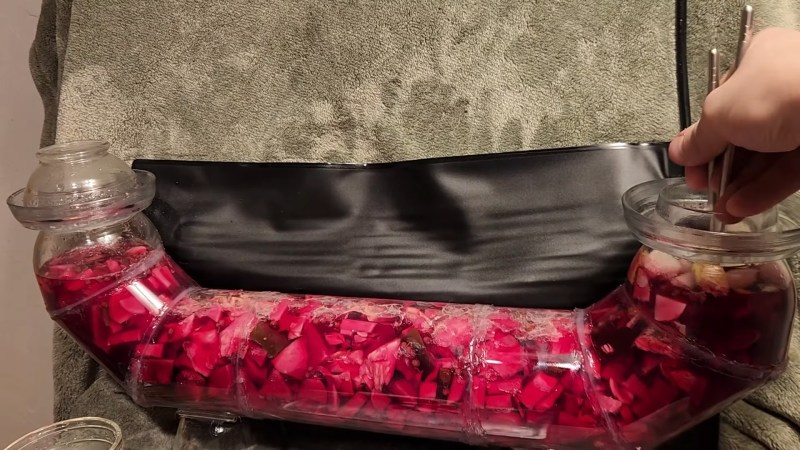
Specifically this is for lactic acid fermentation, the type that gets you kosher dills, saurkraut and kimchi along with a whole mess of other tangy, tasty vegetable treats. Vinegar pickles are a whole other thing. It’s done in a brine, as the lactic acid bacteria are salt tolerant in a way that most things that would rot your food and/or make you sick would not. You can reuse the brine over and over, which is what [Cody] is doing: he crafts a U-shaped crock out of old glass bottles and a couple of pickle jars. He cuts the jars into angled pipe segments that are held together with aquarium sealant, which is apparently food safe. It holds water and looks surprisingly good, in that it isn’t hideous.
The bioreactor gets loaded up with veggies on one end, plus lots of salt and spices to taste, plus some cultured brine from an old batch to kickstart everything. The starter isn’t necessary; it just gets things going faster. The initial packing is the hardest: after filling it the first time, one needs only press new veggies in at one end, while removing tasty treats at the other. A special packing tool [Cody]makes helps with that, but he plans on adding a larger feed side. Thanks to that kickstart, the pickles were ready to try after about a week– which means his tube is a bit long, for his desired dwell time. If you like more fermentation to your pickles, then you might like this size.
May be the first time pickles have been featured on Hackaday without turning them into LEDs. We’ve featured plenty of fermentation projects, with automation to help make the best brew or a build for better tempeh, but not a lot of vegetables.
Thanks to [cam72cam] for the tip!












This is special and practical. I wonder if they have plans to add more flavor. Like dill, peppercorns, and grape leaves. Or maybe that ruins everything. I want one of these though, assuming I don’t contaminate the whole tube with something less ideal
Watch the video.
Aw, yeah! Adding this to the project list. Near the top, of course
I love it. It is a great setup. There are commercial setups used in industry for this, apparently, but this is a home practical setup.
THough I can’t stop thinking that it is, in essence, my colon.
Probably closer to a rumen, honestly.
Blech… no they aren’t ‘more flavorful’ just differently flavored, and typically not in a good way. And even if you have a favorite recipe this is a terrible way to go about it. Dilute the whole thing too much and you can eventually get mold growing which spoils the whole batch from end to end. So then you’re stuck adding small amounts of pickling spice to keep the concentration up as you remove it. Consume them too quickly and you start getting underdone ones, too slowly, why bother. The device is also awkwardly shaped for storage. Just utilize as many jars as you have need for to do the batch you have and you never run into any of these problems.
Spoilsport
For someone who clearly doesn’t like pickles, you sure seem to think you’re an expert on the subject.
They’re sort of right though.
This is a fun project, but that’s all. Not a solution for a practical production of pickled goods for the home user. The risks outweigh the minimal benefits.
They do seem to like pickles.
Do I believe you, or the project author? Now I’m in a pickle!
I’d suggest that is the entire point of this method really – it is a method of PRESERVING stuff! So eating it “too slowly” really isn’t much of a thing, as it will keep till you do eat it (pretty much). And if you are managing to eat it too quickly you clearly need a few more of these set up with deliberately different ingredients for a very different flavour!
So? you can spoil a batch in the jars just as easily and in volume of waste produced the difference may well not be very large at all – this is a long thin double ended tube twist on the method that being shaped that way really isn’t a huge volume, most of the jars are vastly larger in every other dimension and more spherical shaped things for maximum volume!
The goal was a perpetual pickled vegetable machine, a long batch where each addition alters the next pickle. This allows the reuse of the prior ferment anaerobic which is useful.
Ideally you would only use leftover scrap vegetables to feed it regularly. I could easily see 3-4 with different ferments based on what you wanted for the outcome.
It won’t look as pretty, but this could be easily achieved using some stainless steel tri-clamp fittings – a couple of 90 degree bends and a straight section. Sight glasses are available so you can see how your pickles are pickling, but they cost a bit more
You can’t properly pickle in steel. You need plastic, ceramic or glass. When the metal lid that closes your jars is scratched and has some metal exposed inside, typically whole jar is gone, some kind of bad bacteria eats your pickles instead of just pickling them. I don’t exactly know what happens but have seen it many times. And those bacteria will definitely attack stainless. Or chrome from steel will attack the bacteria.
Yeah, metal is not chemically inert, not suitable.
You can pickle stainless steel, but you can’t lacto-ferment it.
Jam jar lids are mild steel, which will definitely corrose. I mean 304 or 316, food grade stainless steel. This is the standard material for the majority of all food processing, including acidic foods, and fermentation (brewing, pickling, etc) . Assuming all welds are done properly and it is properly passivated (which is done using either nitric acid, or citric acid) then it’s going to be chemically inert unless the chromium oxide layer is disturbed, but that requires a very strong acid (concentrated hydrochloric for example), or mechanical damage.
I was today years old when i found this out that there is world beside vinegar prickles. Now I want to taste this fermented variety
“there is a world beside vinegar pickles” – apologies for the typo.
If not true sour/half-sour pickles, surely you’ve had sauerkraut in your life? Look at the ingredients next time you’re at a grocer: cabbage, salt. Maybe some spices if you get the fancy kind.
I’ve lacto-fermented cabbage, radishes, and onions. Never done cucumbers (can’t find the right variety for pickling and don’t have enough space to plant my own).
When lacto-fermenting, make sure you get salt without iodine. In Poland normal salt is iodised and most small shops and some big local markets will have special salt “without iodine, useful for pickling”. But don’t use that salt as normal one, it’s not more healthy for you.
Also pickled cucumbers are the best. If you can, try adding unpickled white onion to sauerkraut or pickled cucumbers. Adds another dimension of flavor.
Try green-as-in-unripe tomatoes– they end up pretty similar to fermented cukes if you use the same flavourings. If they aren’t in stores where you are, it is not hard to find someone who grows tomatoes, and when the growing season ends they’re sure to have a bunch of unripe ones left over. I can’t recommend pasteurizing/canning, them, though. When I tried that for long-term storage, the tomatoes turned into unappetizing mush. Makes a decent relish that way, though!
My personal favourite– outside of sauerkraut–are spicy dill green beans, though.
Well, a modern solution for modern times i guess. Back then, you pickled only seasonally, because you couldn’t get cheap out-of-season produce from a greenhouse in Spain.
Now i wonder about the nutritions diffference of 9 months old seasonal pickles vs. jit heathouse pickles?
I’d suggest that isn’t really true, and is very unlikely to be true for Colby on the other side of the Pond (my understanding is European’s really carry that concept of growhouses much further) – yes its a preservation method so there will always have been a seasonal element to it. But plenty of stuff you can pickle also keeps pretty well in a root cellar, just left in the ground unharvested, or will grow in something as simple as a walled garden for a wider season than the field etc, so using and continuing to add stuff to your pickles “off season” probably has always happened. But you probably are not adding the same things at all times of year, but it is still worth feeding your jars with those roots etc as at least in theory the process also makes digestion easier.
I think you forgot about winter. It’s a season when nothing really grows. And then you have “before spring” season. A very traditional season when nothing is yet ready growing but it’s starting to be warm and anything that was frozen starts to rot. Also, “just leaving it in field” doesn’t work. Pumpkins, about the last growing crop will rot before Christmas if left on field or some animals will eat it. So, to somehow survive until spring, people pickled things.
Carrots and potatoes keep longer mixed with soil but also keep growing in 4°C.
Many root veg, maybe even all (which makes sense as for the plant what is the point of that root tuber!) keep in the ground unharvested just fine, even frozen at the surface ground (though actually harvesting them past the frozen layer could be tricky).
Pumpkin are an entirely different style of crop, as I said some seasonality to it, so if you are going to toss in chunks of pumpkin its going to be around their growing season as they don’t keep that well, though they will keep for a reasonable time in your root cellar. But chunks of other things… A fruit like apple you might well be chucking in apples harvested months ago as some of those have huge shelf life with only a little care – not all apple just keep for a long time with a tiny bit of care, but some will sit on a shelf for a long long time without the fancy plastic packaging and protective atmospheres etc
This is great. I bet Alton Brown would love this!
As someone who worked, long ago, helping engineer batch chemical processes into continuous flow reactors- not a trivial problem!
.
This continuous pickle apparatus is pretty rad.
I would try to find someone with glassworking skills to build it and avoid the glue.
Essentially, this is equivalent to having enough jars to cover the fermentation time and the weekly consumption, and reusing the same jars and liquid once they are empty, with the disadvantage that if something goes wrong the whole batch is ruined. Additionally I wouldn’t trust the aquarium glue to be pickle safe.
I’ll stick to making one or two large batches a year, and labeling the jars well.
Propper Hacker!!!
I wonder if you could build this pickle reactor (oh, that’s a good name) from ceramic pipe or maybe even, if you’re a potter, make a whole ceramic one?
As long as you’ve got a safe glaze on it, I don’t see why not!
I’ve seen antique pickling crocks of all shapes and sizes, but they all seem to have been glazed.
It’s more fun to say Gherkin.