
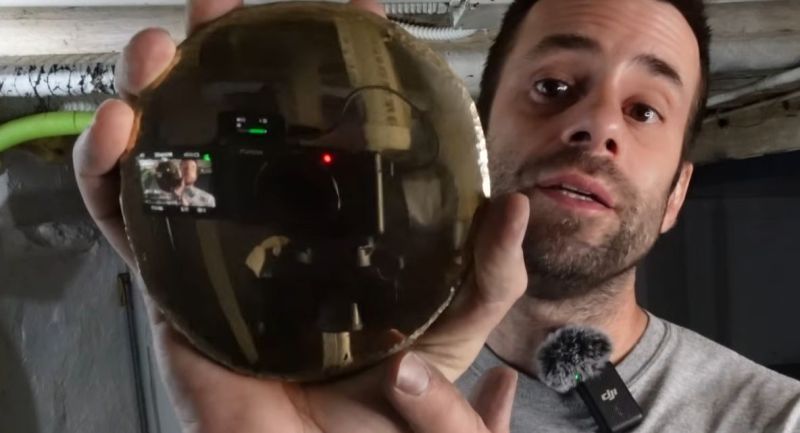
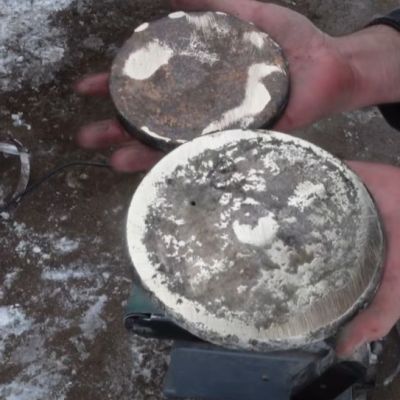
 Although modern-day silvered glass mirrors have pretty much destroyed the market for bronze mirrors, these highly polished pieces of metal once were the pinnacle of mirror technology. Due to the laborious process required these mirrors saw use essentially only by the affluent. That said, how hard would it be to make a bronze mirror today with all of the modern technologies that even a hobbyist can acquire for their shed? Cue [Lundgren Bronze Studios] giving it a shot, starting by casting something flat-ish to start polishing.
Just getting that initial shape to start polishing is a chore, with hammering out the shape possibly being also a viable method. When casting metal it’s tricky to avoid having air bubbles and other defects forming, though using a sand mold seems to help a lot.
After you have the rough shape, polishing using power tools seems like cheating, but as you can see in the video even going from 50 to 8000 grit with a rotating disc left countless scratches. Amusingly, hand sanding did a much better job of removing the worst scratches, following which a polishing compound helped to bring out that literal mirror finish.
A quick glance at the Wikipedia entry for bronze mirrors shows that a tin-bronze alloy like speculum metal was used for thousands of years as it was much easier to polish to a good mirror finish. The metallurgy of what may seem like just a vanity item clearly goes deeper than just polishing up a metal surface.











Kudos for the effort and the pretty good result.
He made his life way harder by starting from a cast. If he had bought a bronze disc that was cut from rod stock using modern tools it would have gone way easier. He probably could have got close to that result by polishing alone.
There are a few reasons why you shouldn’t do this, but it is admirable to try. There are machines that can do this type of machining/polishing but they cost more than you’d ever wish to spend. I would love to see a follow-up with speculum. Is it really that much easier?
So back in ancient days, you went down to a store and ‘bought’ a bronze disk and started making a mirror from there???? :) ha! That said, I think in the interest of the video, trying to duplicate how the ancients may have made a disk to begin with — was interesting way to start the project :) . Makes you appreciate what it must have took 1000s of years ago.
He should’ve just went to the store and bought a mirror, duhhhh!!???!!
A mirror? Is this the distant past when mobile (cellular) phones didn’t have selfie cameras?
I am realizing now that the point of this wasn’t the end product. It’s been a rough week. Please don’t forgive me, I’m hoping someone says something funny at my expense and makes me laugh.
This type of project is a great entryway to appreciating optical components. Start from tin or aluminum for additional dead ends.
Used surface grinders aren’t that expensive, they have a million uses, some useful.
With a surface grinder and a lathe you can make ALL the other machines…in theory.
Home foundry enthusiasts are a strange bunch.
I have to maintain my ‘Fire is cool’ position, for consistency.
But no casting metal under the eves of my house.
Editors…’home thermite welding’.
Surface grinders are generally for ferrous metals. Using them on non-ferrous metals clogs up the grinding discs or cups.
You also bought a monocrystaline diamond bit for the lathe. Which are amazing, by the way.
Why not? It’s not like they invented buying and selling stuff yesterday.
The way most people would have gotten their hands on a piece of bronze or copper would have been through merchants and marketplaces. Copper and bronze items were actually used as money, and these money items were often in the form of half-finished blanks like axe-heads or knife blades – or it could be a piece of copper already hammered into a flat disc for making a mirror.
I realized what I might have written could sound dismissive. He did a good job, despite his technique lacking early on, this is hard work. I think it’s important to say the surface roughness of a true mirror finish, at least for optical applications is literally atoms of variance.
Just a few more items and he will be ready for the Kraken
Umm…the gorgon?
Or Medusa.
Or invading flotilla / army. In sunny days only, of course.
It seems ‘speculum metal’ is a mixture of around two-thirds copper and one-third tin, and bronze is also a mix of copper and tin with 12%-12.5% tin, but often with things added like aluminium, manganese, nickel, or zinc.
So I guess you could go from copper to bronze to speculum metal, but did people actually do that like Maya’s statement suggests? The wikipedia article does not mention that at a quick glance, and I think it was likely just straight from copper and tin to speculum metal with the uncertainty of what else was in the bronze.
Now I am wondering why they did not use copper-tin-nickel for mirrors though.
Nickel wasn’t known (at least in pure form) for a long time. It’s not very abundant, and probably hard to smelt (having chemistry sort of hybrid between iron and copper). It often occurs as sulfides which associate with copper, so such alloys might’ve existed accidentally; iron alloys (a major use of the element today) wouldn’t have because sulfides ruin pig iron, and iron ores don’t associate nearly as much with nickel. (Not much way to separate or purify it either, until solution chemistry developed, I think? Maybe with tedious sorting of ores, if one was sufficiently committed to trying to smelt the stuff.)
An excessively tin-rich bronze forms a majority intermetallic compound, white rather than yellow, and the hardness (and complete absence of ductility) means it cuts, grinds and polishes like a stone — but a shiny one.
This guy has a glacial gold panning channel too, how I recognized him here