
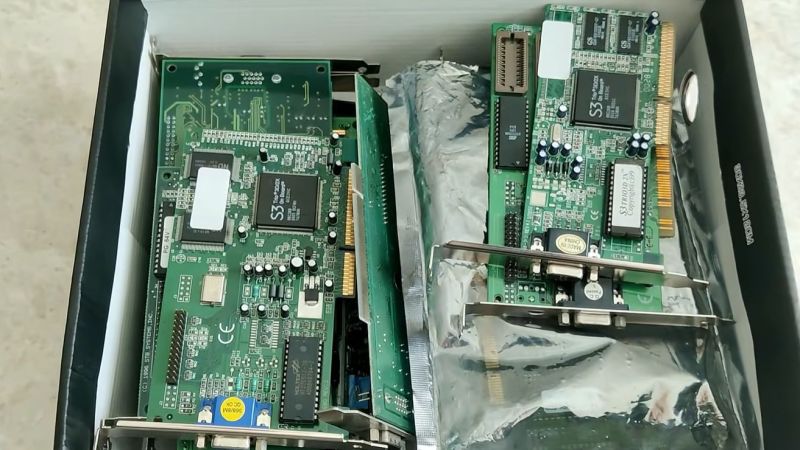
Once a pioneer in videocards, S3’s legacy is today mostly found in details like texture compression as well as the strong presence of S3-branded videocards in the retro-computing world. There’s however a bit of a funny issue with some of these S3 cards in what is often called a ‘brightness bug’, but which as [Bits und Bolts] covers in a recent video was actually a hardware feature that we can once again blame composite video for.

This issue appears with AGP cards like the Trio 3D, Trio64 and ViRGE, where the brightness on the output signal is set too high, easily seen with the washed out look on boot, where especially on CRTs you’d expect to see the nice deep black background. Using an S3 Trio 3D 2X card that was saved from the e-waste pile this so-called Pedestal Bit responsible is investigated and tweaked to show what difference it makes.
At the core is adjusting the black level to make scanline changes easier to detect for TVs, which is no longer relevant for CRTs, LCDs, etc., while adjusting the brightness for one videocard in a system can cause issues elsewhere, such as when using said card alongside a 3dfx Voodoo II card or with inconsistent brightness levels inside 3D games.
Fortunately S3 provided in-depth datasheets on their chips, including how to address the responsible bit. After demonstrating the principle, the BIOS is then patched to set this Pedestal Bit to the value of 0 on boot, solving the issue once and for all.










“Fortunately S3 provided in-depth datasheets on their chips…”
Ah, truly the good old days.
Yup. The S3 Trio32/64 (or rather S3 Vision 864 core functionality) is used as default graphics card in DOSBox (others were PVGA1A/WD90C00 and ET-3000/4000).
That’s how good software support and compatibility was.
It also can do VBE 2.0 via S3VBE20 utility and has 2D acceleration for Windows 3.1 and up (bitblit, hw cursor, graphics primitives).
Virtual PC used S3 Trio32/64, too, but allowed 8 MB of video memory in later versions (VPC 2007, via manual edit of the VM file).
Other notable SVGA chips used as reference in emulators were Trident 8900 (original DOSemu) and Cirrus CL-GD5420 (Qemu).
Demoscene rather used ET-4000 AX as reference.
I don’t know where you guys were getting these CRTs with deep blacks. I remember my CRTs always giving off a fair amount of light even on a black screen.
Yours was out of adjustment or old. The phosphors faded in use, and later CRT monitors compensated for that by increasing brightness over time.
Another thing was that CRTs were never that bright to begin with, so if you adjusted the brightness to see the picture with full room lights on and the curtains up during the day, it would still be washed out and then glow at night, and it would wear out the tube faster.
Turning the brightness up made the acceleration voltage higher, and that would make the whole tube glow, and it would also cause bright pixels to “bloom” which made the image softer, so you wanted the brightness down.
Kids these days don’t know why our nerd caves and LAN parties needed blackout curtains or blankets thrown over the windows.
Wikipedia’s summary of S3 company history is such a rollercoaster:
“Struggling against competition from 3dfx Interactive, ATI and Nvidia, it merged with hardware manufacturer Diamond Multimedia in 1999. The resulting company renamed itself to SONICblue Incorporated, and, two years later, the graphics portion was spun off into a new joint effort with VIA Technologies. The new company focused on the mobile graphics market. VIA Technologies’ stake in S3 Graphics was purchased by HTC in 2011.”
To think that a powerhouse corporation made S3 video cards, Diamond Multimedia sound cards, and VIA Cyrix CPUs then withered and was sold for scrap to an also-ran cellphone company.