
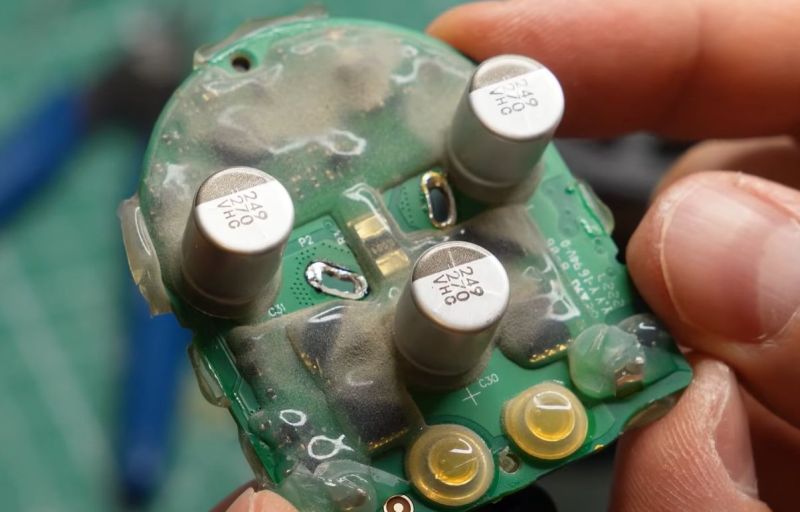
It seems to be becoming a bit of a theme that consumer electronics are dying not due to some critical fault, but due to Cooked Capacitor Syndrome (CCS). Case in point, Dyson handheld vacuums and the capacitors on its driver board. After having his $800 Dyson V15 handheld vacuum die after two and a half years of regular use, [LeftyMaker] found himself elbows-deep in the dusty innards of the vacuum just to replace some capacitors.
After initially trying a new battery and other common troubleshooting steps, he found that lots of people were having the same flaky behavior with their Dyson vacuums, all with the same underlying cause. On the driver board for the DC brushless motor, there are a couple of capacitors that seem to cause issues across models, with the standard response by Dyson being to ‘buy a new body’.
While it’s definitely possible to tear down the vacuum to get to the driver board, you’ll be doing effectively a full disassembly, all to see the capacitors located right next to the hot motor in a very confined space. [LeftyMaker] confirmed a very high ESR on the old capacitors before replacing them with 125℃ rated Rubycon 35PZF270MT810X9 polymer capacitors for $1 a pop.
Unsurprisingly, the vacuum worked fine after that fix, but it shows a trend where CCS has become so commonplace that it’s no wonder that the phrase ‘planned obsolescence’ is being uttered alongside it. For this particular series of Dyson vacuums, the issue is apparently so bad that [Hasan] created a custom driver board that might be superior in multiple ways. Maybe we need an OSHW vacuum cleaner, just to avoid such shenanigans.












the failure points i seem to encounter most with my expensive (though refurbished) Dyson vacuum cleaner is with esoteric plastic pieces that are under-engineered for the repeated stresses they encounter and then crack
Yep. I just printed a replacement trigger for my V11 animal. Orientation was a pain due to material choice (PA6-GF), but it’s hugely better than the OEM part which is practically unobtainium as far as cost/shipping speed. The bin latch is awful, too… simple little cam that sheared off, which kept the tank from staying on. Shot off every time I dumped it. It’s insane how all of the primary wear parts are designed poorly and made out of trash, but honestly that’s probably a design choice. Keep customers buying new ones due to simple wear parts that look like they were designed to fail, after you close up the OEM parts stream a little bit at a time.
That said, the printed replacement parts work great!
Of the several “burned out” LED light bulbs I’ve torn apart, all of them had failed due to bad capacitors. There’s a significant amount of heat generated in a tight space by their basic AC/DC converters, cooking the capacitors in just a few months. It occurs to me that much longer life could be achieved by putting a better AC/DC converter in the fixture with heat dissipation, then selling separate, replaceable DC powered LED bulbs.
look up “Dubai lamp” and its backstory
I’ve figured out how to “Dubai” most bulbs. Of the pair of resistors near the chip, clip off the outer one. Current is halved. Light OK. I did this with some of the mini spot/flood lights for over the desk area. Bought several when on sale. When made in Dubai they leave that part out.
Ripple can be a killer too.
“cooking the capacitors in just a few months.”
That’s a feature, not a bug. Planned obsolescence. Cheaper to make, fails quickly, more sales.
I don’t think the people making these are planning obsolescence so much as just being in a race to make the cheapest possible thing that can still work.
If consumers demanded provably longer-lived devices they’d be doing that instead but the average Joe just buys whatever’s cheapest.
I bought an LED grow bulb back when they were expensive. It’s the same shape as a halogen spot lamp, except the outside is a massive aluminum heatsink with fins. It’s the longest lasting LED bulb I own.
Even though equivalent bulbs made today are a lot cheaper, I’m pretty sure it’s paid for itself several times over.
My company used to design these, and yes, this is exactly what happened: bulbs with our parts and heatsinks would last 20,000 hours, and everyone bought the $5 bulbs rather than our $20 bulbs and now they’re all mad that they only last a couple hundred hours while we gave up on consumer products and now focus on industrial. THEY know that the purchase price of a bulb is less important than the lifetime because the cost of repeatedly replacing it is so high.
“Engineered to fail” has been a Dyson thing from the start. Thankfully, competition still exists in the vacuum cleaner market. LED light bulb makers have the problem of “socket saturation” to deal with. I could see capacitor vendors charging extra for a component with a deliberately shortened lifetime if it means that bulb vendors could get a sale every year.
As for what’s worse for the environment – higher energy usage from traditional bulbs or an inflated e-waste stream due to engineering choices made in bad faith is something I can’t answer.
I remember the early days, there was a design flaw that the vacuums would throw the belt off at the slightest provocation – there were guys making a living driving round all the HWRC’s paying the totters a few quid per “dead” Dyson, cleaning them up, fitting new belts, and putting them on ebay for a nice price.
Well, I have a case on the Milk Frother from some uh, well known maker. It seems that a thermal fuse insists in popping every now and then, demanding full disassembly and replacement of the ludicrously cheap component – again, with the maker insisting in “buy a new model”. Substituting the fuse gets things going again, until next failure.
My theory here: the heater where the fuse lives is embedded in a PCB. It is controlled by PWM by the microcontroller, which also gets feedback from a thermistor to keep consistent temperature – making it theoretically impossible for a software failure that would trip the fuse by sheer accident. The thermal fuse continuity is checked right when the unit is turned on, yielding a red “I’m dead, see?” flashing signal.
I wonder if the firmware has some sort of “yeah, user already made a lot of milk, time to ignore that thermistor reading, fry this fuse and reset myself” routine….
Oh, I forgot to mention “weird shaped one-way screw heads that make dismantling a daunting task”.
No user serviceable parts inside 🤠
Yep, this crap is not uncommon.
Former client had a weird circuit on their widget. Did not make sense to me. Told the project engineer that if the microprocessor trips ‘this’ circuit, then the fuse will blow. His reply was, ‘that is the exact intention.’ That is, the widget was designed to blow the fuse after whatever amount of time or whatever certain conditions occured. The fuse could not be changed – it was soldered, with a big glob of epoxy covering the circuit.
People are generally evil when it comes to money. Full stop. No exception. Myself included.
Hm..I am professionell hardware developer myself and I think it it is strange that the capacitor die in this product because of the low ontime. How many times did you use a vacuum cleaner in a week? One hour max I would think. So I would say in this product the real reason is a more hidden design flaw.
BTW: I did not own a battery vacuum cleaner. I think it is stupid to develope, build and buy something like this for so power hungry devices when there is a socket everywere. .-)
I looked up the caps, they are rated for a fairly impressive 4.7A ripple current @100C, and there is three of them. Sounds like that should be alright.
I know. I’m lazy. But a battery vacuum cleaner is a real pleasure to have. It takes so little effort to take it from the charger and do a quick clean compared to a bigger vacuum, connect the hose, pull the cord, plug in and so on.
The difference is huge in my experience.
Wait until you see a robot vaccum cleaner that drives around by itself!
I’ve had a Hoover Wind tunnel vac that is 15 years old, I took it to work and use it there to vacuum the office in our repair shop. I vac up lots of staples, post-it notes, paper clips. I use it on commercial rugs and it sucked a hole in one of the worn ones.
It has all the original parts except the HEPA filter and I bought it on eBay for $50 about 15 years ago. It doesn’t try to look cool but any clogs are easy to resolve, easy no-tool disassembly.
I have one of these as well. Mine doesn’t look very good either anymore, but it still works. Every 5-7 years it’ll start tripping the thermal fuse (self-resetting), which is when I disassemble the whole thing for a serious deep-clean of its innards, then it runs great again. Aside from normal maintenance parts (belts, roller brush, etc) it’s not required any major repairs. Certain plastic parts have brittled and cracked, but that’s to be expected from an old, all-plastic vacuum cleaner.
Then a couple years ago I was given an old Kirby (~20 yrs old), and now I will never again buy a vacuum from anyone other than Kirby. This thing is built like a tank, but also every single part is available to buy for repairs (down to bolts, and even motor bearings and carbon brushes)! They designed it to be easily repairable. It’s probably the only brand I could ever truly get behind anymore. I don’t know how their new units are (though they do still list every part on them for repairs), but at least when they were building this model I now love, it’s clear they didn’t want to just sell you the coolest new machine—but rather the last one you’ll ever need be to buy. That sounds like some gimmicky ad, but I’m old enough to remember when that was how companies wanted their end-product to be: the last one you’ll ever need.
These days it seems like if a product can’t be made to only operate with a monthly paid subscription, they just build them to function the same way: fail after X months/years/uses. Some big companies have found ways to do both. It’s shameful and not sustainable for our society long term. The e-waste problem seems bad now, but imagine what it’s gonna look like in ten years from now…
Anyone who repairs commercial products these days, especially the kinds that were designed to not be repairable, should be commended. As well should the companies who build a product designed to last, and to be repaired when it inevitably fails.
If you ask me, this is a not a good video. @03:15 he does not know the difference between Philips and Pozidrive. (also mentioned a bunch of times in the youtube comment) He complains about conformal coating (Duh, that stuff is quite good). @04:08 he claims some plastic cap is glued, but my best guess is that the rubber gasket is just a bit sticky. Soldering the motor to the PCB is also perfectly fine.
I also don’t agree with the “difficult to disassemble” It’s just some (normal) screws and a few solder joints. Nothing special.
From the way it’s built, it looks to me that the capacitors are put in that place to be cooled by the airflow.
What is the maximum air temperature right after the motor?
What is the actual ripple current for these capacitors?
A brushless motor with only two connections is unusual (Except for PC fans and such). The current pulses drawn from these capacitors may be out of spec. So I’m curious to know whether the capacitors are either heated, or cooled by the airflow. I’d like to see some more of how this motor actually works.
To me it looks like this video is made with minimum effort on the technical side while riding along on the “planned obsolenece” emotions. And sure, the capacitors should not have failed, but the video is somewhere between inconclusive and dubious.
It’s a youtube video in 2026. He’s complaining about corporations taking our money while wasting everyone else’s time in order to skeez some ad revenue. It’s disgusting, and I don’t know why so many people put up with that garbage
Duh, Hackaday is basically a frontend for Youtube.
Chinese contract manufacturers select components to the exact penny while considering warranty lifetime.
PC power supplies are another place that game the quality/cost. I’ve had CM’s give “golden samples” with quality capacitors to obtain the contract. Then they swap in cheaper parts. Dyson might have missed that.
They know exactly, down to a science how long a cap will last. Amazing and welcome to landfill..
Not if they want another contract. A happy customer tells a couple people. A burned customer tells everyone.
“…A burned customer tells everyone….” and they switch to different maker/seller selling the same chinese-made thing made on the same factory.
Absolutely this is it.
Unfortunately, there’s a really good chance it was designed in the UK by Dyson and just contract manufactured in China to a crap design.
I owned several Dyson vacuüm cleaners. All nice machines to use. All crap build quality. For the price you would expect ten years lifetime, these machines usually fall apart before they reach their fifth birthday.
I luckily had no electrical issues until now.
The CCS is so well known in many fields of consumer electronics, there should be a law against it…
Those Philips vacuums are the bomb. I’m on my second one, after replacing the first as a result of simply having worn most of its components out after 15 years or so.
And I also encountered that problem with the power button. But that was an extremely easy fix. I actually didn’t replace it. I just removed it, opened it, cleaned it, greased it, put it back together, and it has been working fine again for the last 2 years.
$800? Is that RMB or Monopoly money?
To some ppl (like me) $800 would buy four/five vacuums.
BTW, and it is a good thing, since everyone around me is absolutely/insanely into roombas, the price of the average Sam’s upright with basic features had dropped down from the stratosphere to the ground level pricing.
Funny enough, there is competition there (ground level pricing) too, last time I walked past the vacuum isle I noted at least four makers’ selling similar things in the same price rage, $100-$200). Obviously, $200 and up isle had more than four makers/ models, but whatever.
People must hate vacuuming. But the cat must appreciate the free rides.
yep, imho, cooked capacitor are the main planned obsolescence mechanism… they should be well versed to have most break quickly after the warranty period, it’s quite impressive by itself… on the other hand, that’s an easy failure to fix, and replacing them with higher temp capa, fixes them for long…
Dyson is absolute crap. Cheap plastic, poor performance, high price.
China has an orbital space station, and already sent robots to the Moon. They know and can do quality stuff.
To me the problem is the brands and their consumers willing for the cheapest things.
More often you’ve got what you’ve paid for
But also have rampant corruption issues. Those parts with manufacturing errors? The brother has a friend that takes them cheap.
One Child Policy says hi.
Reminds me of a book I bought a few years ago: “Cheap: The High Cost of Discount Culture”, by Ellen Ruppel Shell.
Makes you want to go slap people.
Bearings in most consumer motors need to have lubrication holes for user periodic maintenance, by law. They did in years past. There is a lot of that “greasy” oil crap from China that evaporates in a year or two timing the life of fans of all kinds. If they are porous type the grease residue clogs the pores of the bearing and only rather frequent oiling will keep it going but it is damaged now. A felt donut soaked with oil in the bearing holder with a hole or tube to the outside of the appliance is all we need.
The upside I’ve never bought a vac, fan, power tool, yard work tool, or near anything with a motor for all the weak design fails at the curb.
$800AUD gets you a mid-range Dyson stick vac in electronics stores in AUS. I would have hoped for some better engineering at that price point.
99.9999% of the time it’s not “planned obsolescence”. It’s incompetence and EXACTLY what the buyer is willing to pay for what they get.
Management told their “industrial designer” to ‘design’ the look of the vacuum. Sketches were passed off to the mechanical engineer to model. 3D prints for focus groups. Electronic engineer told to shove the electronics in a tiny space. Same engineer is remote and doesn’t speak their language and isn’t going to point out problems. Same electronic engineer might be good (probably not) and have even defined the correct ESR caps, but probably didn’t note any second sources on the BOM. First article PCBAs are made and passed off to some H1B college grads for “life cycle testing”. All testing is done with the low ESR caps. Design is sent to a few contract manufacturers. Management picks the second cheapest. That chineeese CM underbid everyone else by assuming they could replace the expensive caps and connectors with equivalents down the road. CM now has to figure out how to build because the no consideration was given to HOW it gets assembled during design. After a few orders, the CM says the price needs to increase unless they can use ‘equivalent’ caps/connectors. Dyson approves the high ESR caps because they have lousy buyers/engineers or the CM charges more and uses the lower quality caps anyway.
Either way, the buyer goes in knowing the reputation of the supplier and pays anyway. Always blame the buyer.
Vorwerk Kobold is basically eternal. You’ll find spare parts for cheap for model older than 20 years.
Probably is not opensource in the strict sense of the world, but basically it is, every single part was reverse engineered and it is now in the public as cheap spare parts.