
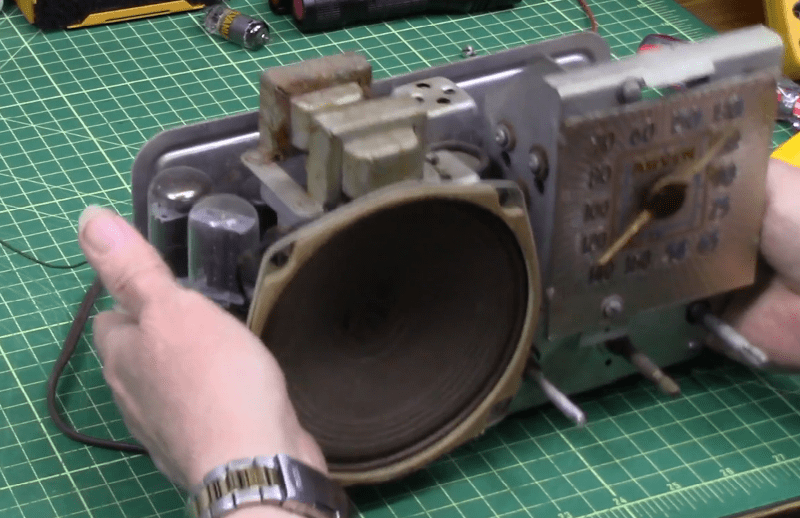
We’ve all done it. We spy an old radio at a garage sale or resale shop. We know someone should bring it back to life, but it looks like a project, so we pass it by. Not [Ken] from [Ken’s Shop]. He found an Arvin 664A AM radio from 1947 in what appears to be a home-built cabinet and decided to bring it back to life.
From what we could find, the original case was a white plastic, not the wood box it is in today. So the first challenge was simply getting inside to see what was going on.
Inside is a pretty standard lineup of six tubes and a few transformers. There were obvious signs that someone had already been in there, as there were some new capacitors grafted in.
What follows is the kind of troubleshooting you have to do when you are working with an old, unloved radio. Getting it powered up was most of the battle and required replacing all the old capacitors.
The radio actually sounded good once it was working. With the box cleaned up, a new speaker grille, and a new window for the tuning dial, the radio looks — well — at least better than it did. A unique radio, for sure.
We love these old radio restorations. Want to get started on your own restorations? We can help with that.












Pretty! This has been a really wonderful post. Many thanks for providing these details.
I’d been lusting over ancient radio teleprinters recently, hoping to find one to restore. No such luck, though Ken’s well-timed reveal has reminded me that I still have my late mother’s old Bakelite radio yet to revive.
It’s a His Master’s Voice, Model C13C, made in New South Wales around 1950. It’s missing the grill and back, and appears to have been hastily stuffed back into the case, presumably in disgust after someone’s failed attempt to make it go.
It still has all the knobs, and the Bakelite is in superb condition, though the speaker has been punched-through. Still, I’ve managed to find a schematic diagram online, and also pictures of all angles which will help in faithfully re-creating the rear panel.
Seems also that Hackaday have some expert’s advice to guide the restoration, so thank you to both Kens, for their counsel and inspiration.
Nice work, Ken.
Oops! Seems I owe thanks to a Gregory, as well just the one Ken.
Golly! First foray into valve technology, and I’m absolutely flummoxed trying to find my way around the circuit from the schematic diagram. It could be alien technology, and I would be no less out of my usual depth.
Also, astonished to find that every component is marked ‘made in Australia’.
This helped…
https://youtu.be/3lDEQNQdvB4?si=h2kgmUBpyWxlqaAg
Ah, that explains my difficulty in tracing the circuit. It often pays to have the correct schematic for the device you’re working on. It appears I have an 1949 HMV C13B, not the later C13C that I had initially assumed.
Lots of out-of-tolerance resistors to replace, in addition to the usual array of capacitors. Hope all the valves are good, because I just found out what they cost to replace nowaday$.
Bakelite case shined-up to a glass finish, with progressively finer grades of wet and dry, some acrylic scratch remover polish, and loads of hard work.
Only source of vaguely similar speaker cloth and figure-8 mains flex, is the United States. I’ll have to do with the Chinese (not really) equivalents, as we don’t do USA no more.
Apparently, the £27/6′ that bought you this model of mantle radio in 1949 Australia, translates to ~AUD$1,250 (USD$900) today!