
First introduced in 1979 by Signetics, the NE5532 was a pretty spiffy dual op-amp for the time with low noise and low distortion. Over the years it has become a standard part that showed up in countless audio products, and has become a so-called jellybean generic component with Texas Instruments (TI) being one of countless manufacturers.
It being such a standard, multi-sourced part makes it thus even more puzzling that TI has now decided to completely overhaul this IC in a way that makes it incompatible with even the original Signetics NE5532. These changes are covered in detail by [Dave] of EEVblog as his mind is pretty much blown at such an incomprehensible change.
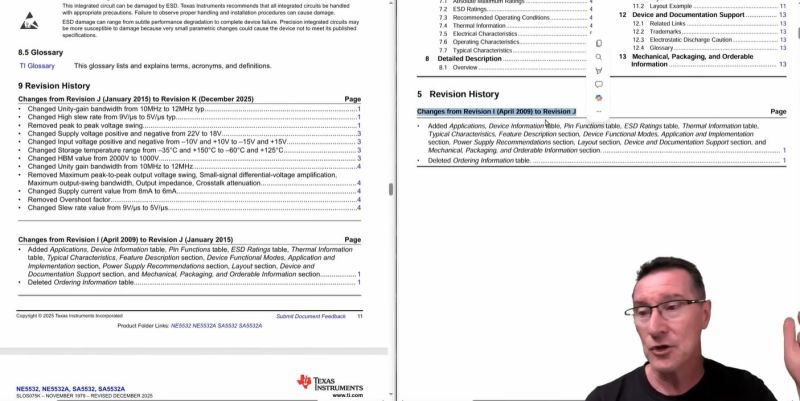
The changes entail an entirely different manufacturing process and a big change in specifications, while making no change to the part number. In revision K of the TI datasheet these changes are first seen, with some specifications changed for the better, like a higher unity gain bandwidth by 2 MHz, but a much slower slew rate.
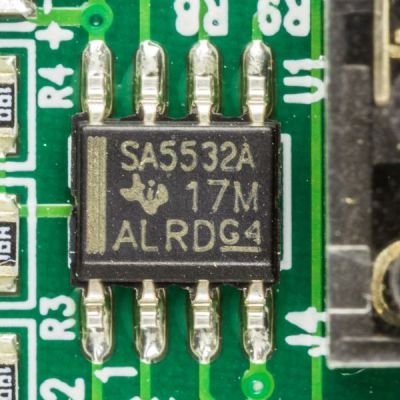
Although the 5532 op-amps are multi-sourced, there are good reasons to just stick with manufacturers like TI, as that means receiving a product change notification (PCN) when anything changes. In the PCN related to this op-amp a change to process node is noted, along with other changes, but no reasoning.
Among the other big changes are a reduction in the supply voltage from 22 V to 18 V, and a halving of the ESD protection from 2 kV to 1 kV. Although it might be slightly more efficient on the new process node this way, it clearly comes with a lot of trade-offs that make it an overall worse op-amp, while also being incompatible with the same op-amp from other manufacturers.
In the video [Dave] goes through the datasheets of this jellybean part of other manufacturers, showing that they still have the original 1980s specifications. Only one exception here was the NE5532DR from Shenzhen HuaXuanYang Electronics, whose supply rail voltage is also 18 V for some reason, along with a similar internal transistor configuration that reduces the ESD resistance.
In addition to the NE5532 op-amp, it seems that TI also took an axe to the OPA134 op-amp, by removing its offset trim feature and listing the pins as ‘NC’, with a warning to not connect these pins and also worsening other specifications. This makes these similar jellybean parts incompatible, with no change to the part number. Worse is that it continues with the LMH6518, whose changes [Dave] argues might even kill oscilloscopes as they are commonly found in those.
Meanwhile the LM317M also got an overhaul, but here TI opted to give it a new part name, calling it the LM317MQ with at first glance no major degradations in the specifications, but instead some actual improvements. This makes it even more puzzling why TI didn’t give the other ICs a new part number to differentiate them from the jellybean part.
Until there’s some clarification from the side of TI, it might be a good idea to source these parts from a manufacturer that is not TI, especially when replacing these ICs in older devices.












If a part suddenly drops in quality while having the same price, it is all about that glorious net profit above else.
Not exactly true in this case. TI could have saved money by dropping these parts entirely. Money was spent adapting these parts to a newer process node.
It sounds more like they did drop them, and they’re using a design from a Chinese company instead. Note the missing specifications.
This 100%. Read in some places that they gave up fab. So they just have the Chinese (clone) fab produce it.
Where did you read that TI gave up fab?
They are absolutely not being fabbed in China; they were moved from SFAB in Sherman, TX on 150mm wafers to RFAB in Richardson, TX (comfortably inside the US). This involved a move to a newer process and a die-shrink re-design.
https://mm.digikey.com/Volume0/opasdata/d220001/medias/docus/5726/PCN20231114002.1.pdf
They did effectively drop them, but wanted to keep the part name for marketing reasons without the “hassle” of losing sales from people who don’t know the difference…
quick some one check for private equity
Didn’t Elliott Investments take out a stake in TI?
I won’t say anything about the first three because I don’t know enough, but the LM317M having a Q version usually means it’s automotive qualified, implying functional safety compliance or capability of being FS qualified, and generally expanded absolute maximum and sometimes functional limits, usually temperature.
What is wrong with these people (people numbering chips)?
New TI 555 model with a new feature
glitch current 400mA
Could have used an NE555.
Compare and contrast the boeing 737max changes with the TI fab changes. The changes are far wider than one device; apparently some opamps input offset adjustment pins have become NC !!
“Friends don’t let friends use Maxim^h^h^h^h^h TI”
I have little doubt it’s because TI is closing the fab node that is currently producing that part and they are basically no longer able to produce it with the original spec. (No you can’t just run the same process/design on systems designed for a smaller node). They were probably running this part on 150mm wafers in the Sherman or Dallas fabs that were closed in late 2025.
We have a winner! Contact your local distributor to claim your prize.
(Not my industry any more, by a couple decades, but even then, this was the primary issue. Good practice is EOL the part and use a new part number, such as 5532-1)
which is all fine, but then they should give it a different number
^ this, given how happily they’ll discontinue parts and re-launch a new version with a slightly different number it feels weird to mess up a very standard part by retaining the number with wildly different specs.
This closure has apparently affected another legacy product, the OPA2131.
The “new” OPA2131 is supposedly the “same” as the old BurrBrown OPA2131. The datasheets even match… new-to-old, parameter-to-parameter.
And yet, in reality, the “new process” part has a short-circuit output 20% lower than than the old part, and the common-mode has changed from (V-)+3V < Vcm < (V+)-2.5V to (V-)-0.1V < Vcm < (V+)-3.5V ! That’s a HUGE difference… enough that it renders the “new” part completely unusable in certain critical circuitry. Worse, it will now cost many hundreds of thousands of dollars to mitigate the impact of this to the production I support.
Now… if TI were to have said: “Sorry… We don’t produce OPA2131s anymore,” that would indeed be painful, but at least everyone would know the score, and they’d know where they stand.
If TI were to have said: “We want to help out our legacy OPA2131 customers with a new version, but the new-process chips won’t meet the old specs… so we’ve changed the part number (and data sheets!) to reflect this, ” OK, that’s also painful, but still, at least every one knows what they’re working with.
But… making changes to a legacy chip design that results in significant parametric changes, without reflecting those changes in a new part number or, at the very least, an ACCURATE up-to-date datasheet, is simply inexcusable.
My hunch is that an issue was found with the new process node only after a large number of chips had been fabbed and packaged. Rather than having a huge quantity of unsellable ICs they hurriedly updated the datasheet to reflect the parts’ actual characteristics (changed specs being the new measured values and untested values omitted). Once parts from the new process node have been fully characterized I expect that a new datasheet revision will be published (or they’ll fix the issue in the silicon and.republish the old datasheet with a datecode-specific erratum).
This is also why I think the pins are listed as DNC.rather than NC as this implies that the functionality is present but broken and that it was caught very late (otherwise the pins’ bond wires could have been omitted and the pins listed as NC).
With so many specs different, they would have had to screw up the testing pretty badly to not discover it until packaged chips have been mass-produced.
With all the grown-ups retired or laid-off, the new kids are designing without the benefit of years of knowledge under their belts.
yup, significant changes in specs to the point it’s incompatible should mean a new part number. TI of all should know this.
Boeing didn’t :(
New CEO at TI, according to some reports.
They did add “MAX” to the name, but TI didn’t add a single letter. Even Microchip added the “B”, if i remember correctly.
Obviously they didn’t run this by Public Relations.
It’s not a 5532 on a new process or different fab. They didn’t invest any money redesigning the 5532, they just relabeled a 4580. The TI 5532s are now PNP input, complementary output stage, 18V rails, and heavily dominant pole compensated (hence the reduced slew rate).
Contrary to the cited blog post, they did not tell customers in advance. I saw parts failures in production due to this last summer. They didn’t update the data sheet until December.
PCN dated 15 November, 2023.
https://mm.digikey.com/Volume0/opasdata/d220001/medias/docus/5726/PCN20231114002.1.pdf
Customers could have life-time bought at that time.
That document says nothing about about things like the reduced slew rate or 18V rails. In fact it indicates there is no change to the Data Sheet.
A PCN doesn’t count when it’s blatant lies. And even if it did count, you don’t simply reuse a part number when it’s essentially a completely different part.
To quote a UKAS auditor “Manufacturers are experts in what they do.
My rider – “ until proved otherwise”.
Manufacturers reserve the right to change specifications without notice. In English law it’s buyer beware!
Sometimes manufacturers don’t even know they’ve done these things until you point it out by drilling down through their quality systems.
it all might be due to fab closure, however, that way TI teared this transition is nothing less than shameful.
They did not share sufficient information and they hid the fact that some crucial feature would not be there, such as protection diodes – this basic stuff. Really shameful. We go hit hard by this transition.
The cynical part of me says that TI didn’t create a new p/n because they would presumably have to put the old parts on end-of-life, with the new part as a suggested alternative. EOL is a lot more visible and would trigger much more scrutiny from their customers than “just” a PCN.
How much scrutiny are they going to get, when the customer’s products start failing? At that point it’s a good idea to start looking for alternatives, maybe for a cheaper price even, since TI parts aren’t to spec anymore.
Educating senior managers can only be done by punishing them financially:
a) reduced sales or b) sue them.
This is also my guess as to why this was done like this.
They bet that 99% customer designs will work just fine.
Absolute maximum vs. recommended supply voltage…
Recommended voltage was always -/+15V. If someone was running it at higher voltage, when they were already operating outside of the specs…
Granted, it is an analog device, but say for TTL logic absolute maximum voltage is 7V. I don’t think anyone in the sane mind will operate TTL logic ICs above 5.5V…
Hmm. but if the recommended is +/-15V, and the old part had a max of +/-22V, while the new has a max of +/-18V, that means that with the old part, the headroom was 7V, while with the new part it’s only 3V. That could translate into some clipping, I would imagine. In audio applications, that could be audible.
Worse is that the slew rate went down. That could also be audible in audio applications.
But the worst part is that the competition is having the original specs, while TI has new specs. Combine that with the rebadging practices of China, we’re all probably going to be screwed over in 10 years time. :)
If the part is being operated at +/- 15V, there’s no difference in clipping whether the part had a max spec of +/- 22V or 18V. The clipping is determined by the actual power rails.
Slew rate change results in reduced full-power bandwidth, still in excess of 80Khz
I remember from a previous job that we had a huge problem. We had a new revision of a device, and it was all tested and ready for production. So parts were ordered, and a run of a lot of devices was made. I don’t know how many, but it was significant, in the high tens of thousands, I seem to remember 90.000.
Devices were manufactured and delivered, and were being sold. But suddenly we started to receive alarming feedback from customers. Their device wouldn’t power up again after they powered it down. Which of course meant that they were able to use the device once and that was it. Bad, bad publicity. These were not cheap devices.
So there was a recall, and an investigation was started. Our device never really switched off, but was put into deep sleep (until the battery would run down to 20%, at which time the battery would be cut off). So we received the device. Charged it, and it would work. Put it to sleep. Nope, never would wake up again. Only by disconnecting and reconnecting the battery would it wake again.
The investigation soon found out what was wrong. We had tested our device with a certain stepping of CPU. And we had ordered that stepping of CPU for the manufacturing. But… The supplier did not have enough of those CPUs, and they decided to deliver a newer stepping. Without informing us…
And of course there were a few “fixes” in the newer stepping, and those fixes broke our device’s wake-up procedure. Manufacturers fault for not informing us.
I don’t really know what happened to the devices in the end. I do think that we found a way to patch around the problem, I remember hearing something about adding one wire and updating some firmware in a peripheral PIC microcontroller.
It was some 15 years ago. I remember the story, but no longer the gritty details. I’m not naming the companies involved, because I like them and I liked working there. This is just meant as an example of how one small communications miss can have big consequences.
Maya wrote:
“Until there’s some clarification from the side of TI, it might be a good idea to source these parts from a manufacturer that is not TI, especially when replacing these ICs in older devices.”
Why would you say this?
I’ll wager the vast majority of applications / uses of these parts are not impacted at all by the datasheet changes. For example, if you’re using NE5532 from +/- 15V rails, there’s no issue. If you’re not directly driving a 600-ohm load, there’s no issue. Put your engineer hat on and validate the updated datasheet against your design(s).
FWIW, while the NE5532 is venerated in some circles as the best-sounding op-amp for audio, the same people think the LM4562 and LME49720 sound different (they are identical dies, no difference).
A lot of (old) devices have imperfect voltage rails that are prone to deviate from what is set. Like audio amplifiers whose -/+15V rails will sit around the -/+18V when a load is absent because their PSU is mostly just a Transformer with a rectifier and a LC filter behind it. This is just how it goes. Even if you design for the recommended specs a circuit can exceed them. Kind of why we got the absolute ratings to begin with.
On that the advice to be careful where you put them with a specific mention of older devices that may require the chip to be a little more “pragmatic”. Is perfectly valid.
Yes, most designs will work just fine. But I would also recommend choosing more reliable and honest manufacturer than TI because you might keep buying the same proven part and suddenly find it has different characteristics, it’s misleading. The whole 150nm US fab closed, so it affects bunch more parts than this one. Eevblog forums have already couple threads pointing out which ones are different. The worst is the same part number has different specs which is a huge no no for a reputable manufacturer.
I don’t know. That felt more like an EEVblab video. The Dave reading Spec Sheet Hour….
Did Dave ask TI?… no… still know anyone in that industry to find out?
TI had some layoffs, closed down a fab that used smaller waver, related. TSMC no longer uses that smaller waver.
Look at the physical parts, see if that new one is smaller, lower feature size?
It feels like there is something more interesting here.
Yeah I’d love for Electronupdate or one of the other Youtube channels that decaps chips and explains the chip die to take a look at this.
Hey I’m Rue Mohr and I’m selling pre-2025 e-waste recovered NE5532, just $4000ea!
(oh sure it sounds expensive today, next week that will be cheap)
I created a thread on TI’s E2E forum, and asked directly if they have merged the NE5532, LM833, MC33078 and RC4580 dies, and they confirmed they have. It’s no longer speculation.