
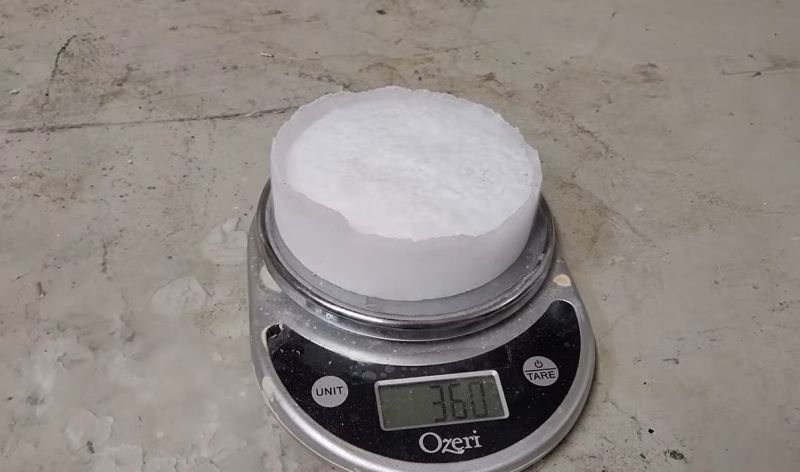
 Although the term ‘dry ice’ is generally used for solid CO2, it’s much more accurate to call this ‘dry snow’, as, rather than being actual solid blocks, they are effectively snow that’s been compressed really tightly. While not really necessary for most applications of dry ice, it is possible to make blocks of actual CO2 ice, and thus [Hyperspace Pirate], as someone with a healthy obsession with cold things had to make some of his own.
As a first step, you, of course, have to chill down CO2 in a container, for which Mr. [Pirate] used a Joule-Thomson cryocooler, with a 15% butane, 35% propane, and 50% ethylene gas mixture. Of course, as ethylene is only easy to get if you have a lot of money to spend, you will want to make it yourself from ethanol. This involves boiling and 400°C aluminum oxide to capture the produced ethylene.
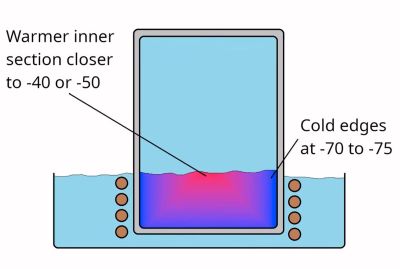
With the CO2 pressure chamber cooled in its refrigerated bath, the process didn’t take long. After opening the pressure chamber, the results were interesting to say the least. Although there was definite ice formation along the sides that contacted the metal chamber the closest, the closer to the center, the more the CO2 resembled the usual fluffy, compressed dry ice.
This is encouraging as it shows that it’s definitely possible to make nice ice pucks or cubes, but the method needs further refinement to get more ice and less snow.












There is a commercial dry ice manufacturer near me. They explained that they make their blocks by creating dry ice snow, then compressing it into large blocks, then band sawing (lots of dry ice fog and “snow dust”) them down into 55 lbs blocks. I believe the dry ice nibs are made by compressing the snow into the nib forms.
off course that is what they do because it is so much easier. This hyperspace pirate likes to do it the hard way?
If you watched the video, he explains that and why and why he wanted to try doing it this way.
There used to be a hack which involved basically putting a bag over the nozzle of a CO2 fire extinguisher or tank hose, using the adiabatic cooling from releasing compressed liquid CO2 as gas to freeze some of the stream. Edmund Scientific stocked this widget back when it was a serious surplus/hacker store (before the surplus streams dried up). Inefficient in material and certainly not the cheapest way to get dry ice, but a cute classroom demo or perhaps on-demand small-quantity solution.
(Well, maybe it’s cheap if the fire extinguisher is due to be refilled anyway… Preferably on someone else’s dime.)
((I should establish where I can buy dry ice in this area. I don’t think the folks I get LCO2 from stock it. Presumably there are lab supply or industrial refrigeration businesses who do.))
They don’t carry it at the supermarket….. Like for food and freeze drying? That’s where we get it here.
I don’t know where you live, but where I live, middle of the US, every large grocery store has a cooler up at customer service full of dry ice.
Over here, there is barely any water ice available for purchase. Expensive, too.
No dry ice in groceries around here. I get it at the local Linde dealer. Air Liquide also has it.
The say they get it as a byproduct from an oil refinery a couple of towns over. They bring in a TEU container worth (a few tons) a couple of times a week.
It’s basically free if you schlep in your own cooler. They’ll shovel it full for $5.
It’s the thumb-size pellets, not bricks or chunks of stuff you find in the grocery stores. Really easy to handle. Clearly it’s extruded from a pipe at some point in its manufacture.
“I should establish where I can buy dry ice in this area.”
“where buy dry ice insertmyareahere enter” <– fewer strokes but it requires a computer