
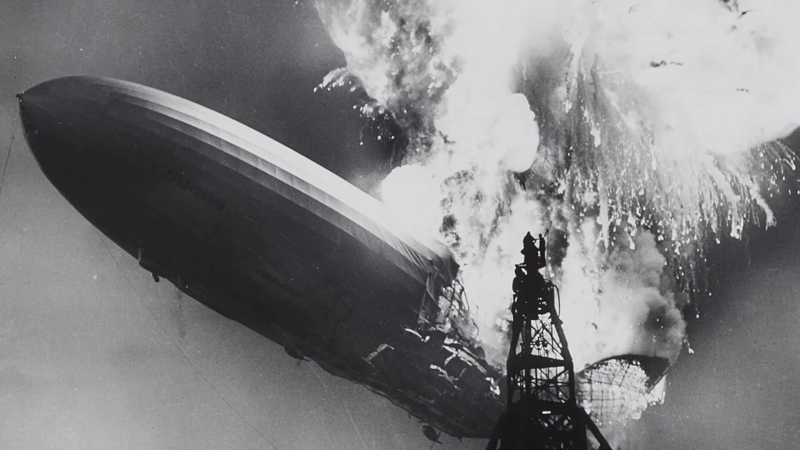
The Hindenburg disaster recently marked its 89th anniversary, and [The History Guy] marked the event with a video that dispels many of the myths surrounding the airship. Example: the disaster did not actually occur on the airship’s maiden voyage. That isn’t true. The ship was on its 63rd voyage. However, it was the first flight of the 1937 season.
The giant ship burned because of the hydrogen gas inside, but the cause of the fire remains debatable and was likely not solely due to hydrogen. In fact, from a technical standpoint, the ship didn’t explode. It only burned.
Some of the myths are just from sloppy reporting or the tendency of people to misunderstand things. Others are a blurring in the common consciousness of the Hindenburg and the Titanic.
It is easy to think of the necessity for safe engineering when you are building, say, a bomb or a spacecraft. But anything capable of wreaking havoc requires careful design and testing. However, ships like the Hindenburg had made many trips without incident. Sure, the Hindenburg was a spectacle, but even the fatality rate was fairly low. Many of those who died jumped to the ground — they might have survived if they had waited a minute.
There are many myths around [Herb Morrison]’s famous “Oh the humanity!” report. We’ve noted before that it was played back at the wrong speed for decades. Airships have a stranger history than you might imagine.












The captain who was very experienced wanted to wait an hour because of the weather but the dammed press and american way of doing things wanted them now! A private film was only discovered in 2009 showing the exact time the mooring line grounds and the high tail end goes up in flames. The first mile high club happened on the Captain’s earlier Graff Zep around the world trip.
Not to mention the fact that the Hindenberg was the pride of Nazi Germany and you don’t tell Hitler to hang on a minute.
“and american way of doing things wanted them now !” ….repeated at the launch of shuttle Challenger.
I find it amusing that EVERYONE cries hindenberg at the mere mention of hydrogen balloooning. The first manned hydrogen balloon flight was December 1, 1783. First death (2 deaths actually) June 15th 1785 in a Roziere Balloon, a hot air/hydrogen dual envelope hybrid….it crashed but didnt explode. The Hindenberg (1937) killed 26 immediately with 10 more succubing to their injuries in the days and weeks that followed. 62 passengers/crewmembers survived 37% fatality. The worst dirigible explosion of record happened 4 years earlier when 73 of 76 members of the USS Akron perished. 73 the worst death toll despite military use of manned hydrogen balloons from Napoleon to World War I. But the hindenberg pretty much ended 154 years of hydrogen balloon advancement.
The first powered heavier than air flight happened dec 17 1903. The first death September 17, 1908. Japan Airlines Flight 123, the most deadly single plane crash killed 520 with only 4 survivors in 1985. We still use the 747. Without digging too deep in detail.. This list despite its label includes 101 incidents, http://www.planecrashinfo.com/worst100.htm, The 100 worst aviation disasters, excluding the Towers, claimed 18990 lives….and thats just the worst of the worst, the oldest of those 1962. We still fly planes.
Im with Walternate….nothing wrong with a little h2
Note: this was copied and pasted from a Jan 2013 HAD post “An Arduino Hydrogen Blimp… Oh The Humanity!” Since then in 2014 Malaysia Airlines flight 17 claimed 298 lives, 2025 Air India 171 claimed 270, 2018 Algerian Air Force 7T-WIV claimed 257, 2014 Malasian Air Flight 370 claimed 239, 2015 Metroair 9268 claimed 224, 2018 LionAir 810 claimed 189, 2024 JeJu Air 2216 claimed 179, 2020 Ukraine International Airlines PS752 claimed 176, 2014 AirAsia 8501 claimed 162, 2019 Ethiopian Airlines 301 claimed 157, 2015 Germanwings 9525 claimed 150.
11 flights added to the top 100 worst aviation disasters accounting for 2301 lives in under 13 years andand thats just counting the worst of the worst, the oldest of those 1962. We still fly planes.
Note that there have been very few accidents where an airplane suddenly went from “everything’s fine, normal operation” to “now it’s crashing and on fire for no apparent reason” – the most well-known being TWA flight 800. If that kind of problem could happen solely due to a combination of the aircraft’s most fundamental design and the type of basic flight supply used, I don’t think we’d still be using that aircraft/supply combination anymore either.
We also shouldn’t overlook one of the most common causes of zeppelin crashes which is easily avoidable with airplanes: getting torn apart midair or blown into terrain by bad weather. As cool and diesel-punk-tastic as zeppelins are, there are good reasons they’ve been relegated to the aircraft curio cabinet regardless of the lifting gas used.
The Hindenburg was far from the only zeppelin to suffer a “surprise fast fire” too, this was probably the 2nd most common cause of airship destruction after weather:
https://en.wikipedia.org/wiki/List_of_airship_accidents
The larger reason airships faded is more simple. Speed.
Airships typically have a maximum speed between 70 and 85 mph (110–135 km/h),
The Hindenburg crashed in 1937.
The world’s first jet-powered aircraft was the German Heinkel He 178, which made its maiden flight on August 27, 1939.
The world’s first commercial passenger jet was the British-made de Havilland Comet 1, which began regular scheduled service on May 2, 1952. Its op speed was approximately 490–500 mph (789–805 km/h), with a typical maximum cruising speed of 450–460 mph
When it comes to most transportation scenarios, Airships arent practical, theyre fanciful.
I don’t understand what you’re trying to prove here but remember that that 18990 number must be considered against the hundreds of billions passengers that have travelled on commercial flights (9.5B in 2024 alone).
This wasnt an airships are better argument.
Im saying that very few people have died in airship accidents.
Very many have died in airplane accidents.
The hindenberg is a poor reason to decry airships.
If its crash justifies the discontinuance of airships, or even the use of hydrogen as a lifting gas, than any of the many plane crashes should have us legging it instead.
I have nothing against either form of transport.
Id rather take a jet TO my vacation, than a Blimp AS my vacation, but thats an entirely different matter.
I will continue to title this “the denominator problem.”
everyone reports the numerator (number of deaths) like on the news or whatnot. but it is the denominator (like “M” says) that matters.
.
one other example the “your chance of winning lottery is less than getting hit by lightning” um sure if you never leave the house and do play the lottery. If you are an outdoors mountaineering enthusiast and not stupid enough to play the lottery (vastly different denominators there) the situation is very different.
.
Oh shark attacks too. My chance of getting eaten by a shark is zero. Well unless I dress up like their prey and swim in their feeding grounds i.e. go surfing in N Cal.
The LZ-127 Graf Zeppelin was a pioneering German passenger-carrying, hydrogen-filled rigid airship that operated from 1928 to 1937, becoming the first to offer commercial transatlantic flight service. Named after Count Ferdinand von Zeppelin, It flew 590 times, including a 1929 around-the-world cruise and 144 ocean crossings. completing travel over one million miles, nearly 1.7 million km, carrying 24 passengers in cabins and a crew of 36. It had zero passenger fatalities over its long, successful career,
The Hindenburg (LZ 129) completed 62 successful flights before its fatal 63rd flight on May 6, 1937. During its1936 service year, it completed 17 successful round-trip transatlantic crossings, including 10 trips to the United States. ZERO deaths, until flight 63.
So 653 combined flights over 9 years. 1 accident with 36 deaths and 62 survivors.
Much like your other whataboutisms,
Youre dealing with false equivalencies.
Millions of flights a year tip the denominator/numerator assertion. There werent millions of airship flights a year to water down the fatalities of the ONE significant accident. There certainly werent millions of airship flights AFTER the hindenberg to soften the blow either.
Almost there.
Now crunch the #s.
Deaths/passenger mile.
craig is right, denominator problem.
I’d add innumerate problem…’FEELINGS’
I agree the Hindenberg incident is a poor reason to decry airships.
The incident in the collective imaginary because it was narrated live and (very) visually documented (and because a symbol of nazi germany military might going up in flames is good propaganda).
The Concorde faced basically the same fate: despite an almost spotless record (no casualty has ever been recorded until july 2000) a single incident was enough to retire the entire fleet.
In both instances the actual reasons for abandoning the technology wasn’t the incident, the incidents were the last nail in the coffin.
you make a good point about trade offs. But it’s a far cry from “other mechanisms also have spectacular failure modes” to “nothing wrong with a little h2”.
There’s something wrong with everything, and that’s why we chose technologies that still have failures.
Has the “HindenbErg” in the title a special hidden second meaning or a joke attached?
Yes, actually it should be Hindenberd, in-line with thttps://en.wiktionary.org/wiki/hamberder
While the German word Burg translates to castle, Berg translates to mountain.
It’s almost like no modern airliner has ever gone up in flames on a runway or in the sky after an incident compromised the integrity of a fuel tank and, separately, created an ignition source.
Yet we don’t get “oh the humanity” reports about these events and ditch the technologies as “fundamentally unsafe” despite death tolls an order of magnitude greater than those resulting from the Hindenburg ‘anomaly”.
In the big picture, Hindenburg doesn’t even rank in the top ten aviation disasters. Maybe not even in the top one-hundred.
man if you happen to be watching a modern airliner crash, you will definitely say something like “oh the humanity”. i mean, we’ve had some linguistic drift, but i know i definitely swore at the screen when i first saw the UPS MD-11 that lost an engine last november, even though i knew the body count from that one was fairly low (because it was a cargo flight), knew hundreds of similar flights operate safely every day (huge denominator), knew what i was gonna see before i clicked ‘play’, and was only watching it on the screen instead of seeing it unfold before my eyes live.
it’s true that the live press coverage influenced the perception of it but there is absolutely wailing and gnashing of teeth every time a big airplane crash makes it to the telly
hahah in fact i went back to the first widely-publicized video of the UPS crash and the live narrator (a ground technician who found a camera in his pocket) is saying ‘holy s—‘, which may not be as memorable as ‘oh the humanity’ but is surely just as impassioned
I haven’t bothered to look for a clear image of the latest jet engine event at Denver runway. Through the blur you can see half of the intake turbine is bright red. Geese are much smaller.
It slices it dices the Vegamatic makes a whole salad in seconds.
the hindenberg debacle reminds me of the nuclear debacle. where a couple disasters undermined what could have been a very interesting series of developments. had these things persisted the bugs would have been worked out much like in commercial aviation. its amazing what kind of damage a fireball and an overly dramatic reporter can do (the latter causing the most damage). i think the thing that made the hindenburg disaster notable at all was that it was caught on film.
“they might have survived if they had waited a minute.”
Oh come on now, would you ‘wait a minute’ if a hydrogen fire of a thing dozens of times bigger than your gondola was happening above your head? That a ridiculous thing to say.
Some died from the fall, some from burns. Passengers on the starboard side were trapped and more likely to be burned. On the port side, passengers had a chance to escape. It seems that from the start of the fire to hitting the ground was less than 40 seconds, possibly including a slight bounce.
The best chance of survival might have involved waiting until the drop to the ground was about 10 feet or less, then dropping and running away from the fire. Those in the gondola didn’t have to wait a full minute until they were on the ground, and the gondola itself might have provided a few seconds protection from the fire.
Individual responses to emergencies vary: some pause to think before acting, some panic. Even panic responses vary, including freezing, dropping to the floor, screaming, running, etc..
I think everybody would have some sense of panic, and I think that since you don’t know what is going to happen but all you know is that there is a giant fire in a giant structure right above you, which is the same structure keeping you in the air, and even if calm you would figure that if you wait and then you touch down on the ground the burning debris will also be hitting the ground, through you. And many people have an instinctive fear of fire that is quite powerful.
I think some people might even have thought about it in advance ‘what will I do if the thing gets on fire? Well I don’t want to burn to death..’
And you can’t go with hindsight and then say the people did something wrong because of factors they could not know at the time of the event.
Either way, to suggest it’s the passenger’s fault that so many died is ludicrous in my view.
Oh and I recall hearing about a large number of people that died during a building fire because the firefighters told them to wait in place, and then it turned out that was a huge mistake because the fire was too quick and strong and the firefighters too slow or unable to get to them, while others that ignored the advise survived, and were able to tell about what they were told to do.
And a number of people also waited in place in the WTC for the firefighters to rescue them, instead they tragically both died in numbers.
It’s very hard or impossible to determine all the factors and predict what will happen, and so you sometimes are between a rock and a hard place.
classic hackaday spelling in the title
This all reminds me of a debate between a naval aviator and a submarine captain. The submariner won by observing that “there are airplanes in the ocean than there are submarines in the sky”.
Why have airships not been a commercially viable success?
Airships have struggled commercially primarily due to a combination of safety issues, operational limitations, high costs, and superior competition from airplanes (and ships for heavy cargo). While they showed promise in the early 20th century and see occasional niche or revival interest today, they have never achieved widespread, sustained commercial success beyond advertising blimps or limited military/scientific uses.
Companies like Hybrid Air Vehicles (Airlander 10) and LTA Research (Pathfinder 1) are developing hybrid airships for cargo, luxury travel, or remote access, leveraging composites, better engines, and helium. Some promise lower emissions and ability to access unpaved sites.
However, they remain in prototype stages after hundreds of millions spent. Challenges include certification, scaling production, securing markets with thin margins, and competing against established transport networks. They may succeed in specific roles (e.g., cargo to remote regions or eco-tourism) but are unlikely to displace planes or ships broadly.
In short, airships excel in some efficiency metrics but lose on the practical economics, speed, and reliability that drive commercial aviation success. Technological advances help, but fundamental physics and market dynamics remain tough hurdles.