
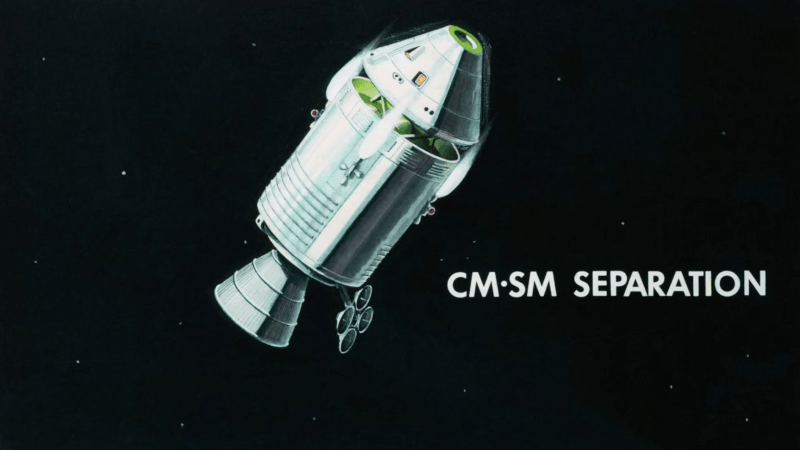
If you’ve watched a Saturn V launch, you’ve probably seen how a large rocket will often jettison a stage on the way up. There are several reasons for this — there is no reason to haul an empty fuel container, for example. However, you can probably imagine how the separation works. You release something — probably explosive bolts — and gravity pulls the old stage away from you as you climb on the next stage’s engines. But what about on the way back? The command module drops the service module before reentry. [Apollo11Space] has a video explaining just how complicated that was to pull off. You can watch it below.
The main problem? The service module has almost everything you need: oxygen, a big engine, fuel, and electrical generation capability. If you’ve ever seen a real command module, they are tiny. Somehow, you need to get the command module prepared to be on its own for the amount of time it takes to land, and get the service module safely away.
In orbit, gravity isn’t a big help in pulling the two pieces apart. For that reason, the mission design called for a very specific orientation for the separation. There are a number of other details you might not have known about.
Landing Apollo 11 successfully depended on some spy tech. We imagine the separation of the LEM had some similar issues, although even the moon’s weak gravity would have helped.












“How Did Apollo Separate?”
It got a good divorce attorney.
Couldn’t have been that good – the SM got almost everything in the divorce, but the CM was stuck with the kids.
Ugh. Is this where these things are going? LLM-generated drawn-out blather. It’s repetitive and information-sparse. And the synthetic voice complete with synthetic breathing just adds that special “I’m in a dystopic hell” cherry on top.
It’s awful, horrible and toxic. Literally brain-damaging. Doctorow was right. It’s Enshitification.
The worst part is that it could have been interesting and engaging, because the topic actually was before it got turned into this pabulum.
It was even boring at 2x speed. I listened through the whole thing to see if our author’s misconception about gravity contributing to separation had any roots in the video. Nope, but oh man what sloppy sloppity slop.
Fully agree. The video could have been a fifth of the length and convey all infromation. It’s tiring.
Can hackaday stop linking to such things or at least give a warning?
Clearly a part of one’s YT contract:
Heading 335, Subheading xxxiv, Paragraphs 47-49: Videos shall be at least 2.5 times the length required to impart the desired information and shall not be shorter than ten (10) minutes in any event, even for the most trivial nonsense. This is especially important for titles that apparently may be answered with a simple Yes or No.
AI slop, irrelevant video clips, and plausible misinformation shall be included as needed to meet these requirements, with random feline video clips being preferred. Titles shall include “shocking” and/or “what [group] doesn’t want you to know”.
AI shall be employed to generate narration when possible. Monotone, mispronunciations, incorrect or missing emphasis, and similar attributes are strongly approved and may be emphasized with creative misspellings, poor or incorrect grammar, faulty capitalization, etc.
The moody music and unnecessary drama writing… terrible.
” LLM-generated drawn-out blather.” True, but I’d just say AI SLOP.
AI clankers are worse than politicians: They can say even less with even more words!
AI slop is basically an averaged out version of what is already on youtube made by humans. It’s kinda fascinating in how it manages to distill any topic down to the pure essence of banality.
Then the people who upload these videos also make the AI reply to the comments on the videos to fake engagement with the audience. The audience is also AI bots used to generate fake views of the videos, and make comments to disguise themselves as people.
You see, the whole thing is not even content, it’s a simulacrum of content. Like a wax apple, or a hollow injection molded plastic shell representing a television in a store that sells furniture. It’s a placeholder or a prop for the real business they’re doing.
The real point of these videos is to be just plausible enough that Google doesn’t demonetize the channel, which they won’t as long as they in turn can pretend to the paying companies that their ad money isn’t being wasted on bots.
‘hollow injection molded’
The phrase you are looking for is ‘blow molded’.
For net less words, you have to use that phrase the # of words in this post + 1 times.
cue: fewer…
If you had played Kerbal Space Program, you’d know that gravity doesn’t do anything for separation.
Meh, cut him some slack. The way it is worded might be interpreted as a popular misconception of how it works, but I’m sure Al knows better and is just describing it in a relatable way.
Sure it’s all weightless in freefall, but the discarded stage is still bound by gravity, still literally falling. From the perspective of the departing stage it’s falling away.
So, armchair hotshot, how would you have worded it?
Gravity pulls equally on both stages in all of those cases, so will not cause them to move apart. You need some deliberate separation mechanism – sometimes springs or pushers, but usually an engine burn by the RCS thrusters or special ullage thrusters used to settle the propellents in the tanks.
I mean it is gravity, technically it causes them to move together.
But note the author doesn’t say gravity pulls them apart. He wrote: “gravity pulls the old stage away from you as you climb on the next stage’s engines” All literally true and correct, even while it evokes the cartoon image of gravity pulling the discarded stage away (and calls the armchair pedants to action).
Sooo… it’s not, actually, and it’s not really pedantry. Stage separation often happens after pitching over, when the rocket is much closer to horizontal – meaning that gravity acts exactly the same on both of them, close to perpendicular to thrust. I mean, okay, it’s not totally horizontal, so gravity does a little, but it’s actually not “burn and the other stage falls away.” Gravity won’t provide nearly the separation you need in a lot of cases.
If you have a hot-staged engine (light the second stage engines while still burning), the separation is generated by the thrust of the first – you’re pushing off the first stage.
Most rockets aren’t hot-staged, and the delay between the first stage being spent and the second stage (a ‘gravity turn’) completes the pitchover, and then you need either a physical separation (e.g. the Falcon 9’s pushers) or additional ullage motors to separate.
“thrust of the first” should be “thrust of the second stage”
There will be a very small difference in the gravitational forces between both parts of of the spacecraft, depending on how they are orientated. eg. if the SM engine was pointed towards the Earth with the CM pointed outwards, the SM would be in a slightly lower orbit, and would slowly move ‘ahead’.
That said, in low Earth orbit, there would still be some atmospheric drag, but whether the drag would be more or less important than the tidal forces would depend on a lot of factors.
At LEO the two are actually similar scale – people started calling it “micro-gravity” at the ISS for a reason, because most accelerations are at the part-per-million level compared to 1 gee (1 ppm*g = 1 micro-g, see, aren’t we clever). But they’ll be different directionally.
That’s just in orbit, though – for reentry you’re often moving significantly faster and drag’s going to win.
“but I’m sure Al knows better”
Dude, Hackaday needs to change its font just to make Al’s name not match “AI” because it took me way too long to figure out what you were saying.
As someone with a last name that includes the sequence “illi” I HATE sans serif fonts.
Illi is a german last name.
I forced Firefox to change all its fonts to Hyperlegible just to fix Hackaday. It makes some of the other sites look a bit funny but on the whole I think it was worth it. And now I can tell the difference betwen Al and AI. Also one and lower-case L. And Capital O and zero.
There’s probably a clever way to do it on a per-site basis but the brute-force approach certainly did the job I wanted it to, and then some.
Going from Point A to Point B, being in orbit and being in freefall are 3 different things (freefall includes but is not limited to being in orbit).