
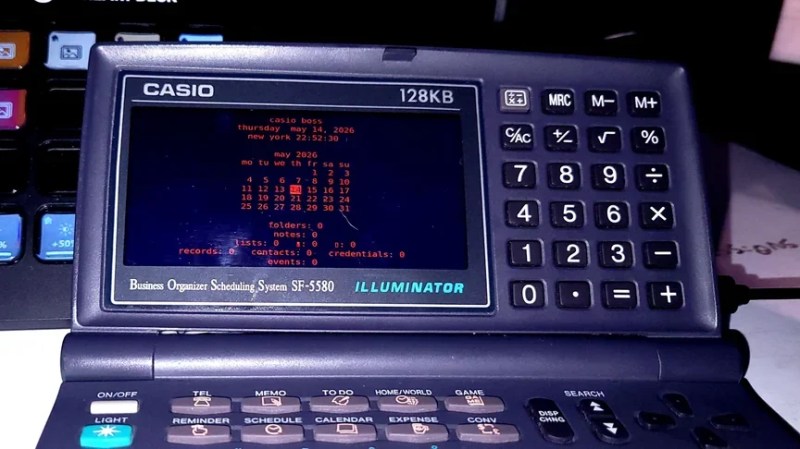
Remember digital organizers? They were like the lower-spec version of a PDA that couldn’t really do much more than store a few phone numbers and calendar entries. [TundraLegendZ] recently grabbed such a device from 1995 and set about transforming it into something a little more capable.
The device in question is a Casio Business Organizer Scheduling System SF-5580. The original guts have been replaced , though, with the power of a Raspberry Pi Zero. The single-board computer is hooked up to a small color LCD screen with a resolution of 480 x 800, which is tucked neatly into the spot where the original display lived. There’s also a Raspberry Pi Pico on board, which is charged with interfacing all 82 keys of the original keyboard. Power is courtesy of a 6000 mAh battery which should last a good few hours on a single charge. Hearing the buzzer hacked is fun, too. It’s more mobile phone ringtone than outright chiptune, but we still enjoyed listening to the results. Screencaps of the software show just what this setup can do with better hardware and a nicer screen than 1995 could provide. Future work is planned to give the build more capabilities with a HackRF upgrade.
We’re not convinced anyone ever got much use out of these diminutive digital organizers, but a great many were sold in the 1990s.












Awesome! Looks really well done! Kudos! 😃💙
Btw, I bet it might be even powerful enough to run CP/M 2.2 or MS-DOS 2.11 or ELKS in emulation (808x emu+OS+small COM files may fit into 64 KB to 128KB of RAM).
Playing Zork or Adventure on the go should be possible that way! 🙂
Cool, but I love those hacks more if the outside aesthetics are 100% preserved, i.e. using the original screen.
People got just as much work done on those as they do modern cell phones. They were all work related and though some of them had a few games it was only like chess and a few others and they cost like $300 xtra.
By 1989/1990, there were DOS-based handheld PCs that could run AutoCAD or Windows 3.0, as well.
Extreme miniaturization of 8-Bit PC/XT technology made it possible.
https://www.youtube.com/watch?v=SqyKiSVILDM
By mid-90s, you had something like the Nokia Communicator, which was the iPhone of the 90s, basically. Just better/more professional.
https://en.wikipedia.org/wiki/Nokia_Communicator
My boss (of a small business that I still work for) carried one of these BOSS for many years, well into the 2000s. Just having names, addresses, phone numbers and a few notes of 250-300 clients on it actually filled the memory. But it was reliable and worked for months on one set of batteries.
The perfect device. Keeps your head up… doesn’t invite doom scrolling.
I never found the devices in Star Trek (TOS) dated…in that it made sense for a post-cyberpunk era to have devices that ennoble humanity rather than degrade it.
in 1995 this thing had instant power on/off and a long standby life. once again, the stick-a-pi-in-it crowd has failed to keep up with decades-old technological innovation in portabl computing.
maker here, all original on off and function buttons work, battery life actually lasts around 24 hours.
Glad to see a numeric keypad on this instead of the Bell Handicap upside down keypad from Touch-Tone which has similarities with the roman 12 hour dial. Even though it has 0 it’s not next to 1. With modern touch slabs we should be able to switch to this but but no option seems to exist. Another devo for mankind.
Excellent hack, thank you for sharing!
“We’re not convinced anyone ever got much use out of these diminutive digital organizers”
I don’t know. My version of that was a Timex Data Watch. I never really used the calendar functions but I used the phone number list all the time.
Obviously that was a different time….
Very cool project and kudos on getting it back in and looking tidy! I love it :)
It is a bit off topic, but I have an old Casio organizer ……somewhere…. lol. I have a pile of boxes of the usual “cool stuff I will use one day or sell on ebay” in my work area and every day the alarm goes off at 6:30pm. I have torn thru the boxes several times now, but could not find it. I set that alarm to test it and the scheduling and what five years later it is still going strong somehow.
Back in the day though I thought my casio databank could run a small country lol. It really was very useful for phone numbers and scheduling and working in other timezones/countries. Heck even the calculator was useful when doing repairs or matching sample lengths in sequenced tracks or spl or frequency filter calc things. I dunno now I am nostalgic for that little arm computer (though I probably cant read the screen or keys anymore). Best part was it was offline I guess lol. I loved that casio shoved a calculator into pretty much everything, practical or not.
I still own one of those Casios, too, and, if I remember right, it happily runs on two CR2032 for like half a year. Sadly, it reset to factory settings once batteries die. Also has some simple games that are mostly time wasters, and I long thought it would be nice to figure out how to add something like simplified/short wikis for quick lookups here and there. Also, could use a text-to-speech that could read plain vanilla ASCII text (books, news, weather, etc).
Never figured out how to slosh data out/into, though, but it is some kind of simple serial data protocol, so should be relatively simple to figure out with some kind of Arduino/RP solution. Since it is serial, it probably in theory could command outside speech engine.
Most useful features were note taking, clock and alarm. Addresses/telephones, meh, okay, telephones would be useful is one could hold the thing to the headset and tone-dial these directly, but no, that was not one of the features.
One day I’ll get around to figuring out what to do with it. For now it sits in my drawer without batteries. Good form factor, though, just right.