
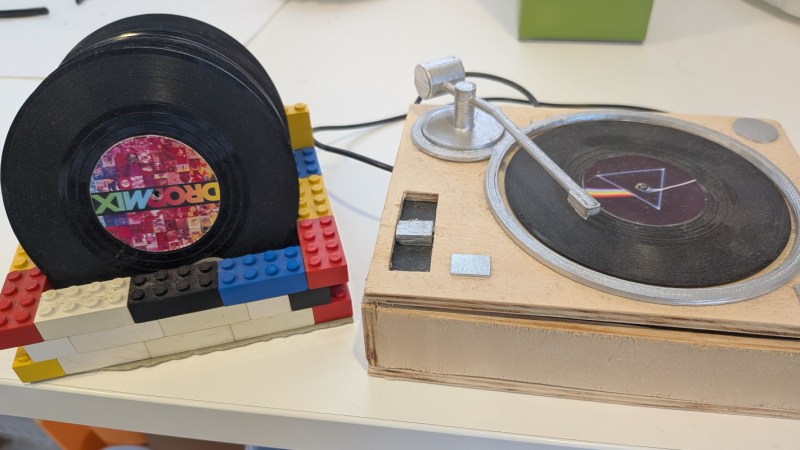
Streaming services have enabled many of us to have easy access to the world’s media library at the touch of a screen, but [Coconauts] thinks we’ve lost something along the way. To bring some intentionality back to the listening experience, they built an NFC record player called Minilos.
Like a normal record player, Minilos requires the user to select an album to play on the machine. These were originally decorative coasters with records printed on them, so they are much smaller than even a 45. Each one features an NFC tag that instructs ESP32 microcontroller hidden in the device to play the requested song. Once placed on the record player, it will then play through that album and come to a stop.
In [Coconauts]’s current setup, the ESP32 is connected to a Home Assistant server which then instructs a Google Speaker to play the requested song via Spotify, although we could easily imagine this being used to play music directly from an SD card or other digital storage device instead.
If you want complete control over your music listening while still keeping that authentic vinyl experience, you could always look into cutting your own records with a laser.









Given the turntable geometry (that looks like it was built by a cargo cult), does it play the music backward?
Of course! So you can hear those hidden reverse recorded lyrics.
I’ve always been mad, I know I’ve been mad, like the
most of us…
You’re showing your dark side😄🌘
This will be my new descriptor for (1) cringe-worthy Youtube makes and (2) a certain number of my own projects where I needed something quick and dirty and couldn’t be arsed to do it right.
IMHO with the amount of technological prowess thus shown one can design and build a real record player from scratch. Not that it would be much of value, really (LPs in general are kind of mid-fi, not low-fi like cassettes, but somewhere in the “okay” region).
Good hack otherwise.
I get not wanting a real record player. This one is smaller, and the records aren’t real. Real records these days are quite expensive, and finding everything you want on vinyl is pretty much impossible. I like records well enough, they store the sound and replay it at qualities I find sufficient, but I think I only own a few records, and one is signed and unopened, so I just listen to that one via MP3s. These “records” can also hold an arbitrary amount of music. I would imagine you don’t have to flip them over either.
eh I wouldn’t say vinyls are just OK. but they do have some “you get what you pay for” thing to to them. a decent, even an entry level stylus from a respectable manufacturer gets you 80% there. the preamp is the rest.
I broke my dad’s player’s stylus when I was a kid in the mid 90s. I could only source a shitty one locally in my 12 year old world where vinyl was mostly out. it was SO shitty that his stylus (a Shure), bent back into shape, still sounded better than the replacement I got.
vinyls are, in every objective technical metric, inferior to CD and that is out of discussion, though.
a lot of the modern “vinyl” experience is bad $20 turntables with terrible pickups and awful preamps (which is mind-blowing since opamps that can leave 70s preamps biting the dust cost pennies nowadays). added to awful bad pressings, it’s a disaster. I bought a “new” vinyl once and it was dirty straight out of the sleeve! sealed from the factory! later I learned a lot of “secrets” of vinyl manufacturing died with retired factory employees and many of the PVC formulations for vinyl haven’t been made in decades. vinyl is mostly vinyl, it’s black because of carbon content to reduce static and lubrication, and has additives for extra lubrication and to avoid bacteria and fungus, and make it flexible so it won’t shatter so easily. clear vinyl has no carbon and is a tradeoff
nowadays when I go to Japan I buy old japanese music vinyls for $1 a piece and I’m blown away at the quality and how well people keep them (and all things in general in thrift stores).
I will disagree on vinyl being inferior
Disagree on the inferiority of vinyl for a few reasons.
Disc rot.
Vinyl makes my listening more intentional, and my collecting specific
Both (anything) are superior to paying Spotify to screw artists though.
I don’t know if it’s imagined but I feel more warmth from vinyl. Especially while it burns.
Sound quality though? No contest. A good CD can sound world’s better than mid grade vinyl.
A good CD can sound world’s better than mid grade vinyl? Ok…but dies a good CD player sound worlds better than high end turntables?
“Vinyls” is actually not a word. It’s always “vinyl”
It’s the same as saying a 6-Pack of beers. We say “beer” not “beers”
All good points, appreciate the details.
Electronics engineer (by education) here, so I kind of witnessed LPs going from The Best (consumer market, obviously) to okay to nobody wants them any longer. The point I was making average okay LP player is not much more complex than average cassette player from about the same era. Not even cassette recorder, merely a cassette player. It is all analog electronics.
LPs had quite a lot of advantages over compact cassettes, one – they stay about the same throughout the years, minus the obvious (dust accumulation, inevitable scratches, etc), though, of course, cheaply made LPs would show their age rather quickly.
I own two boxes of LPs, one inherited from a friend cleaning his house, and some were rather good quality, dating to late 1970s, and there are few early 1980s, when NY recording studios could mint excellent LPs. The art was lost since then, of course, but here’s what I was thinking.
Modern sound processing available to average Sam is not just superior to the best multi-million-dollar 1980s NY studios, it is far, far more capable than that – it can now not just “enhance”, ie, say, remove artifacts, smooth out the response, and get rid of the pesky high-freq “sharps” that is really the result of the needle reacting too swiftly coupled with the non-linear output transistors response (thus making some sinus waves into semi-triangles, I’ll leave the detail out). it can also reconstruct/guess the original in its proper stereo, say return low frequencies collapsed into mono.
Methinks LPs are not really lost per say, but perhaps awaiting being properly reborn, say, ultraviolet laser instead of needle, etc. I’d even venture to say with things like compressed bar-coded “augmentation” that would fine-tune the equalizer (thus, helping with the tone compensation and taking guesstimate out of it), in addition to perhaps doing some synth to enrich the sound. IN a sense, this hack is the step in the right direction, and if I am to reinvent LPs today I’d start from the same.
Sorry about the run-on, I just found this inspirational.
If you think turntables are mid-fi, seems you haven’t heard a high end turntable. So…what have you heard?
I first read this as NFT instead of NFC and started to get irrationally angry.
“we could easily imagine this being used to play music directly from an SD card” – We imagined oral histories directly from an SD card
https://museuminabox.org/
My eyes were drawn to this post, excellent project and results.