
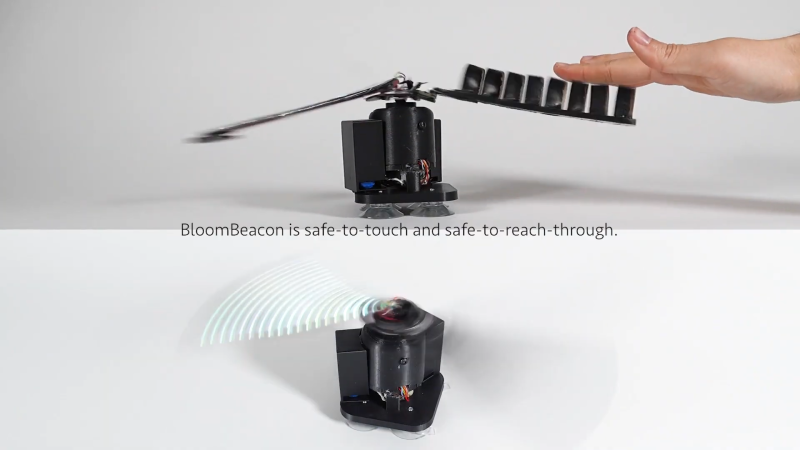
Typically, when we think of touch screens, we think of LCDs or OLEDs with a resistive or capacitive sensing layer laid over the top. However, a team from the University of Chicago has developed an entirely different type of touch-sensitive display that uses persistence-of-vision techniques.
The project is called BloomBeacon. It consists of a pair of spinning arms to create a stable round display in mid-air. One arm is covered in LEDs, while the other is covered with capacitive pads for touch sensing purposes. The trick behind this device is evident in the name—the device uses soft, flexible arms which are hinged and “bloom” upwards as the device spins up to speed. This makes it safe to physically interact with the spinning blades while they’re in motion to create a touch-interactive display. The device can thus display user interface elements like buttons that the viewer can interact with by reaching out and touching them directly.
Normally we’d advise not sticking your fingers in a rotating piece of machinery, but in this case, BloomBeacon was designed specifically to make this safe. Even sticking your fingers or hand right through the spinning arms won’t cause injury.
We’ve featured some other cool POV projects over the years, like this neat volumetric display.












“Video after the break”…. It’s been a long time since I’ve seen/heard that phrase… and I still have never figured out what it means. Is it some TV reference, like “we’ll be back after the commercial break”?
OK I will explain…just give me a break.
Its the digital equivalent of “below the fold”. Basically it means it won’t show up in previews or RSS feeds.
In many content management systems such as WordPress, there is a “break” feature. Everything under the break will not be shown in the post overview, pages, rss feeds etc. I basically means “click further to read the whole article”
“Nice tech demo. Now build a box around it. No… nope… doesn’t matter – if it moves, nobody can touch it.”
-Health and safety regulatory consultant
Anyone here have advice for designing a slip-ring system for a project like this involving high RPMs and data transmission?
How many wires?
Always two, for power. Data can be sent back and forth by light signals / IR coupling, or RF signals. No need for data lines.
There are plenty of ways to transfer the power wirelessly too. Inductive coupling is fairly efficient and easy to do if you only need a few watts.
Can you explain further?
With an IR setup, it feels like tx/rx would have to be axially aligned (which wouldn’t be possible in my case, but an interesting idea—using a hollow shaft), or timing the IR signals proportional to the RPMs if the tx/rx are not axial?
Three wires: pos, gnd, data
Doing it for power alone isn’t a big deal, noise there can be filtered. It’s the data where noise is obviously more of a prob. My simple copper to copper brush method is not letting the data through unpolluted.
The project is not completely unlike the display from the article. It’s less ideal, but I could just put the microcontroller in the spinning section, then just provide power via the slip-ring (or batt—even less ideal), but I’ll still need a data connection to communicate with the microcontroller real-time.
cool.
Yet in my mind I can imagine that during development there must have been a first scary moment of touching the device. Maybe even some fingers where cut of and thrown around the lab because somebody forgot to use the super-duper-bendy-stuff and somebody else forgot to properly configure disable the motor torque control. But these are the risks that need to be taken to advance our species. Another part of my mind thinks that they just used a stick or pencil to do the first test, that would probably be better.
It’s neat, but like the makers I too can’t find a good use for it.
Maybe instead of a touch interface put a few hundred volts on it and then use it in education to teach american kids to not try to eat CR2032’s :)
Dont stick your fingers in the fan.