
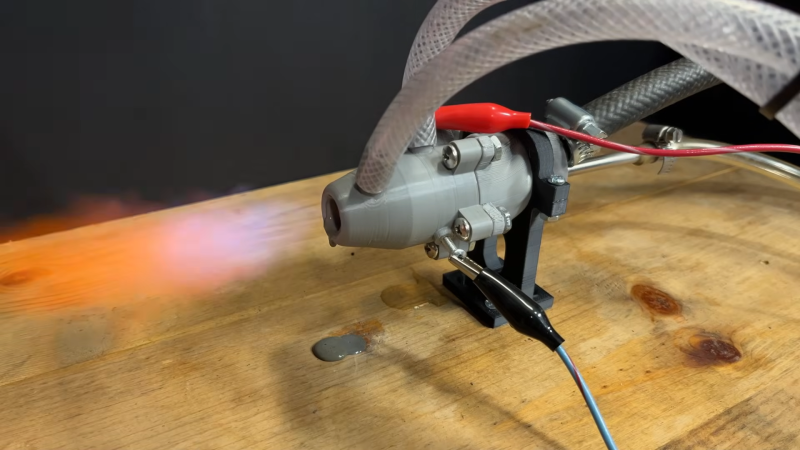
Consumer-grade 3D printers are useful for lots of things, but they kind of fall down when it comes to making stuff that survives high temperatures. [Mr. More Gooder] wasn’t deterred from a rocket build using FDM printed parts though, instead relying on water cooling to try and beat this practical limit.
The concept is simple enough—[Mr. More Gooder] printed a propane-burning combustion chamber and nozzle out of plastic that you’d totally expect to melt when the flames started. Thus, the nozzle was given fittings to allow water to be continually pumped through to try and drag away enough heat to let the rocket survive more than a few seconds. Unfortunately, during testing the uncooled combustion chamber quickly melted. A redesign with water cooling throughout performed a little better, until the water jacket began to leak into the main chamber and extinguished the flames. Melted plastic could be seen dripping out of the nozzle shortly after ignition, too.
Even if the nozzle did hold up for a longer period of time, it’s worth noting this is probably not a viable route towards a flight-ready engine. Mostly because you would need a huge supply of water to keep the components cool which would add a great deal of weight to any such build. There’s a reason NASA doesn’t recycle old drink bottles to make rocket engines, after all.
In any case, we love to see all sorts of rocket experiments, even the unsuccessful ones.












Not a rocket engineer, but:
The two wall approach with water in between is IMHO not the best approach. The inner wall will be exposed to several hundred degree anyway and act as an insulation layer between heat and coolant.
So the inner wall will melt inevitably.
Maybe it might be more viable approach to cool the back section indirectly (two wall approach with water in between) and in the burning chamber itself maybe the wall of the chamber can be protected by some fine water mist directly?
Don’t have an idea up my mind on how to do that (maybe some brass nozzles in the back wall spraying in direction of outer walls?), but having the water cooling the wall of combustion chamber directly might pose a minimal chance for it to not melt.
Would be interesting to see this as one of the next approaches to tackle the problem.
Although impractical for rockets because carrying a consumable coolant to the skies is somehow nuts, but the engine might be able to survive longer.
Fuel as coolant.
My understanding is that using the fuel as coolant(worst case it’s going to be roughly room temperature; best case cryogenic) is downright common and implemented on at least a crude level right back to the V-2; but has a lot of fiddly details just because of the fundamental tension between wanting basically the thinnest combustion chamber lining possible for low delta T and good cooling; but needing an actually mechanically sturdy combustion chamber lining with correspondingly worse delta T to survive the mechanical demands of running at relatively high pressure. Plus all the fun of different parts of the system heating up to different degrees and being cooled more or less effectively and the resulting thermal stresses.
I suspect that plastic is a hard sell just because it combines a low melting point with relatively poor thermal conductivity, so the inside of the combustion chamber is absolutely going to be sacrificial unless you manage some really clever high pressure injection approach where there’s some sort of laminar flow of cold fuel protecting the walls of the combustion chamber from the combustion(ideally without losing too much of the protective fuel straight out the back); but if you only need a short burn regenerative cooling with the fuel could, absolutely, keep the entire engine from reaching heat deflection temperature and deforming wildly; and instead have it shed the inner wall of the combustion chamber at a relatively stable and manageable rate.
Both of those things — running coolant through a jacket between two walls and spraying it against the inner wall — are used in real rocket engines. The difference is that they use fuel instead of water. Nearly all large engines run fuel through the engine walls as coolant before burning it, and quite a lot spray some in around hot spots to provide evaporative cooling and a film of non-combusting gas between the flame and the metal.
This only fails because the plastic’s thermal conductivity is far too low. The heat flux that needs to be conducted from the inner surface to the coolant is massive, and a layer of plastic thin enough to keep its inner surface below the melting point while carrying that much heat is too thin to have any strength.
Maybe sandpaper as a nozzle liner?
Semi-ablative perhaps.
That might last just long enough for the water to get flowing good and transport the heat away.
Maybe the cooling pack chemicals in place of the water
Of interest
https://phys.org/news/2026-05-physicists-figure-formation-viscous-fingers.html
What if the 3D print is made intentionally more porous and the liquid fuel injects into the engine by being forced through the pores?
“There’s a reason NASA doesn’t recycle old drink bottles to make rocket engines” – yeah they’ve all grown out of it. I’d bet all their engineers who have kids still do though.
In fact I wonder how many, if any NASA engineers didn’t build a bottle rocket as a kid.
Bottle rockets are launched from bottles.
Rockets made from bottles are usually named for their propellant.
JATO bottles are a kind of rocket engine.
The movie Bottle Rocket as far as I remember has nothing to do with rockets, although bottles may appear incidentaly, but it’s a fairly confusing film.
Got that?
NOPE.
While solid fuel rocket engines can be made out of paper/cardboard and the inner layers will burn creating heat insulating carbon, plastic melts and gets striped away by the exhaust gases, no matter how much you cool it.
The only advantege of being 3d printed melts away with metal 3d printing advances towards home availability.
Better use 3d plastic for formers for paper or metal sheet parts that you can weld (using laser or spot welding).
Integza used ceramics in resin 3d printer, with mixed results.
I was wondering when someone would mention Integza. If this article is interesting to you, it would be well worth your time to watch his many videos on unusual rocket and jet engines. Some were made from plastic, some lasted better than I thought they would, but 3D printed metal has served him better.
What’s next, trying to 3D print the Eiffel tower?
Oui mon ami, ven mee medal 3d priteur will be redy, we’ll print Le Eiffel Tover avec petitte smaller tovers on it, et each pettite smaller tover will have more evwn smaller tovers. Et le most important thing: no access pour les trouristes!
My hat’s off to [Mr. More Gooder] for trying this–nothing like a practical experiment to see if an idea works. However, ABS, PLA, and most other common FDM plastics are pretty good thermal insulators so heat can’t be carried away from the combustion chamber surfaces into the water fast enough to prevent melting. I doubt even cooling with liquid nitrogen (assuming the plastic could withstand it) would be good enough.
Surely under the right circumstances there is a high enough energy density in certain plastics that they could make an ok fuel for a solid rocket fuel. Lots of hydrogen and lots of carbon in the long chain polymers. It would need a really good oxidizing agent and an high temperature to break the bonds but in theory it could be used as a fuel.
Solid rocket boosters use ammonium perchlorate oxidizer and do in fact use a polymer [HTPB — hydroxyl terminated polybutadiene] as the primary fuel. (Aluminum is a secondary fuel that increases combustion temperature.) Amateur hybrid rocket motors often use PVC or other polymer tubing as the fuel.
So yes, plastics are used as fuel.
HTPB is the binder. It burns, yes, but the aluminum is the fuel, typically out-weighing the binder 2:1, together about a third the weight of the propellant. The perchlorate oxidizer is the bulk of the mass.
Integza, as mentioned in other comments, has made rockets using 3D-printed plastic propellant. His YouTube videos are well worth watching.
PLA makes an excellent fuel, great kindling for starting wood fires. It flows well when hot, so needs a substrate like cardboard or paper to wick it up, but it burns clean and hot with no ash. A lot like a candle wax.
The PLA molecule is already 25% oxidized, so doesn’t have the energy density of (say) polyethylene, but it’s right up there with many other fuels like wood.
Potentially of interest: https://forum.nasaspaceflight.com/index.php?topic=53964.0
lmao that was pretty funny.
First gonna say: that’s not a rocket. It’s just a propane burner with negligible thrust. It has no chamber pressure to speak of.
3d print mould then cast it from clay, plaster, cement, etc.
Twice I attempted to post a link to the Vortek water-wall plasma lamp, but it got sucked into the moderation vortex. Search for it yourself.
On the assumption that it will forever remain in limbo, here it is without the link:
The Vortek is a high-intensity carbon-arc lamp with an inner wall that is a vortex of flowing water for cooling. It’s an example of cooling a super-hot high intensity thermal source with liquid water. Put it under pressure and it would be a fine rocket.
It would be a tripropellant rocket. It would not be quite as good as a conventional steam engine rocket, like the bipropellant RL10 or RS-25 engines, but it could be better than a propane-oxygen rocket, because the exhaust would have lower molecular weight, so higher Isp for a given temperature.