
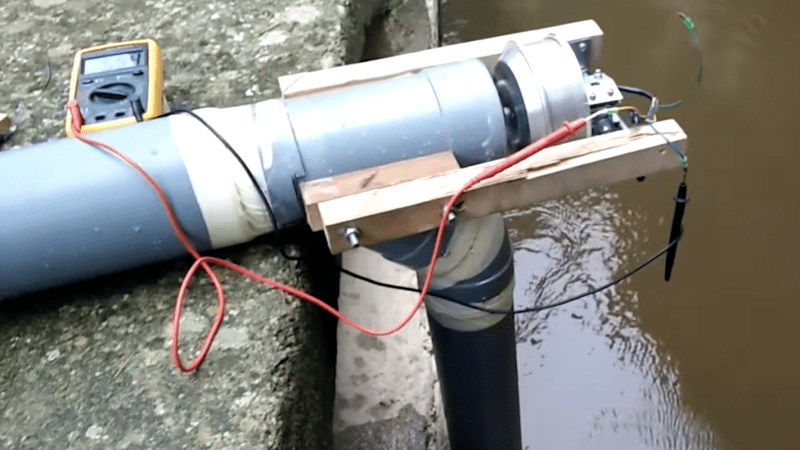
Engineering design makes all kinds of tradeoffs. Power trades off with torque, strength trades off with weight, and cost can trade off with quality. For designing a hydroelectric turbine, one of the main tradeoffs is hydraulic head with flow rate. Many large dams meant for bulk power generation will go with high head (or medium) designs, and for small dams with low head it’s usually not cost effective to build any generation. But if you’re really determined, you’ll want to build a low head water turbine like this one.
The build aims to use easy-to-find materials and simple tools. It uses 110mm and 160mm PVC pipe to not only siphon water up and over a dam, but to house the turbine as well. The turbine is built from a computer fan and sits inside the pipe with a shaft running through a Y-type fitting to the generator. The generator is built from a scavenged hoverboard wheel, and outputs a reported 3.3A DC at 60V for around 200 watts of power with only around 3m of head. The design allows the turbine to be placed at the point in the pipe that best suits the environment.
[OpenSourceLowTech], the creators of this project, make a compelling case that this build is cheaper than a 150W solar panel and it might even be able to produce more energy as well over certain timeframes, provided there’s a reliable source of water available and the owners of the dam don’t mind someone siphoning water over it continuously. The build video is worth a watch as well if for nothing else than the animation, which documents the build in excellent detail. Generating usable energy from hydropower doesn’t even need this big of a dam; if all you need is to charge your phone this tiny waterwheel will get the job done.
Thanks to [Keith] for the tip!












“for small dams with low head it’s usually not cost effective to build any generation.”
Turbulent disagrees. their turbines generate reliable electricity, typically ranging from 15 kW to 70 kW per unit—requiring a height difference of only 1.5 meters
15-70kw is enough to power 9-60 average american homes given the 24/7 potential of hydropower.
Their 15kw system costs $60-80k installed and has an expected lifespan of 30 years. That works out to around $25/mo per household in the worst case scenario.
At 70kw the cost rises to $300-350K installed. Thats good for 40-60 average american homes.Thats $14-25/mo per household.
They can even chain multiple turbines in series if there is enough drop across the property the water flows through.
I’ve looked at their stuff before, years ago. If I ever manage to snag property with a stream, that’s absolutely one of the first things I’m installing. I love the idea of reliable, continuous power – even solar power drops out at night or cloudy days, but water power just keeps going.
Solar power does worse than drop out at night and on cloudy days. Depending on your location and whether you use 1 or 2 axis tracking you only get the equivalent of 4-6 hours of your panels rated power per day.
To match a 15kw hydroplant you would need 60-90kw of solar panels.
For a single family home hydropower system, a small pelton turbine with an output of ~1.4-2kw using batteries as an accumulator to store during your consumption valleys for use during peak consumption hours and to allow for startup current spikes. Of course the hydroplant can get away with a much smaller battery reserve than a solar system would require.
If looking for a sustainable offgrid property, flowing water and vertical change is definitely a prize worth paying for.
If you are an aficionado of contours, you might appreciate my cousin’s hostel, built adjacent to Dean stream around the 100m contour:
https://www.topomap.co.nz/NZTopoMap?v=2&ll=-41.593086,171.899186&z=16
https://www.oldslaughterhouse.co.nz
And yes, it is hydro powered.
Here in Scotland there are a lot of small hydro power stations, some I have seen just connect onto a little stream, don’t require a big dam and still provide enough power for quite a lot of homes. There are also a lot of small ones that produce over 100 kW.
I mean, a angled pipe is enough to get pressure, don’t need a dam. But a dam is a buffer.
Everyone can build trash for a quick YouTube video. The real question is how willing are you to maintain this trash long-term? Cheap parts will break, get worn or biofouled.
Unless you live as a $2 per hour senior JavaScript developer in some remote village in Laos then time spent on repairs and maintenance might not exactly be worth it.
Hey, you, the other “anszom”.
Serious question. Are you randomly trolling by picking nicknames from old HaD posts and reusing them? Or is this just a bug in the comments system?
I have a home-built cider/grape pressing system that I slapped together cheaply the first year and I have been upgrading ever since. The heart of it is a cheap tongue jack from Harbor Freight and a purchased garbage disposal and the rest is from salvaged or repurposed parts. Each year shows me what I did wrong, and each improvement shows me what else is poorly thought out, but not apparent due to other flaws. I could have bought off the shelf gear, but I needed it fast and dirty and it started out fast and dirty. Sometimes you just need to hack.
Sometimes I have to shake my head and say “why?” and then I replace another part with something that is better.
It is not yet the cidery of Theseus, but I am getting there.
” needed it fast and dirty ”
garbage disposal? like an in sink garbage disposal?
You do realize that is in no way shape or form a sanitary design?
you definitely nailed DIRTY
If he modified the garbage disposal and throws the parts in the dishwasher after each use, it’s totally fine.
Assuming it’s new, that’s actually not a bad idea, pressing the whole fruit is much more difficult. This way he can get maximum juice and a goodly amount of pulp. 👍
It is presumably a new one (“… a purchased garbage disposal, …”), but its intended application did not oblige the designer and manufacturer of that unit to make it “food grade safe” in regard of chemicals and particulates emitted during operations, so it may be safe only unintentionally, and was probably never tested and certified as such.
How do you cultivate such a sunny disposition?
Don’t forget to check out Farm Craft 101’s channel where he built his own turbine from 3D printed parts, a rewired alternator, and lots of heavy farm equipment to handle the excavation – including jack hammering gneiss bedrock.
From 3D printed parts? I am genuinely curious about the lifespan of such a turbine.
It’s still very much a work in progress. He is still prototyping for the most part.
He did get an engineer with fluid dynamics experience to volunteer an engineered turbine which gave him a perfect laminar flow. Huge difference that made. That’s what engineering schools are for! And if anyone hasn’t seen the video (shame on you), the turbine is 3D printed but it uses metal rods & bearings and a rewired alternator, so not ALL 3D printed. That would just be silly.
Seconding farmcraft. John is more of a hacker than he thinks!
Without mentioning the amount of water going through this, nothing can be said about efficiency.
But 3 meters is enough to get some real usable power. For example the link below squeezes 28kW out of a head of just 2.5 meter.
https://nl.wikipedia.org/wiki/Apeldoorns_Kanaal
This one gets 2kW out of a head of 2m It’s also an 150 year old museum piece (apparently there were water wheels in that location for over 700 years now).
https://nl.wikipedia.org/wiki/Spoordonkse_Watermolen
And of course, here in the Netherlands, (nearly) all hydro power is “low head”, as the whole country is pretty flat. There is a list of over thirty hydro power installations in the Netherlands in:
https://nl.wikipedia.org/wiki/Lijst_van_waterkrachtcentrales_in_Nederland
“Generates Plenty Of Power” Uh, I don’t see how 192W is plenty of anything
It’s constant, so that’s over 4.6 kW/h per day which is equivalent to between 3 and 5 solar panels depending on where you are. Nothing to sniff at
“this build is cheaper than a 150W solar panel ”
hydropower is generally continuous.. 192W of hydropower is the equivelent of 750w-1kw of solar panels.
So it might not be niagra but Its enough to keep a houseful of LED bulbs lit, your phone charged, and if you buffer the power with a battery bank, you can probably cook a meal in the airfryer too.
Might be more the, I have all these power sources around me, type of utilization. Who knows? Maybe next week is backyard geothermal, or harness the vibrations from the road in front?
That’s optimistic. Residential scale solar usually doesn’t get that high of a capacity factor. 750 Watts you could expect from a utility scale solar farm in southern California. The residential setup would probably be 1 kW.
If you’re not living in southern California, things get a whole lot worse. If you’re up in France, Germany or Poland, you can easily expect to install 2 kW for 200 Watt average output because of the higher latitude and cloudier climate.
I guess this proves that any head is good head.
lmao
FarmCraft101 has been doing a great series on a low-head turbine system.
sure, every pun is its own reword…
But then again, efficient waterpower is indeed interesting!
Especially in the middle of an epic drought.
At the start of the second sentence; it should be “Speed trades off with torque”. Speed and torque trade off and multiple together to total out to the same total power.