
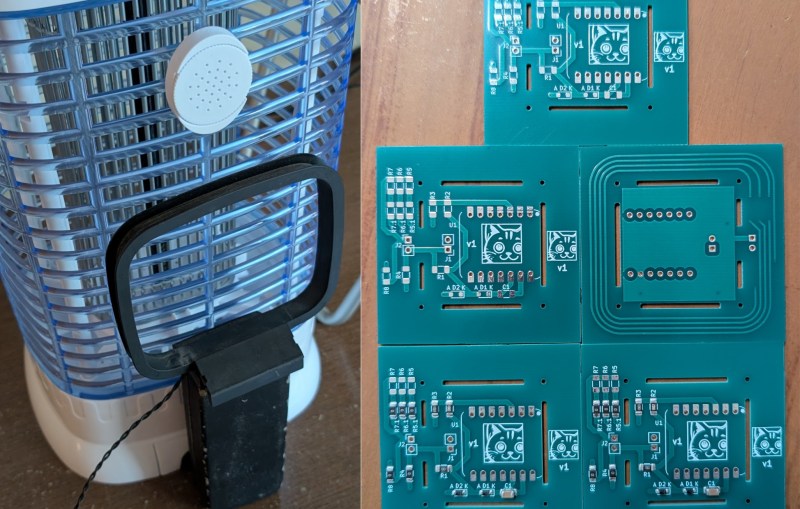
If it’s summer in a warm, humid climate, bugs can be the bane of your existence. A natural solution is to place a passive bug zapper to catch bugs at night. But what if that isn’t fancy enough? [Nicolas Boichat] spices it up with a passive bug zapper that tracks its kill count.
But how exactly do you detect a bug zap? With an antenna, of course! When a bug gets caught, it arcs, creating an electromagnetic pulse. A small loop antenna on the backside of the zapper receives the signal.
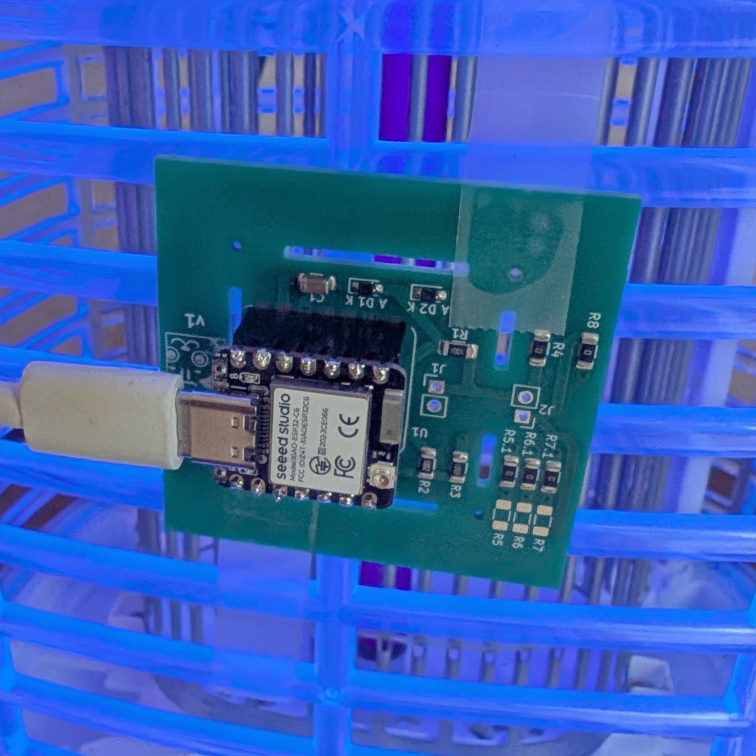
It was also in part an experiment to see how good you can “vibe-EE” and, well, mixed results. Claude was able to correctly identify basic concepts of EE needed here, but was largely worthless at making schematics. After some manual circuit doodling, then building, [Nicolas] successfully got an ESP32-C6 to detect the voltage spikes.
Of course, where there’s data, there must be a dashboard. Using existing graphing libraries and a custom PCB, [Nicolas] has the ultimate bug zapping experience.
We’ve covered a similar idea in the past, namely one based on current sensing.












Cool project! 🦟
But what’s passive about an electrically powered bug zapper? This question is for the Hackaday author, as the linked article doesn’t contain the word “passive”. Google’s AI definition of “an electric or ultraviolet (UV) trap that operates automatically without needing you to manually swat insects” isn’t very convincing either, especially as this Hackaday post is the only search result referencing “passive bug zapper”
If this is a passive bug zapper I’d be interested in seeing Hackaday have a contest for the best active bug zapper. Drones? Mechatronics? Mass sterilization by MEMS surgical robots?
I’ve seen projects here involving laser bug killers. CV target identification, laser mounted on a pan/tilt turret, zap when sights line up.
“Mad Science” seems to fail to capture the absolute reckless disregard for safety of such an idea. I have no problem with grown adults doing things that may cause them bodily harm, but risking the retina of any creature within eyesight is stupid and irresponsible. I’ll take these ‘passive’ solutions any day
What about a RC spitfire that identifies insects with OpenCV AI, then flies close to them and uses a modified airsoft gun to fire 6mm balls made of compressed permethrin?
Weird. Mosquitos are parasites whether or not you accept the definition (this is my opinion) and harbingers of disease. Would you make a case for ticks also? Curious about the tree you hug and what offsetting benefits to your life and others you would make a case for based on Malaria, Dengue and the like. Perhaps Lyme disease is your flavor.
Of the 5,000 odd species of mosquito, only a few are dangerous to humans.
They are also pollinators, which us humans find handy.
Also most humans enjoy birds and bats who eat what in large quantities?
Most humans don’t eat bats. I’m not even sure I would classify Chinese as humans. They eat weird stuff, have horrible teeth and smell funny.
I’ve seen a kind of documentary where they got sharks with lasers on their heads. Now, while this solution may involve a large tank of sea water and a feeder of some sorts, the issue here is how the sharks will detect the flying pests. It is known that sharks feeding time is when the night comes, as the active time for mosquitos, so we have timing solved. Well, I’ll leave it here for you to fix the remining details.
P.S. long time ago, being a child bitten by them, I was thinking of three laser turrets in my room tracking and hitting the mosquito such that combined heat will disable it, but one laser won’t set my room on fire.
12 gauge or AR15
Bug zappers kill the wrong insects, at a time when there are substantial insect population declines. See more at https://www.nytimes.com/wirecutter/blog/do-bug-zappers-work/
The amount of bugs inside our homes is insignificant when compared to outside our homes. They are pollinators, sure, but on cities there’s little to pollinate.
Declining insect population on a city isn’t an issue, only outside the cities, and I doubt insects commute every day from city to work.
most Americans live in suburbs, and if you discount all the nature there, that’s a huge chunk of it gone. I would argue that the pressure of humans on our limited life support system means we should be more indulgent of nature everywhere, including inside our homes (to the extent that is possible). There are a lot of fat juicy assumptions about living as a typical American that could use some critical thinking. Do you really need that big lawn that serves no purpose but signaling to your neighbors? Does it have to be a monoculture? Does a leaf blower actually have a useful function aside from annoying your neighbors? Have the insects trying to get out of your house at the window done anything to warrant death?
I know “bugs” (you really mean “insects”) are SUPER unpopular because they are so funny looking and small. But we have ecosystems everywhere that depend on insects, and bug zappers are known to kill lots of insects without any sort of selectivity other than that they are attracted by light. Just spend a moment to think about the use of such devices with some critical thinking skills and don’t just assume that icky creatures all need to die.
Well, most already disappeared anyway. In my childhood a hour hour car trip before sunset and the windshield was splattered with insects juice. Now you can drive days without having to clean it. Staying outside at night with a light and there was a whole cloud of flying insects around the light. Now pretty much nothing.
I agree with the sentiment with a few exceptions. Disease carriers, like mosquitos, are on my list. Also true for insects like bees and wasps that can cause severe allergic reaction in humans. I don’t hunt them, but I do protect family and guests from being stung.
On the other hand, I have a pair of lizards I named Fred and Barney living on my deck for some time now. They get the job done without a bug zapper.
I have geckos in the house, but I think they are only interested in the ants (and occasionally spooking me when they appear in unexpected places, and in the process get spooked themselves).
I’ll have to do research on lizard pets now! And see how I can make a lizard dashboard to measure their effectiveness.
I am providing icky creatures 2 acres of beautiful icky creature habitat. The only thing they need to do to live a long and happy icky creature life is buzz anywhere but my bedroom. Where there isn’t anything for them to feast on anyway, or anything to feast on them for that matter.
That’s better than most Americans, I suppose, who insist on turning all the property they control into closely-cropped turf with no place for icky creatures simply because otherwise their neighbors would tut-tut (and they would have no other way to spend their sad, sorry weekends)
… technically, they probably really mean arthropods.
Anyway, the irony for everyone mentioning mosquitoes, ticks, and fleas in the comments to justify UV bug zappers is that most of them aren’t especially attracted to UV.
A carbon dioxide source would be a much better bait.
yeah most of what is killed is moths and harmless crane flies that people think are “enormous mosquitoes” because nature illiteracy is much worse than actual illiteracy
The crane fly comment is really interesting. It looks quite likely that the biggest things I see getting caught are just that, indeed. There are mid-size “bugs” too, though, that at least Google Lens thinks are mosquitoes (including some Aedes).
I could try to line them up and identify them, that sounds like a more serious project that my silly EE experiment described here ,-)
This is literally the only thing you need to know about anything and anyone using UV as a lure.
You’re killing the wrong bugs.
I keep reading this too, and I’m also skeptical… But.
At least in my house, it definitely zaps mosquitoes. For sure other little bugs too (and that’s the majority by count — again, sorry about that), but mosquitoes are getting caught.
Didn’t do an extensive analysis of the remnants to figure out if it’s the disease carrying type either. Maybe not. All I know is that I don’t get bitten.
It’s pretty easy to tell if a mosquito is Aedes by the distinctive set of white stripes on the legs (I mean, as far as identifying small insects goes). As far as I know, none of the other human-biting mosquito genera have them.
Admittedly they may be harder to identify after they’re fried, but odds are that if you live somewhere with Aedes, a decent number of the mosquitoes you see are Aedes.
How would you safely generate small quantities of carbon dioxide to attract the right insects.
Candles (fire hazard)
Oil lamp with a candle wick (burns as long as there is oil – still a fire hazard)
Or Citric acid mixed with an equal mass of baking soda (sodium bicarbonate) dripped on with a really really low flow rate water drops.
All use consumables, and would need daily/weekly attention.
Or something else ?
Typical CO2 traps either use straight CO2 from a compressed cylinder, or they use catalytic burning of propane to create the CO2 (technically also from a compressed cylinder).
Sometimes this is combined with a synthetic chemical lure that I believe mimics compounds in sweat.
These are established products that work well. That said, they are not a general practical replacement for an indoor bug zapper like this project’s use case.
Also, a candle in the middle of a pie pan of water/dish soap is actually a pretty effective and traditional way to catch fleas, though of course it’s arguably a combination full-spectrum light and co2 lure. Not a long-term “set and forget” solution, but handy.
Hi! I briefly mention this in a footnote in the first sentence of the article.
I live in a place that has relatively frequent dengue cases, so getting bitten by mosquitoes is not just an inconvenience, it’s a real threat.
It’s placed indoor (I’m hoping that reduces the harmful effects), and yes, it also catches a bunch of other little insects and I’m sorry for that, but also, I almost never get bitten since I got that bug zapper.
Same here. There are even bug zappers in public areas to reduce this risk!
biological warfare is “passive”
Bacillus thuringiensis – Wikipedia
Then there is a fan sucking up bugs near a light. I call it the bug-u-later. It’s indoors.
cool project 👏🏻
(I usually feed the carcasses collected in the Bug Zapper to the aquarium fish)