
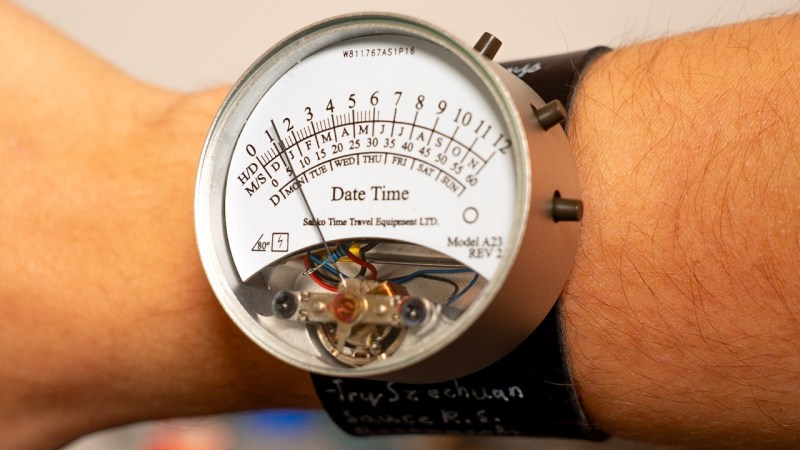
Most conventional analog watches have two or three hands, covering hours, minutes, and seconds (where present). [Sahko] has built a different kind of analog watch that creatively displays the time with just one.
The build is based around a simple analog coil meter, which, at its heart, just sweeps its needle across a scale based on the voltage input to the device. A Raspberry Pi Pico is employed to drive the meter through a digital-to-analog converter. Pressing the buttons on the outside of the device tells the watch to display hours, minutes/seconds, or the current month or day of the week. With a single needle, only one parameter can be displayed at a time, but that’s just a compromise you accept for having a cool unique analog dial watch.
Another cool touch in the design is that the dial backer isn’t just a printed piece of paper—it’s a custom PCB, which has a much nicer, hardier finish. The case of the watch is also CNC milled out of aluminum and bead blasted for a quality surface finish, adding a nice industrial touch to the build.
This is a great example of a custom watch with quality fit and finish. The attention to detail really pays off in terms of feel. We’ve seen other watch projects use similar construction techniques before, too.












not enough unnecessary brass fittings. it’s as if the 19th Century never even happened
Analog measuring instruments serve the purpose of displaying analog measured values much better—in the classic manner.
The display of values such as seconds or hours—without the countless intermediate increments—should be left to digital displays.
Yet another pointless attempt to grab attention.
You must be fun at parties.
Who hurt you?
back in 2006, early in the days of Arduino, before cheap LCD digital displays, I had my solar sufficiency control display a series of values using an analog meter like this. various LEDs were illuminated, and with each one, the meter showed a different value. this worked very well and I was quite proud of it at the time. but, overall, once I got a cheap 20 by 4 LCD display (that even permitted a scrolling configuration-changing UI) things were decidedly better
“The display of values such as seconds or hours—without the countless intermediate increments—should be left to digital displays.”
Dial wrist watches on the other hand (pun poorly intended) show as much increments as quartz mechanism allow them and it seems fine.
Huh ?
Before watches were digital, they were analog instruments lol. Your comment is a pointless attempt to grab attention.
This is hackaday, sir, not reddit.
Does it fit under a shirt cuff?
A standard mechanical watch is already an analog meter watch, as were all clock towers. On the other hand, I owned one of Seiko’s first chronograph quartz watches, that kept within 2 seconds per day.
Doesn’t the escapement count as digital?
I think the idea themself is not bad! Perhaps a little bit better with two coil meter so one can show minute and other one the hour. However a watch with RP2040? The RP2040 themself is not bad, I used it myself from time to time, but it is realy ugly when it comes to low power! And external flash uses boardspace. And with a good low power microcontroller the battery can be much smaller. So it is possible to made the housing 50-70% smaller.
So I think he should made a version 2.0 .-)
there are dual-display analog meters! Usually they’re for showing the interaction between two parameters with a LUT printed on the face (ex, Temperature/Humidity, with a Humidex chart) , and you read at the crossing of the two needles -> https: thedxshop.com/product/dual-needle-power-swr-meter/
Is it shock resistant😁
You were powerless to resist making that comment, weren’t you
@the dumb bad ass Cuvtixo Daniels
I demand that you retract your insult.
You have responded in a manner to be expected from people who are unable to put forward any sound arguments—or indeed any arguments at all—regarding the matter at hand.
Instead, they resort to attacking the individual on a personal level.
I’m assuming this isn’t satire (if it is then it’s pretty subtle). If not, then pot calls kettle black! Calling someone a “dumb bad ass” just before accusing them of personally attacking you is such a thin skinned response especially considering he only dryly implied you are too uptight (you’ve already proved his point multiple times by now with your original comment and this reply)!
Also no one cares about your retraction demands, welcome to the internet.
I can imagine using a cross needle meter for this. Pointing hours and minutes, or doing something “smart” at the point where the needles cross.
(But that type of meter might be to big for a wearable.)