
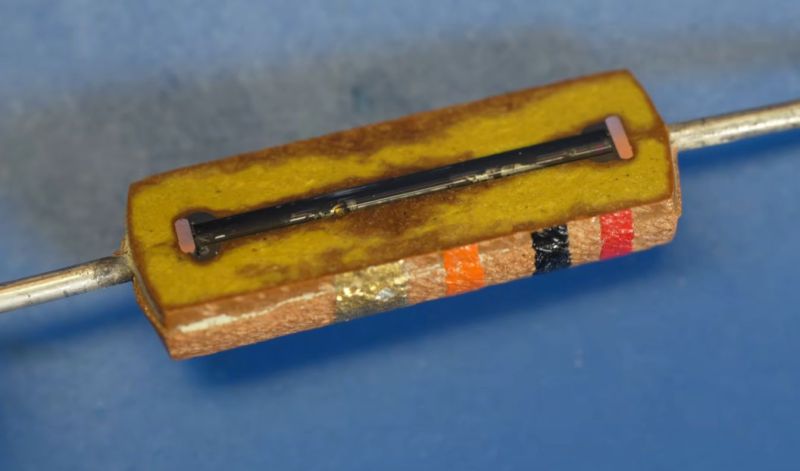
Although resistors are hardly among the most exciting components, they are arguably one of the most important ones, as anyone who has done any amount of circuit design and debugging can attest to. So too with a single carbon resistor in a vintage Metrix oscilloscope that [CuriousMarc] recently repaired. After recapping the board there was still a major issue that got traced down to said resistor. After replacing it with a fresh resistor obviously this meant doing an autopsy to see why the old resistor had failed.
The 20 kOhm-rated resistor looked fine on the outside, with no obvious damage or discoloration, but it measured around 0.843 MOhm. To get to the insides [CuriousMarc] asked his friend [TubeTime] on how to proceed. The answer here was sandpaper and a lot of patience, and thus the experiment to see how much sanding it takes to get to the core of a fairly big resistor commenced.
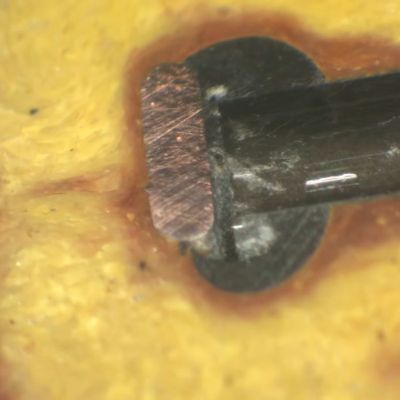
Ultimately the insides were revealed, and they turned out to be rather interesting, with what looked like a glass tube filled with what would be the carbon-laden material between the two lead terminals. From poking around a bit at these insides it would appear that the failure mode was a degraded contact between these terminals and the carbon material. Considering that this resistor is many decades old and has gone through many thermal cycles and potentially various kinetic events some fractures are probably to be expected.
Perhaps most fascinating is the construction of this carbon resistor that looks to be a step above that of the average carbon resistor that [TubeTime] has taken apart over the years.












It’s amazing that the crimp lasts as long as it does. Protected well till crud grows up the lead and into the encapsulation. Those OEM wirewound resistors on brown flat stock and wrapped in insulating stuff then tapped and terminals crimped on stuffed slim metal and riveted to the chassis always have a bad connection. Typically in tube B plus supplies, they’ll kill the power to something.
One, Two, Three Hundred licks to get the the center of a carbon Tootsie pop.
Thanks, Mr. Owl!
Wow, I thought I was the only wierdo that sands electronics apart like that. I want that book it justifies many of my motivations to microscope stuff apart like that.. Very cool!
For you frank: https://archive.org/details/open-circuits/
A must-see in my view, really neat and interesting.
This is a new type to me. Circa 1970, carbon resistors came in 2 types, carbon composition and carbon film. Carbon composition resistors had leads embedded in the carbon-containing resistive material, which was molded into a non-conductive cylinder. Nothing was impermeable to water, which made the value of the resistor sensitive to humidity. The glass tube of the resistor investigated here appears to be a technique to prevent the water problem.