
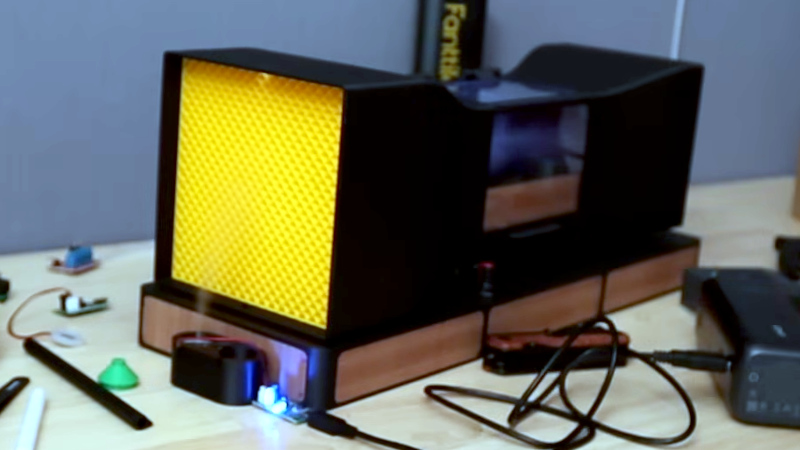
While most of us don’t design aircraft or racing cars, it’s likely that we’re still fascinated by some of the aerodynamic studies behind them. But a full-sized wind tunnel is going to cost a small fortune, so how can we experiment? Never fear, because [luisengineering] is here with a 3D printable desktop wind tunnel.
There’s a build video that we’ve embedded below, and if you can sit through the continuous shilling of random tools, it’s an interesting watch. It’s an open design in that air is not recirculate through it, instead it passed through the machine from left to right. On the right is the fan, on the left the intake with a rectifier to ensure laminar flow. Then a constriction compresses and speeds up the air past the stage for the model under test, and an expansion slows it down again for the fan.
A wind tunnel needs a smoke generator to easily spot turbulence, and in this case a vape is called into action. The result is surprisingly effective, as we see with a demonstration using a small model car. Meanwhile if you’re interested in wind tunnels at this size, it’s not the first one we’ve brought you.












That felt more like a video that’s trying to sell me a whole bunch of tools, rather than a video about a wind tunnel. On the other hand, it did lead me to discover particle image velocimetry (PIV) – using a laser sheet, fast camera to track particle movement to understand turbulent flow. That led me to Laskin nozzle seeders which generate suitable particles for use with PIV.
Not going to try to build my own though, even though it might be a fun challenge.
That’s what YouTube was for the last 15 years, though recently it really accelerated towards becoming an online shopping channel. What’s old is new again.
jezus what a commercial. There used to be less product placement even on cable TV. Wtf haha
I’ll just point out that the Wright Brothers did OK with a lot less. :-)
https://www.wright-brothers.org/Adventure_Wing/Hangar/1901_Wind_Tunnel/1901_Wind_Tunnel.htm
The Estes model-rocketry-hobbyist magazine — whose name, alas, I forget — published plans for a bench top wind tunnel to test designs and construction 50 years ago. (Gods, it feels odd to write that phrase.) Their version used a honeycomb of cardboard tubes to break up and mostly cancel out the rotational turbulence created by the fan.
Wasn’t it more like 60 years ago? I recall reading that report during my first stint with model rocketry, say 1967-1969… Wait, search shows it’s TR-5, published 1961.
Here’s a link:
https://www.modelrockets.nl/downloads/educatie/download/TR-5%20Building%20a%20Windtunnel.pdf
My dad was a wholesaler for Estes (and other hobby products) when I was growing up. My brother and I were into model rockets and I never even knew they put out Technical Reports. This looks pretty easy to make. Thanks for finding it.
This is pretty neat! Now I’m craving a desktop model that magnetically levitates the model in the chamber. I just read an article about tests being done in a maglev-enabled wind tunnel at a larger scale to detect whether very specific roughness of a surface can reduce drag – which apparently it can.