A Failed SwitchBot Plug Mini And Cooking Electrolytics

Poorly designed PCBs and enclosures that slowly cook the electrolytic capacitors within are a common failure scenario in general, but they seem especially prevalent in so-called Internet-of-Things devices. The SwitchBot Plug Mini that [Denki Otaku] took a look at after many reports of them failing is one such example.

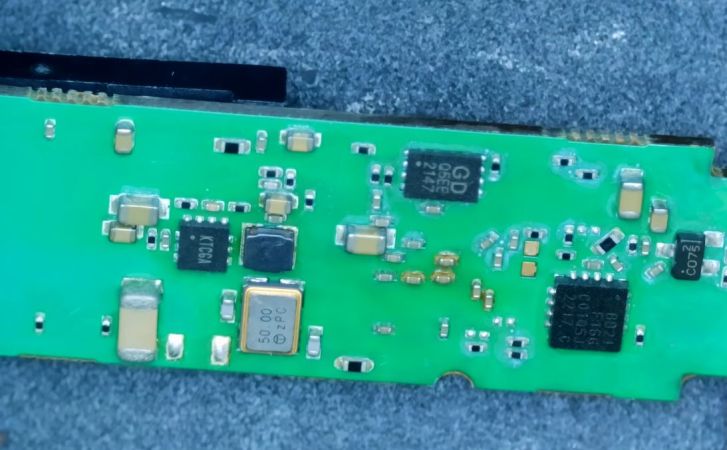
The location of the failed electrolytic cap in the SwitchBot Plug Mini. (Credit: Denki Otaku, YouTube)

These Mini Plugs are ‘smart’ plugs that fit into a regular outlet and then allow you to control them remotely, albeit not integrated into a wall or such like the Shelly 2.5 smart relay that also began dying in droves. Yet whereas with the Shelly relays this always seemed to take a few years to show up, generally in the form of WiFi connectivity issues, these SwitchBot plugs sometimes failed within weeks or start constantly switching the relay on and off.

After SwitchBot started an exchange program for these plugs, [Denki Otaku] decided to examine these failed devices from affected users. Inside a dead unit the secondary side’s 680 µF capacitor was clearly bulging and had cooked off its electrolyte as a teardown of a dead capacitor confirmed. After replacing this one capacitor a formerly unresponsive plug sprung back to life.

Continue reading “A Failed SwitchBot Plug Mini And Cooking Electrolytics”

White LED Turning Purple: Analyzing A Phosphor Failure

White LED bulbs are commonplace in households by now, mostly due to their low power usage and high reliability. Crank up the light output enough and you do however get high temperatures and corresponding interesting failure modes. An example is the one demonstrated by the [electronupdate] channel on YouTube with a Philips MR16 LED spot that had developed a distinct purple light output.

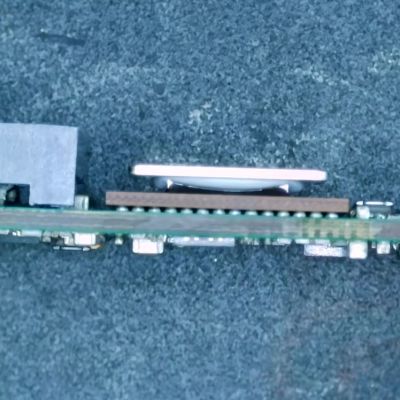
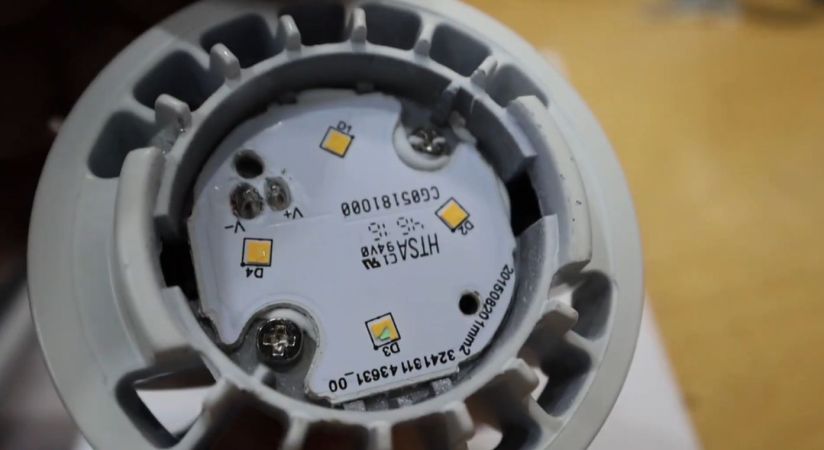
The crumbling phosphor coating on top of the now exposed LEDs. (Credit: electronupdate, YouTube)

After popping off the front to expose the PCB with the LED packages, the fault seemed to be due to the phosphor on one of the four LEDs flaking off, exposing the individual 405 nm LEDs underneath. Generally, white LEDs are just UV or 405 nm (‘blue’) LEDs that have a phosphor coating on top that converts the emitted wavelength into broad band visible (white) or another specific wavelength, so this failure mode makes perfect sense.

After putting the PCB under a microscope and having a look at the failed and the other LED packages the crumbled phosphor on not just the one package became obvious, as the remaining three showed clear cracks in the phosphor coating. Whether due to the heat in these high-intensity spot lamps or just age, clearly over time these white LED packages become just bare LEDs without the phosphor coating. Ideally you could dab on some fresh phosphor, but likely the fix is to replace these LED packages every few years until the power supply in the bulb gives up the ghost.

Continue reading “White LED Turning Purple: Analyzing A Phosphor Failure”

Fault Analysis Of A 120W Anker GaNPrime Charger

Taking a break from his usual prodding at suspicious AliExpress USB chargers, [DiodeGoneWild] recently had a gander at what used to be a good USB charger.

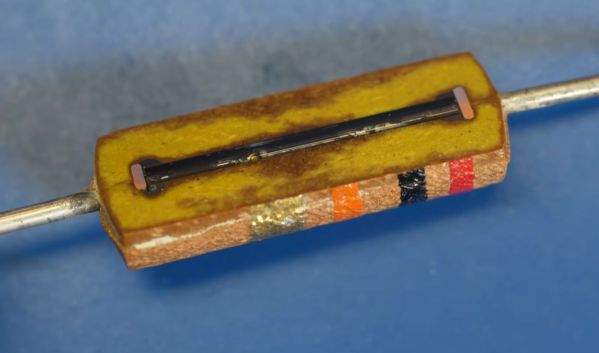
The Anker 737 USB charger prior to its autopsy. (Credit: DiodeGoneWild, YouTube)
The Anker 737 USB charger prior to its autopsy.

Before it went completely dead, the Anker 737 GaNPrime USB charger which a viewer sent him was capable of up to 120 Watts combined across its two USB-C and one USB-A outputs. Naturally the charger’s enclosure couldn’t be opened non-destructively, and it turned out to have (soft) potting compound filling up the voids, making it a treat to diagnose. Suffice it to say that these devices are not designed to be repaired.

With it being an autopsy, the unit got broken down into the individual PCBs, with a short detected that eventually got traced down to an IC marked ‘SW3536’, which is one of the ICs that communicates with the connected USB device to negotiate the voltage. With the one IC having shorted, it appears that it rendered the entire charger into an expensive paperweight.

Since the charger was already in pieces, the rest of the circuit and its ICs were also analyzed. Here the gallium nitride (GaN) part was found in the Navitas GaNFast NV6136A FET with integrated gate driver, along with an Infineon CoolGaN IGI60F1414A1L integrated power stage. Unfortunately all of the cool technology was rendered useless by one component developing a short, even if it made for a fascinating look inside one of these very chonky USB chargers.

Continue reading “Fault Analysis Of A 120W Anker GaNPrime Charger”

Publish Or Perish: The Sad Genius Of Ignaz Semmelweis

Of all the lessons that life hands us, one of the toughest is that you can be right about something but still come up holding the smelly end of the stick. Typically this is learned early in life, but far too many of us avoid this harsh truth well into adulthood. And in those cases where being right is literally a matter of life or death, it’s even more difficult to learn that lesson.

For Ignaz Semmelweis, a Hungarian physician-scientist in the mid-19th century, failure to learn that being right is attended by certain responsibilities had a very high cost. Ironically it would also save the lives of countless women with a revolutionary discovery that seems so simple today as to be self-obvious: that a doctor should wash his hands before seeing patients.

Continue reading “Publish Or Perish: The Sad Genius Of Ignaz Semmelweis”

Interesting Switch Autopsy

We put a lot of trust into some amazingly cheap components, sometimes that trust is very undeserved. Long gone are the days when every electronic component was a beautifully constructed precision lab instrument.  As [Rupert Hirst] shows, this can be a hard lesson to learn for even the biggest companies.

[Rupert]’s Nexus 5 was suffering from a well known reboot issue. He traced it to the phone’s power switch. It was always shorting to ground, even though it clicked like it was supposed to.

He desoldered the switch and pried the delicate sheet metal casing apart. Inside were four components. A soft membrane with a hard nub on the bottom, presumably engineered to give the switch that quality feeling. Next were two metal buckles that produced the click and made contact with the circuit board, which is the final component.

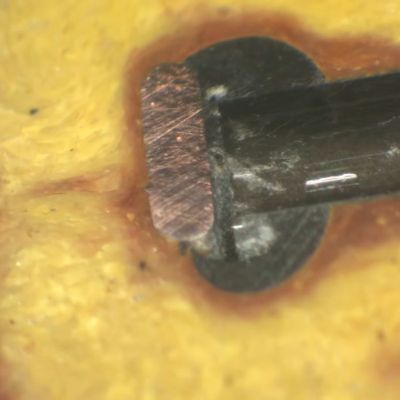
He noticed something odd and  busted out his USB microscope. The company had placed a blob of solder on the bottom buckle. We think this is because steel on copper contact would lead to premature failure of the substrate, especially with the high impact involved during each switching event.

The fault lay in the imprecise placement of the solder blob. If it had been perfectly in the middle, and likely many phones that never showed the issue had it there, the issue would have never shown up. Since it was off-center, the impact of each switching event slowly deposited thin layers of solder onto the copper and fiberglass. Finally it built up enough to completely short the switch.

Interestingly, this exact problem shows up across different phone manufacturers, somewhere there’s a switch company with a killer sales team out there.