
Once upon a time, computing was simple. You had files on a floppy disk. If you wanted to take them to a different computer, you ejected the disk from one machine and put it in another. It wasn’t fast, but it was easy and intuitive. Besides, you probably only had one computer of your own, anyway.
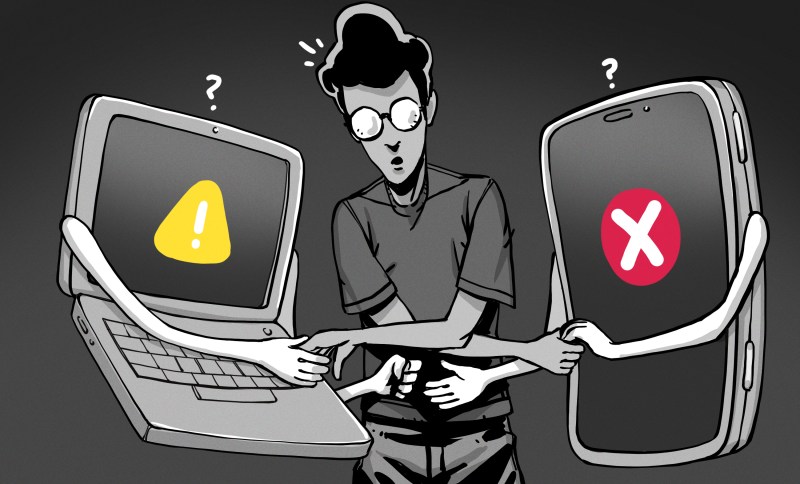
Life has since gotten a lot more complex. You’ve got a desktop, a laptop, a work laptop, your personal and business phones, and a smart watch to boot. You live amongst a swirling maelstrom of terabytes of data. Despite all the technical advances that got you here, it’s still a pain to get a file from one device to another, even when they’re sitting on the same desk. Why?!
This Modern Glitch
Our computers are actually very good at connecting to each other. We have Ethernet devices with auto-negotiation, WiFi and Bluetooth in just about everything, and DHCP for good measure. It’s easy to get devices on the network and online. One might think all this connectivity would make sharing data easy. But we’re not so lucky.
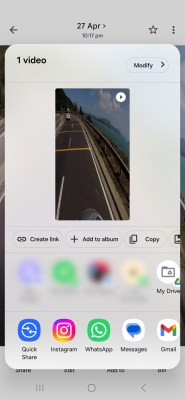
Let’s take a straightforward example. Just getting a JPG off a smartphone requires jumping several hurdles and a little bit of begging to the benevolent tech gods. You can plug your phone in via USB to grab files, assuming you’ve got an Android, but you’ll have to flick through menus multiple times to get it to shift into the right mode to get files off. An iPhone will allow the same but you’ll need an app to help “import” them.
You could alternatively try sending them via Bluetooth, but you’ll have to go through the hassle of pairing, which almost never works first time. You’ll also get glacial transfer speeds and watching the process fail a few times. Alternatively you might see if your phone comes with a proprietary app for transfers, or you could try waiting to sync files to a cloud service or just emailing them to yourself. The latter method will make a mess of your inbox, but at least you get the files across when you need them.
It Was Not Ever Thus
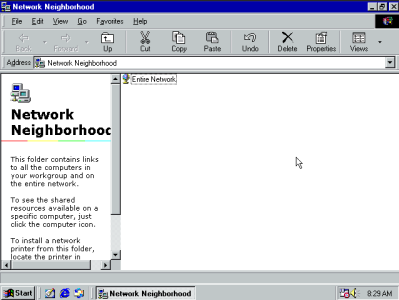
It wasn’t always like this. Jump back a quarter century, and things looked very different. Windows 9x had a massive install base, with Windows XP just bursting on to the scene. You could still sneakernet stuff around with floppy disks if you wanted, of course. But it was also a cinch to set up simple network shares to access files across machines on a home network. It just worked.
Much the same was true of the Macintosh ecosystem. Back then, smartphones weren’t a thing, and few of us were carrying any sort of device with any real amount of data. Things like digital cameras and MP3 players would soon rise to prominence, but getting files on and off them was a dream—simply plug in, and they’d present as a USB mass storage device. No drivers, no passwords, no bloated apps. Just peace.
Of course, that would all change a few years down the line. Take the Windows world as an example. Network shares still exist, and you can set them up if that’s what you really want. Unfortunately, though, they’re so much worse than they used to be at the turn of the century. They’re buried under layers of permissions and user account nonsense that makes enabling them absolutely arcane. Only some of us run multi-user logins on individual machines, even fewer of us choose to run domain-style networks in our homes. In contrast, a lot of us would like it to be easy to pull a few files off the loungeroom computer when needed. However, doing so requires navigating passwords and accounts and setting permissions and if you get the slightest bit of it wrong, you won’t even see the shared files, let alone be able to access them. A task that used to take 3 minutes of setup now takes half an hour or more and a couple trips to Knowledgebase.
It shouldn’t be like this. One can imagine a world where all our devices in the home are allowed to share files openly and freely. Imagine if you could just click into the network tab on your PC, and see everything across all your devices – your laptops, your phones, your desktops and lab machines. Imagine not having to pair your phone or fiddle with utilities or special sharing tools or, god forbid, sending files all the way to the cloud just to move them three feet across your desk. Imagine this, all your files across all your machines at the click of a button, no auth, no nonsense, whether Apple, Windows, or Android. You already have all these devices talking on the same network, so all your stuff should just be there!
Alas, we cannot have such nice things. It’s not just because Big Tech is full of mean people that want to make life worse than it used to be, but it can feel that way sometimes. Instead, it’s more because of boring, sad, practicalities that are difficult to overcome. Security is perhaps the biggest headline issue in this regard. We now use our personal computers to store more private and confidential data than ever.. This makes access control paramount to avoid bad actors getting access to compromising information. There’s also the need to prevent the easy spread of viruses, which becomes very difficult when there’s a permissive file sharing route between devices. Malware has often taken advantage of holes in network sharing protocols as a vector for infection.
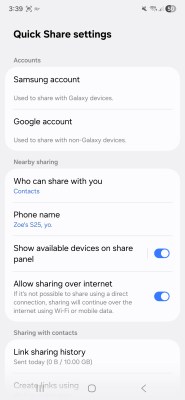
Beyond this, there’s the simple problem of interoperability. There isn’t a uniform standard that would allow easy, secure file sharing across laptops, desktops, and smartphones of all makes and models. This would require a large number of different tech companies to all get together, define a solution, and agree to implement it going forward. Sadly, current thinking seems to be that the proprietary solutions we have today are “good enough.” Apple’s AirDrop or Samsung’s Quick Share will get you by if you stay in the right walled garden, for example, and neither cares much to start a dialogue to establish something better and more cross-platform. Few tech companies would be excited about opening up potential security holes by implementing a new broadly-accessible file sharing protocol, either.
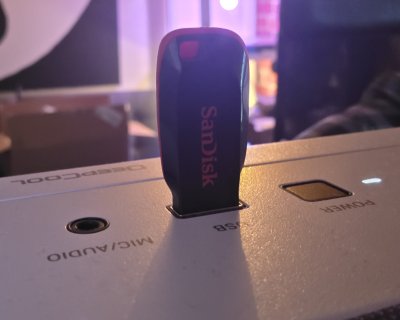
Perhaps a metaphor best explains the misery we find ourselves in today. If you live in a safe town with low crime, you might not feel the need to lock your car doors when you pop down to the supermarket. It means you can get in and out of your car without fishing for your keys, which is a great convenience when you’re carrying a bunch of heavy grocery bags. At the same time, you can’t live like this in a nastier place. Bad actors will simply open your door, rifle through your car, and take anything they like. That could end badly for you.
Unfortunately, cyberspace is that nasty place. By and large, we can’t just freely share files between devices because it’s too dangerous to do so. You don’t want your bank accounts drained, or your personal photos used for blackmail, so we have to drench everything in layers of authentication, even in the privacy of our own homes. Perhaps one day there will be some framework that allows us to create a close-knit network of “trusted” devices so we can freely move data about our own protected little bubble. But until then, we’ll have to suffer with Bluetooth passcodes and proprietary apps and the fact that it’s usually quicker to email a friend a photo then to find a way to directly transfer it to their phone which is sitting right next to you. It’s an annoying problem, and one that will not easily be solved.












The author seems to have a very rose-tinted memory of 90’s windows networking, which was in fact a nightmare most of the time. The average person will have more success today, especially as they can search the web for solutions rather than having to actually know anything about it
What about USB4STREAM?? (https://www.phoronix.com/news/Intel-Linux-USB4STREAM)
Sneakernet is underrated. Wasn’t there a Supercon talk about a transport truck filled with digital books delivered somewhere? Might have been a Google tech talk. But it was faster than than sending them over the Internet.
“Never underestimate the bandwidth of a freight train full of disks.”
I find that I no longer spend a log if time moving data between machines. Stuff I may use multiple places usually stays on (or has its master copy on) a shared server or is being explicitly transmitted/synchronized from one box to another without my attention. Most other tasks still have just one device using them at a time. Occasional manual transfer via sftp when I really need to move something.
Is the main issue one of difficulties moving data, or of assuming data location needs to be managed?
Back in my day we had to walk to school uphill, both ways, in a blinding cold blizzard, in summer. :)
The easiest and most universal protocol for transferring information is ASCII.
Every computer and phone understands it, and when you get right down to it, ASCII is just 8 bits from 00000000 to 11111111. That’s what all these protocols etc. break down to if you think about it.
My favorite DOS program was Telemate. That program did a wonderful job of transferring files over
a modem connection. Good old ZModem. You’d call a BBS, find the tile you want, and download it.
No fancy bluetooth or worrying about what protocols were compatible. For chatting in real time aside
from the big networks like Compuserve, there was D-Dial written for the Apple //e by a mad genius.
Look that one up. Chat in real time. There are still die-hards like me that use it.
Every system be it a Commodore 64, Commodore 128, Apple //e, Tandy TRS-80 etc. have two things in common. An understanding of ASCII, and the ability to store files on magnetic or flash media.
These two things are what make file transfers between different systems possible.
Nowadays, most if not all of us are using a PC to communicate. The fact you’re reading this on a
screen shows that broken down to as basic a form as possible, ASCII is indeed the purest form of information transfer between computers, no hardware compatibility issues etc.
ASCII makes is so we don’t have to know binary. And on that note…. 01100010 01111001 01100101.
Cloud desktops have been a game-changer for distributed teams. The consistency in performance and security compliance is worth the switch alone.
Great post.
I think we’ve spent years optimizing cloud storage, but not enough time optimizing “right now” sharing.
A large percentage of transfers are temporary—links, terminal commands, screenshots, PDFs, or snippets of text. Those interactions shouldn’t require accounts, uploads, or extra friction.
That’s the problem I’ve been trying to solve with Textunnel (https://textunnel.com).