
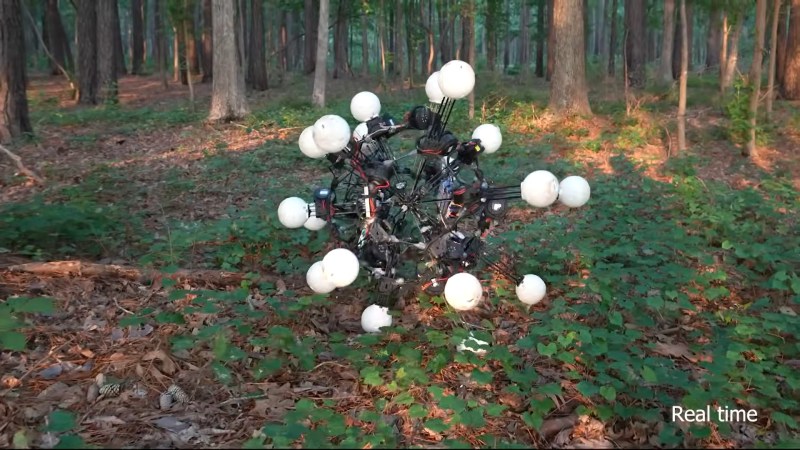
If you were making a multi-limbed symmetric nightmare of a robot, where else would you look for a name but Greek Mythology? The team at Duke University that came up with this particular multi-limbed creature had two obvious choices: name it for one of the Hundred-Handed giants, the Hecatoncheires, or lean on the fact that each limb has its own sensor and go for many-eyed Argus. Argus sounds better to a funding committee, so Argus it is.
Hecatoncheries would be a bit of a reach anyway, considering Argus only has 20 limbs in its current incarnation. It uses what the researchers are calling its ‘dynamic symmetry’ to get around– extending and retracting its many limbs to exert forces in any direction, it can bounce about like a beach ball on a windy day.
At least in the embedded demo video, it seems to work surprisingly well. If you want to try it for yourself but don’t have a robot-building research grant, you’re in luck. The team at Duke has an open-source simulator available on GitHub so you can explore the concept, including trying variants with more and fewer legs than the 20-limbed unit featured here. Given that it works with only a dozen effectors, you can imagine the Argus we see has a certain degree of redundancy, something funder DARPA is doubtless keen on.
It is an oddball idea, and something we might imagine seeing in Star Wars, but it’s obviously got its pluses. We can’t really imagine any of the humanoid robots we’ve seen doing parkour like this thing. Somehow it’s less creepy than the robot dogs that are becoming common — along with being security risks.












Did Argus just come out of the pub?
I love it!
But If I were an alien and this landed on my planet, I would kill it with fire. :)
Unless of course it actually looks like me, which lies entirely within the real of possibilities of forms of alien life. :D
Way ahead of you
https://www.bbc.com/news/uk-scotland-50262655
Awesome!
I grew up in the north of Scotland and was friends with the local bobby as a kid in the ’80s. He give me a copy of the official police form for reporting UFO sightings.
What’s a bobby? I assume it kinda means police officer or sheriff
Yes, regional slang for police officer.
It did make me think of the Beach Ball Alien from Dark Star.
thankfully there was no tlking bomb
Very cool, this might be the next most useful, or at least most mobile robots around. I wonder if its possible to make them much, much smaller. Also all the data from 20+ cameras/lidar sensors must be difficult to process without an FPGA.
I wish we could go back to the time where we didn’t care about quadruped and humanoids, and instead the tank track robots and fixed robots that weld and stuff.
Lets be honest, quadruped and humanoid robots are a dead end. No one uses them for anything more than photo ops, and scamming gullible investors. Because guess what, organic inspired robot shapes only work when you have the budget to add enough actuators to match what organics have.
Your posts are consistently ill-considered.
Humanoid robots are not a dead end. Humanoid robots can fit in the spaces humans can fit into, and use tools and equipment that humans use, because we made this environment to suit us. It’s useful to explore other forms, but the humanoid form is probably the most versatile in a human-centric world.
Humain robots for our spaces only works with software we don’t have yet.
And also cost; guess why we don’t use underwater-snake-robots for exploration? Because one actuator more is expensive and a liability, while in nature one spine bone more is basically free.
That might be true, but robots built for a specific purpose will always be cheaper and better at what they do.
A human can run and swim, but people will never be as good swimmers as aquatic animals or as fast runners as animals that evolved to be great at running. We don’t need multipurpose robots, robots that are good at their job are good enough. This obsession some people have with bringing every stupid sci-fi idea to life is ridiculous.
I agree, it’s a dead end. (Just like thinking LLMs are taking AGI research any further. It’s another dead end that just makes certain people richer, because some people will believe anything)
I think you’re confusing human versatility as something that must be replicated when purpose specific robots are made. Do you know why those welder robots in car factories are basically shaped like arms with welding equipment built in, instead of a human hand that can hold a human welding torch? Its because purpose built, specialised equipment is better than jack-of-all-trades
I have seen robots with wheels serving food and things in restaurants and hotels. I have never seen a robot dog or humanoid doing anything useful in the wild. Just saying.
Robot dogs were used to create 3D model of Chornobyl NPP after the 1986 incident. They reach places like Elephant Foot because normal robots break from radiation.
You could name one. Meanwhile robot welders, drones, and wheeled robots are working in places right now as well speak. I get your point, but you must remember humanoid robots were dreamt of in the early 1900s science fiction, and almost a hundred years later they are still being researched upon and not in active production and use. Within this time other kinds of robots have went from being science fiction to bring actual mass deployed products. Drones doing actual work, industrial robots making things, medical robots assisting in surgeries etc etc
Tell me, if you had to transport things by air would you build a humanoid robots and have him fly an aircraft while sitting on the cockpit? Or would you build a UAV style drone? Human limitations do not mean we have to make the robot “do it our way”. They have better ways of doing things
The “dead end” statement isn’t literal, it’s a colloquialism. Do not take it literally. We will likely have mass produced humanoid robots doing our bidding in a few decades of a century. Just not anytime soon.
A perfected purpose built robot fills one niche.
A perfected humanoid robot will eventually be capable of filing any niche a human worker could fill.
Economy of scale then allows the factory churning out a single model of robot capable of doing a wide array of jobs at lower and lower prices.
Purpose built specialized systems arent better than jack of all trade systems. They are just easier to accomplish.
You not having seen humanoid robots doing useful things all over the place doesnt mean they are useless, it simply means they havent reached the point of development and adoption that other simpler systems have.
…for a certain definition of “eventually”. Not all curves approach infinity. It may reach an asymptote and keep approaching but never surpassing that asymptote. If you want a humanoid robot that can do any task a human can do, you are attempting to create a human. Is that something to strive for? Depending on your worldview, maybe. Is that something that is feasible? Not right now. Not in 50 years. Maybe in 150 you could get something that does the job briefly before running out of power or wearing out. The issue you will consistently run into boils down to “biology is a more advanced technology than robotics”. Until we can create a form of nanotechnology which approaches the space-complexity and ease of manufacture of cellular life we cannot produce more than clumsy imitations which may be useful for specific tasks (easier to put lead shielding on a robot for example) but pale in comparison to the longevity and versatility of a human. Look at each as a black box, robot and human. What percentage of global industrial capacity does it take a make one robot with capabilities approximating a human? What percentage of global industrial capacity does it take to make one human? How long does each last? What is the duty cycle they can each perform at? The economics just don’t make sense, let alone the technology.
I’ve run out of reply depth, so I’ll reply to your UAV point here, although you’ve basically made my point for me. Yes, I could build a UAV. Or I could get a humanoid robot to fly a plane that already exists. Then, when the plane lands, my humanoid pilot can do other stuff. The UAV sits there, waiting (or maybe it blew itself up because it was a missile).
As always “it depends”, but it was you who claimed that humanoid robots were a dead end.
It would cost you less to make a UAV without a cockpit. Only a few actuators. What is the point of having expensive humanoid robots? The flexibility sounds cool and futuristic but its silly. Why not have a dozen cheaper non humanoid robots? Even if you mass produce said humanoid robots, economies of scale can’t make a super complex general purpose robot cost less than purpose built robots. Its just not possible.
There is a reason why we have CPUs, GPUs and NPUs, instead of just CPUs. A swiss army knife is not a great knife or a great pair of scissors. Its only barely adequate at doing these things while costing more. If you have to do mining, you don’t build an army of humanoid robots and give them pickaxes, you instead build a massive robot with a rock crusher, and a large conveyor belt.
Humans are terrible at many things. What is this obsession with trying to replicate that in robots? And I did say the “dead end” statement was a colloquialism, not literal. I think they are “dead ends” because they have received massive funding and research attention yet they don’t do much actual work at all.
This is very different to other types of robots which managed to deliver value and were productive even in their R&D phase. Hell, drones in the beginning were toys but before any major corporations took notice of them and began using them for deliveries, do you know who was using them for real work? Drug cartels. An evil use case for sure, but its real work that replaces people.
I remember a few years back i saw piezoelectric motors that would fit on a penny, imagine getting 20 or so of those running in a ball, you’d have a versatile sensing robot the size of a horse fly!
360º would be only a 2D slice of the full 3D spherical view it can achieve.
apparently instead of 360º a it should say 4π steradians
Incorrect.
360 degrees would still be 3d as the slice of the spherical view would include data from more than one point across the horizontal axis. Depending on lens geometry this slice could potentially include the entire 4π steradian.
180 x360degree fov would be the most accurate way to describe a 4π steradians system though after the 1/3 pounder burger fiasco marketing would rightfully recommend 360X360degree fov for the packaging and datasheets.
I find it really weird that the cameras are mounted in the ends of the moving effector balls, and not on the static surfaces of the pollyhedra. Each camera has a tiny viewing area, is constantly in motion, and spends a lot of time pressed up against a surface.
Seems intuitive to me that you’d have better vision from within the ball (even if you have to mask out your legs), particularly for SLAM tracking the moving environment. You may still want a few eye-legs, but… seems less practical to have more moving complexity.
I was thinking the same thing, eventually those camera holes are going to fill with mud.
But otherwise it’s a great idea, especially if they replaced all the white balls with hands. But then the creepy factor skyrockets.
That is potentially a huge selling point. Some people seek creepy.
Reminds me of YT’s skateboard wheels on Snow crash
Hiro’s motorcycle, too.
isn’t there a mobile bomb half-life 2 enemy that functions like this
Exactly what I thought, I hope they give it a speaker and those sound effects. I can’t forget those weird chirps and trills.
https://www.youtube.com/watch?v=nGcBwbuYjRk
It’s a great idea and not oddball at all IMO. The camera positions seem very wrong – could easily mount less cameras in fixed positions nearer the centre.
Hopefully they rethink the design to something more organic looking (or dare I say Cronenberg-ish) and then rename it to Mahobeco in homage to ‘Manmade Horrors Beyond Comprehension’?
More organic looking?
https://blog.unisr.it/en/structure-sars-cov-2
Umm….
Hear me out: we build a bunch of these at a 6-foot-ish scale and make them corona-looking but with more scary pizzazz, like some sort of decayed, diseased-filled patina.
Then we train them to become experts at climbing places really fast, followed by identifying people who still wear masks while driving alone to this day.
Slowly release them into the streets and make them follow those people around and climb out of sight every time the people turn to see if it was “real.”
These people are certainly Redditors, so they’ll inevitably flood the internet about it in their chronically online ways. It’ll go mainstream and the government will have to act.
The gov will catch one and analyze it. And that’s when the kicker hits: we “hide” data deep in the hardware “proving” it was funded by cyclists and vegans’ NGOs in a joint venture with Flock and other privacy-crushing companies, with the backend being held by Redditors and… BOOM!
The public outcry would be so loud that all surveillance cameras AND vegans AND cyclists AND Reddit would be forbidden to even exist.
Privacy restored and the most annoying people banned from life. Humanity is saved by a little trolling, boys.
You had me till you crapped on bicyclists. I don’t get that part. Bicyclists are certainly not more annoying than car drivers. The one takes less space on the road, makes less noise, makes no pollution, and improves human health. The other results in fat blobs that “roll coal” (pfft) and give everyone lung diseases while killing entire families in one mishap with their hundred mile-per-hour moving piles of steel and plastic . Your priorities are a little effed.
I’m all on board about the spying corps. Evangelical vegans also suck, but just being a vegan on your own is fine. The first rule of living free is letting others live free as long as no one is being hurt.
In the header photo it might be poison ivy, any ivy vine is bound to get entangled. De-con will be fun.
While it is blurry and hard to say for sure, these plants look to have spade shaped leaves and they seem to grow individually. Poison ivy has 3 almond shaped leaves per group. Conceptually, it would be funny if it were poison ivy, stick in the mud-ily, it’s probably not. ;)
(It looks similar to morning glory, but again, its blurry.)
I knew that but would you want to touch and maintain it if you didn’t know where it had been?
T is for trouble which rhymes with bubble, which is the distinct form of the leaf stems and then blisters. The side 2 are short stems but the center leaf will have a stem about 4 times longer, about the proportions of a capital T in most fonts. Three leaves leave me be, maybe. But that “T” always trumps it, do not touch!
Okay cool, but running that thing through the woods, grass and dirt isn’t fun any more at the end of the day, when it needs to be cleaned…
it’s just a toy
Argus! Pass me the wrench!
Um, Argus?
And I didn’t see it tackle stairs either!
https://cuttingsarchive.org/images/5/56/1981-05-08_Punch.jpg
I remember discussing this form of robot last year, https://x.com/DanielSMatthews/status/1981976028416450656/photo/1
Not exactly the same, but the core ideas are similar, so it is interesting to see how people are applying them. I still think that tentacles are better as they offer movement and manipulation capabilities.
Biblically accurate robot