
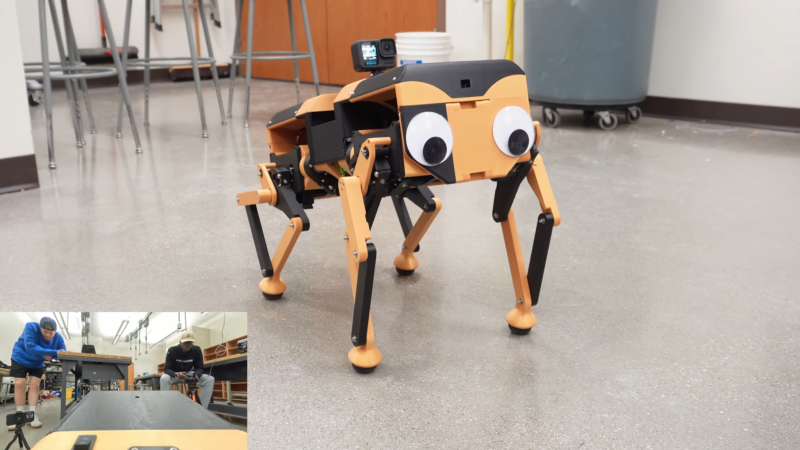
[Aaed Musa] has been building robot dogs for a long time now, so it was only natural that he would make one for the senior design project of his mechanical engineering degree. Since this meant working with potential customers, the requirements were somewhat more stringent than for previous dogs, but [Aaed] and his team were able to deliver CARA 2.0, their most agile, versatile robot yet.
Based on conversations with potential customers, [Aaed] and his team aimed for a price around $1,000 USD, a weight under 20 pounds, and a durable design. Like the original CARA, this used capstan drives to actuate the joints, which reduced costs. The drives were printed in resin and powered by brushless drone motors. These motors were designed for speed, not torque, so the team had to rewind them with more wire, an ordeal which paid off by roughly tripling the torque. As far as durability, one joint motor was tested by running it continuously back and forth, and it lasted for over 1,000 hours without obvious damage.
Since the joints don’t contain any absolute encoders, each motor has to home on startup by extending to its limit, as detected by a rise in motor current. As a happy side effect, this creates a lifelike stretching motion on startup. Compared to the earlier iteration, CARA 2.0 takes shorter, quicker steps, and thanks to angled step movements can turn much more quickly. In testing, it originally skewed to the left, which turned out to be due to an asymmetric leg design. Once corrected, CARA 2.0 could walk in straight lines, walk sideways, turn in place, crouch, jump, and keep its balance on an inclined surface. It didn’t quite make the price goal, but $1,450 is still cheap for such a capable robot dog, and it reached every other customer requirement. Most importantly, all the team graduated.
For another take on a capstan-powered robot dog, check out Stanley. We’ve also taken a look at TOPS, one of [Aaed]’s earlier designs.












What already was a supercool and smart project, keeps getting cooler. Nice job!
Not to take anything away from a wonderful achievement, I have to say that it looks more like an RC vehicle than a true robot. Isn’t that a controller being used in the lower left corner picture-in-picture?
If you watch some of the videos for “true robots”, those are often programmed to go through a set list of steps or moves. In the commercial robots, they often have an operator who controls directly (eg to find infrastructure failures), or who map out a fixed set of moves. Even the so-called ground-breaking robots that get news time. For utility work, the real gain is labor saving by finding the failure, taking advantage of IR or other sensors, without having to send a large and fragile human into hazards, or dedicate an expensive technically trained human to walking around with a measuring instrument before you can send a repair team.
Remote Control robots require direct human operation, programmed robots follow strict, pre-set routines, and autonomous robots independently make decisions based on sensor data.
A “teleoperated robot” is a widely recognized class of robot operated at a distance. Examples include surgical robots like the da Vinci or hazardous waste removers, which are undeniably robots despite being steered by humans.
Many remote-controlled robots possess low-level automation. For instance, the operator commands “move forward,” and the robot’s onboard system handles the stabilization or motor output.
Conversely, A vehicle is a machine or device designed to transport people or cargo, primarily on land, though it can also refer to air, water, or space transport. It acts as a means of conveyance. As there does not appear to be any sort of cargo carrying features and it certainly is not large enough to be ridden, Your certainly incorrect in calling it an RC Vehicle.
edit edit: no I got that right the first time. LMAO sorry Ive been up too long
damn it. I wish this site had delete if not edit.
Edit edit edit: YES Your to You’re. It was wrong I was wrong then right then wrong and now hopefully finally right.
I give up. Goodnight
I caught this on Youtube earlier, an amazing project and very well executed.
The only thing that bothers me are all the leg joints being in single-shear which I feel may be adding a lot of wobbliness to the platform that could be easily removed – making the legs out of something other than 3D printed materials would also make a lot of sense.