
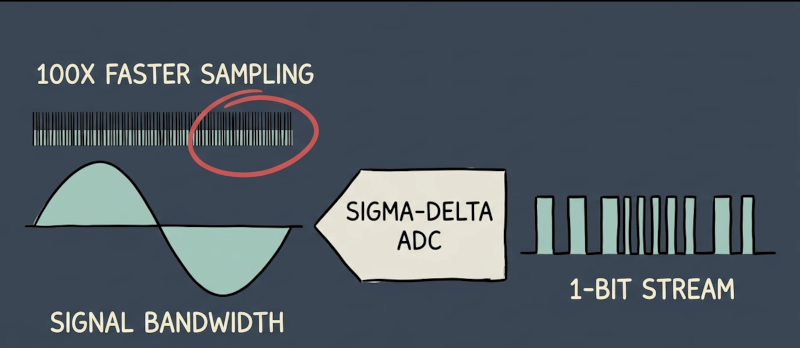
An old algebra teacher used to say, “You have to take what you know and use it to get what you don’t know.” You might say the same thing about converting analog signals into digital. Computers know how to count and keep time. [Eric Explains] has a video purporting to explain “every type of analog-to-digital converter.” We aren’t sure he got every possible method, but there’s still a lot of information in the video, which you can see below.
From the flash ADC, using a ton of comparators to the successive approximation converter, which essentially plays a game of hi/lo, guessing the answer and figuring out if the real answer is higher or lower.
Those are pretty common, but the video also covers things like the Wilkinson ADC and other more exotic techniques. Each method, of course, has its advantages and disadvantages. For example, the flash ADC is fast, but requires a lot of components and power.
Sometimes, the method you use depends on how you are building. For example, you probably wouldn’t use a charge system on a breadboard since precision capacitors are finicky. But on an integrated circuit, capacitors made with photolithography may not be very precise, but the ratio between capacitors is super precise, making that a common technique in that domain.
Even if you never need to design your own converter, understanding the different architectures will let you make a better selection among alternatives. Then again, you can design your own. We’ve seen most of these architectures in past projects.












ugh, the AI narration is brutal what with its mispronunciation of “live” in that high middlebrow British accent
I had to watch to find out what you mean. You are not wrong!
Also the strange mismatch between British accent and American numbers (“two hundred fifty five” vs “two hundred and fifty five”).
Skipping or including the ‘and’ in numbers is an American/Brittish thing?
I remember being taught to include the ‘and’ in my US elementary school. But… I wouldn’t even notice someone saying it either way. I feel both are common here although I have never actually done a study on it.. or even thought about it before now.
I didn’t even know how I said it until reading this. I slip in about the middle 1/3 of an “and”.
The text is the output of chatgpt too, the whole video is sloppy
The graphs and logic diagrams are all over the place too. They don’t match the thing being described.
So the Commodore analog joystick was done with a Wilkinson ADC. I recall being blown away by that idea. Run a counter while a capacitor discharges/discharges through a pot, stop at threshold. So ambiguous, so clever.
I’ve been in electronics for 50yrs, and never heard the name Wilkinson till today. That’s something we’d just call “single-slope”…
In fact, I independently invented this in high school, ca. 1979—interfacing joysticks to my computer. I’d like some credit please…
You are an intelligent and wonderful person.
I don’t know.
Have you learned to start in the library not the lab yet?
Wilkinson is kindof just the generic term for “charge to time + time to digital with a counter.” Dual slope ADCs are still referred to as dual-slope Wilkinson ADCs. You usually only hear the term in ADC design rather than in actual usage, though.
I discovered the cap charge method via Atari 2600 paddle controllers. I had no clue that the method had an actual name.
Just what we needed to see ….. more Ai generated slop disguised as “educational material”.
This got to be the first one which is fully generative AI build content on HAD, so that’s something. I hope it doesn’t become more common. As I would have watched it if it was a human who understands the subject explaining each ADC.
Watched the first few seconds and it was already baaaad:
* Signals coming out of the flash ADC are completely wrong
* “Words” made of jumbled nonsense letters in the diagrams.
A lot of the outputs are just the common simplistic stuff you would get from a 2-second read on Wikipedia, too – I mean, it’s AI slop, what do you expect, but still. Don’t watch this.
For instance, yes, obviously, no one makes completely flash ADCs above about 7 to 8 bits or so. Almost every place just says “it’s because there are too many comparators since they grow as 2^n and all the power and size would kill them”. Except think about it – flash ADCs showed up in the 60s and 70s. Transistor density is literally a million times higher, and switching power consumption is also lower as well. A factor of a million gains you a lot of powers of 2, so what gives?
It’s because the comparator growth fundamentally kills the advantage of flash ADCs, because your input signal now has much bigger capacitance from the fanout and it’s fundamentally slower. And the only reason to use a flash ADC is because you can sample fast. Lose that, and it’s a stupid way to do it. So the fundamental issue isn’t number of comparators or power, it’s that actually getting the signal to those comparators becomes the limiting factor.
Surely if you can afford the acreage of silicon for the comparators you can also afford to include a buffer amplifier to drive them?
Surely the smaller transistors also result in the capacitance being smallened?
This is a really bad video. Like most of the visuals are unintuitive. Riddled with typical AI errors like garbled words, images of Comparators with like 5 inputs, nonsensical connections and arrows and awfull pronunciation. “Eric” didn’t even try to make it look somewhat decent.
A shame as the topic itself of the many different ADCs does make a for a fun topic. It just deserves better than this AI Slop….
Pretty graphics awful AI narration
Please stop publish AI generated bullshit from deep stupid shitty dumb dummy retarded western morons. Your site still have a high reputation and no need to break down it with such nonsense that ALSO is factual incorrect.
This place?
High reputation?
LOL
It’s so far gone, you can get a video story on here for the change in your couch.
Not worth it, you’ll get 100 views if you’re lucky.
Much better deal on traffic from Indian click farmers.
I regularly use HD for bookmarking topix of interest – for exploring the rabbit holes of proper depths.
KGBook is, too full of such things. Reddit, too, at timez.
Excellent video, I didn’t know the tenth of this,
stop moaning about AI and enjoy the content (for which you didn’t pay a thing, nor went down to the library to search for)
Your research skills have officially hit zero……………………..NOW. Trouble with crap like this is one never knows what to believe. In shock this is on HaD.
I didn’t know the tenth of this,
You still don’t know any of it, because this is hallucinated slop. Maybe it’s right, maybe it’s not, but you can’t know!
If it’s paid by ads on youtube, everyone is paying because the money comes from the customers of the businesses that advertise on youtube.
If youtube is showing you ads of a supermarket chain that you use, congratulations, part of the cost of your food is going towards paying fake content and you can’t opt out.
I’ll be expecting HaD “articles” on “Eric’s” 77 other videos… Do I send them to the Tip Line??
Just get your favourite AI to generate the articles.
Stop complaining! This was obviously just a test from HaD to see if we were on the ball.
I didn’t watch the video but this reminded me of the importance of the ADC to my Ph.D. work. Apple II with a $1200 (1986) ADAlab card. Twelve-bit SA ADC, twenty bits per second! Primitive by today’s standards but after manually recording hundreds and hundreds of data points just two years earlier, it was pure heaven!
I’ve said it before, I’ll say it again. Hackaday needs a “Report article” button.
I recently ran across the claim that Hackaday is like the Tiktok of tech.
It made sense.
Al, are you OK or have you also been replaced by AI?
I want to explain the heuristic i used to learn this was AI slop with less effort than many of the upset commenters on this article.
I looked at the cover image on the youtube link, which was clearly xkcd, and then i looked at the name. Eric Explains is not a Randall Munroe brand. The way something in this day and age looks exactly like xkcd without being xkcd is by being AI slop. Slop. QED.
I didn’t even consider watching it.
Failed to include the creator’s surprise butt-sex face in the thumbnail, hard nope.
Also:
YouTube is a terrible format for getting technical information.
Why would anybody go there?
Better question…
Why would an objective search engine send people with technical questions there?
Why are they treating all humans like middle schoolers?
I mean assuming the search engine didn’t own YouTube…
In the universe where ‘objective’ is possible.
“YouTube is a terrible format for getting technical information.”
Is it?
https://youtu.be/_Pqfjer8-O4
For a professional cynic you could do better with your complaints.
Yes, it is terrible. The video format is slow, not indexed, not indexable, not searchable, not skimmable.
It’s good for harvesting non-discerning passive viewers as fodder for advertising revenue.
It’s a low-effort mediocre way to introduce a subject to naive consumers of content.
As a reference source for technical material, it’s terrible.
yes it is terrible. the book ‘the way things work’ is way better for that specific article for example.
I think Eric is all in on the AI content creation, script to slides to narration. His personal video also seems to have auto translate with lip adjustment, but badly, somehow.
It’s fake content.
It’s the same as the fake restoration videos or “watch these workers…” video channels, except now it’s completely automatically generated. This “Eric” guy also probably doesn’t exist.
I don’t see what you mean about xkcd style in the thumbnail. The diagrams and stick figures look at least as much like generic diagrams and stick figures as they do like xkcd diagrams and stick figures.
78 videos and the oldest was created 2 months ago. This guy’s fast.
Fake content click farm. It’s AI slop straight to video without fact checking.
The cyclic (recirculating remainder) ADC, and any other ADC relying on capacitors to store a varying voltage also suffer from dielectric absorption. Old conversions upset the ongoing conversion, and may cause nonlinearities.
Slop