
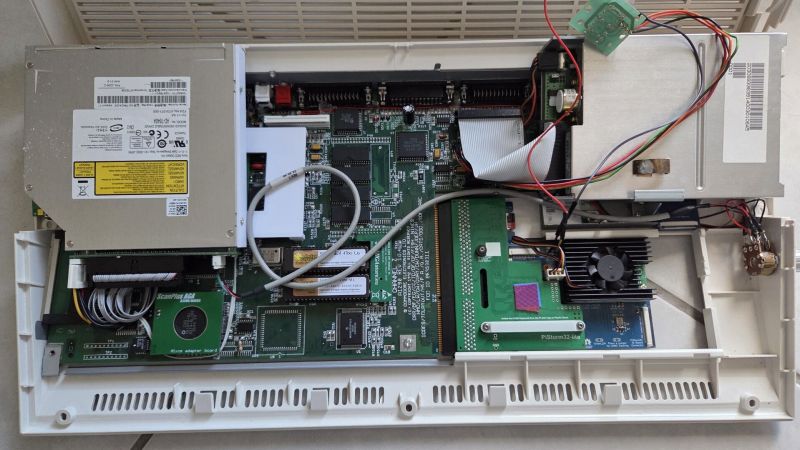
You know what they used to say– once you go Commodore, you’ll never leave by any door. Well, they might not have said that, but given the prevalence of projects still using Commodore-branded systems decades after the company’s demise, perhaps someone should have. A case in point is [Jit06] with this writeup on his Ultimate Amiga 1200 — or “Amiga 1232 Storm CD”– which crams just about every upgrade you might think of into the 1990s wedge computer.
Of course it has the PiStorm 32, with a CM4 providing supercomputer performance, at least by A1200 standards. That’s rather old hat, though, and it’s everything else crammed into the old Commodore that takes the score. For one thing, there’s a slot-loading, slim-form DVD drive from an old laptop that’s been incorporated so smoothly it almost looks factory. Ditto for the compact flash card slot, which is also on the IDE bus. The two share a custom IDE cable– yes, kids, we did used to roll our on 44-pin cables back in the day, but you’d better believe no one did it unless they really had to. With the space constraints inside the A1200 case, [Jit06] falls into that category.
The optical and CF cards trigger the drive LED on the Amiga case by default, but [Jit] wanted to see access on the PiStorm’s SD card as well, so he wired a couple of red LEDs to the default lightguide to get a colour-contrasting flash. That SD card is also broken out with an extender for easy access without opening the case– and once again, it looks almost as good as stock. So does the modded-on VGA port, which is stealing space that once belonged to the Amiga’s RF modulator and fed by a ScanPlus AGA board.
The only thing that really stands out as modded is the volume knob on the floppy-drive side of the case; that controls a mixer that sits between the CD audio and Paula, the Amiga’s custom sound chip. This lets him use the A1200 as a CD-32 system, and is very handy to have as CD-32 games used CD audio tracks that apparently were not well mixed with the digital audio in the games.
With all the cutting and soldering, this is not a reversible mod, something people are becoming much more concerned with as these machines slowly increase in rarity. Still, as a quality-of-life improvement, this sort of upgrade might be worth it if can keep the old A1200 relevant for another three decades. For anyone else who never got over the Amiga bug, he’s also published a linux-native SD-card creator called emu68 bootstrap on github to help with making images for the PiStorm.
Thanks to [Jit] for the tip! With the easy OS-swapping he’s enabled with the SD-breakout, there’s no reason not to try the rediscovered Amiga Unix. If you want the same without cutting into a vintage case, the PiStorm can be a sidecar.












So it’s basically three different machines crammed in one case, with the ability to switch between running each at boot time. I don’t see how emulating an Amiga on a Raspberry Pi is exactly “upgrade” on the original rather than a total replacement.
Well, the Raspberry Pi is not emulating an Amiga, though.
It’s emulating a 68k CPU at ludicrous speeds, Fast RAM, networking, mass storage and RTG hardware. As far as the original Amiga is concerned, it only sees legit hardware connected via Zorro…
The PiStorm is emulating a much faster CPU, instead of using a physical one, but otherwise it’s basically the same as existing Amiga expansion boards from back in the day. Most of which used a faster-than-stock 680X0 CPU, but some added a PowerPC or x86 CPU, and sometimes included extra ports (eg SCSI).
So while the PiStorm is waaaaay more capable than the expansion cards we had (or rather, dreamed of having) back in the day, it’s not much different in practise. Commodore added that expansion slot for a reason ;)
Which kinda goes to the same point. A lot of the “upgrades” or “expansions” were totally different computers that simply bolted on to the Amiga to use it as a sort of motherboard.
So is it still an Amiga, or should the system be defined in terms of whatever the new module is?
It still totally is an Amiga. At least if it’s a 68k CPU. The Amiga architecture does not suffer from the (DOS days) x86 Problem, where a faster CPU could totally wreck timings in your software. You could think of the Amiga CPU like another custom chip or subsystem, that is tasked with the compute stuff.
You can even run specially created demos on a stock Amiga, with the CPU removed. (By basically pre-orchestrating the data and data flow between memory and the different custom chips…
That wasn’t an x86 problem, it was a problem of naive programmers using busy wait for timing because they believed that everyone would have the same 4.77 MHz system.
It was mostly due to inexperience and the ‘one size fits all’ constraints demanded for backwards compatibility. Even Microsoft had problems with W95 crashing on the ‘new’ AMD K5 because it’s integer performance was significantly better than the corresponding Intel CPUs.
The timing issue was because in 1981 IBM had merely one single PC model in stock.
So software written for PC compatibles instead of MS-DOS compatibles appeared.
This was bad practice, of course, because the PC BIOS and DOS provided an abstraction layer.
In the previous CP/M days, CP/M software was mostly hardware-independent with exception for the CPU (8080 or Z80).
Programs such as WordStar allowed selecting the terminal type or CRT device.
Things like escape sequences, text-mode resolution (chars per columns, columns etc).
But poor performance of the 8088 based 4,77 MHz system seemed to made some developers desperate, so they made the programming IBM PC-specific.
To give an idea, an 4,77 MHz 8088 had lower performance than an 1 MHz 6502.
The 8086 was twice as fast at same clock speed if it had access of an 16-Bit RAM bank.
Still, both 80x8x had a poor bus interface unit (BUI).
By 1984, the NEC V20/V30 and the IBM PC/AT were available (6 MHz 80286, later 8 MHz 80286).
From then onwards, developers should have known better.
Turbo XTs later had a Turbo button to go down to 4,77 MHz.
They also had a keyboard comination for switching speeds (low/high or low/medium/high).
Many AT compatibles had a Turbo switch, too. It allowed matching speed of the original IBM AT at 6 or 8 MHz.
Speaking of the Amiga, there’s something that’s often forgotten.
While the PC was built with expansion and modularity in mind (BIOS, support for Option-BIOSes, PC bus etc) the Amiga was not.
Not from the start, at least. The Amiga was an arcade machine with an architecture set into stone.
Thus, it was difficult to expand over time.
Games expected a specific hardware and a change caused compatility issues.
Of course, using AmigaOS (Kick 1.3/WB 1.3) could have provided certain degree of hardware abstraction, but it wasn’t used (for games). Not cool enough, I guess.
Games and demoscene had accessed the hardware on low-level basis, just like on the C64.
There was no way of expanding functionality and maintainig compatibility same time, except by building layer on layer.
Meanwhile, PC applications/games assumed different hardware configurations.
For graphics, in the 80s, it was CGA/Hercules/EGA/MCGA/VGA or Tandy/PCjr.
For sound, it was PC Speaker/Tandy 3 voice/Game Blaster/AdLib/Sound Master or LAPC-I.
For controls, it was keyboard/mouse/joystick.
In general, DOS software had auto-detection or a setup program to let users make a choice.
Some even used external drivers, such as the Sierra games.
PS: The A2000 was an except here, I might add.
It was a real desktop PC and had an CPU slot meant to take an 68020 or 68030 processor card.
Which was a serious upgrade over a lowly 68000 @8 MHz.
So by 1987, software developers should have had kept that in mind, maybe.
It has been brainslugged with pistorm, so not amiga anymore.
PiStorm only emulates the CPU (and adds fast RAM), so it’s no different to any of the contemporary accelerator cards that were available. EMU68 runs bare metal on the raspberry pi so it’s not running a Linux distro as well as the CPU emulation. The base Amiga is still using all the rest of the native resources like the graphics chipset and sound hardware. It can also act as a Picasso96 RTG graphics card which although not available on “wedge” Amigas it was standard practice on big-box miggys. (Except I’ve just seen someone has made an RTG card that fits in the PCMCIA slot of A600 and A1200’s ) But again, that doesn’t replace existing graphics but runs alongside it, and only in a workbench environment that’s been configured. Anything requiring OG hardware graphics like games, still go through the original chipset and display port.
That point of view makes sense to me.
But I can also understand the point of view of the critics.
To them, it’s confusing to understand why so much different hardware is shoehorned into the aged Amiga platform when the whole thing could just be emulated.
(Especially if the modern hardware has more computing power than the whole thing.
It feels like using an i7 PC for controlling a blinken light instead of an 555 timer or Arduino Uno.)
And indeed, there had been several attempts at moving Amiga platform to different architectures, sometimes involving emulation.
Such as the Power PC cards in the 90s or the AmigaOS XL+QNX on x86 platform in 2000.
Ordinary users perhaps don’t see or didn’t see the relationships here, maybe. Neither did I at first.
They may have wondered why those PPC cards were stuck into Amiga systems that normally use totally different 68000 processors.
That doesn’t make any sense until someone sees the bigger picture, maybe.
That in early 90s Motorola had positioned the Power PC architecture as a successor to 68000 and that 68k-based Macs had switched to PPC, too same time.
In addition, the Amiga (and Atari ST) also had been hosts to emulators from early on, as well.
There had been both emulators for IBM PC and Macintosh (System) platform, for example.
Some were purely software based, some had used a CPU card for assistance (NEC V30 and 80286 cards for PC emulation).
So historically speaking, emulation always had been a companion to Amiga platform.
The Macintosh was similar here, since System (MacOS) had used compressed disk images (virtual floppies) instead of LHA or ZIP files early on.
It had to do this because Mac files needed a resource fork to hold extra information and a simple file extension thus wasn’t enough.
PiStorm does only replace the CPU, no other Amiga component.
I would preferably say that pistorm is what any accelerator card can be, it is just software defined.
” this is not a reversible mod, something people are becoming much more concerned with as these machines slowly increase in rarity”
I had an uncle who realized his childhood comic book collection which had been thrown away would have been worth tens of thousands of dollars. So.. he started ‘investing’ in them. He had a whole room filled with comic books in sealed bags. A whole lot of people his generation did the same, ensuring his new collection would be as common as dirt. I don’t think he ever got his investment back.
When I think of all the old computers I scrapped for that one piece that I still found useful… I could probably retire if I still had them. But if everyone else had saved them too they would be worthless. Just as they were worthless at the time I scrapped them.
If you somehow come into possession of a barn when you are still a child maybe you should fill it full of ‘junk’ and leave it until you are middle-aged. You just might strike it rich. For the rest of us… remember that your precious collection is only not-junk because most people aren’t saving that stuff. The owners of unmodified, stock Amigas can thank this guy for making theirs a little more rare. You can use that when you need to justify the pile to your significant other.
Also… if the retro community keeps storing these things pristine forever… how long before they fall apart anyway? How long before all that plastic is too brittle to handle or maybe even support it’s own weight? Like it or not, that day is coming.
Your best bet is to preserve it digitally. Take it apart, measure everything. Make 3d models. Perhaps tweak the design just as little as is necessary to make it printable. That’s your future.
They sell new keyboards, new cases, reproduction motherboards, essentially the only thing that can’t be replaced easily are the bespoke Amiga chips, when those dry up it’ll be the end. Or someone could make them in FPGA or ASIC form… either way.
Or, you could make a software based hardware emulation of the original chipset out of a Raspberry Pi, so you can connect it to another Raspberry Pi that is emulating the CPU and other peripherals, and eventually combine them into a single Raspberry Pi doing both jobs.
I think that a group of interconnected Raspberry Pi makes sense, because there are multiple components physically doing one job each.
On a single Raspberry Pi, everything usually is on a time-sharing basis.
There’s no real multi-tasking in the truest sense of the word, just a very fast simulation of it.
Even by using multiple CPU cores, there’s the problem of synchronization.
Historically, software emulators have trouble using multiple threads in perfect harmony.
Or they could be replicated by that time, eventually.
“Lithography at home” might be possible in the future, just like there are 3D printers now. Who knows?
About 20 years ago, there was the “Z80 on glass”. The 68000 and the Amiga chips are of about same vintage
https://www.idealine.info/sharpmz/z80glass.htm
One way to look at history…as an investment. The other as something to learn from, both good and bad. You preserve enough that lessons aren’t lost.
I would say that real comic fans do have a collection simply because they love reading comics, they own comics in both good and bad shape.
The investment thing is very sad, I think. Though I do admit that collecting and merchandise had been linked to comics for a very long time.
In the early days, comics/comic magazines were seen as a rather cheap medium, comparable to sci-fi/phantasy/western/romance type of novels..
“Worthless” only in the sense of monetary value I would say.
Last time I checked, Nintendo NES clones were very popular still.
And not just 1:1 clones, but variants in all sizes, colors and shapes.
The PiStorm is quite nice, but not very interesting to me until it can emulate the MMU, too. Until then, my 1U Amiga 1200 with a 50 MHz m68060 on a Blizzard 1260 with 256 megs of memory does quite well.
Trigger’s broom all over again.