
Some municipalities implement bike counters on cycling routes in order to monitor traffic. [nullpxl] recently investigated how these counters work, and explored methods that can be used to trick the counter into thinking a bike passed over it.
A great many of these devices are built using inductive loop sensors. This involves passing a current through a loop of wire embedded in the ground. When a conductive item such as the metal wheel of a bike passes through the electric field, eddy currents are generated in the item, creating their own magnetic field which reacts with the loop’s field itself. This creates a change in inductance which can be measured, and thus used to log the number of times a conductive item has passed over the sensor. By looking at the signature of the inductance change, a system can be tuned to detect specific objects—for example, two bicycle wheels passing over a sensor will create a signal that varies over time in a characteristic way.
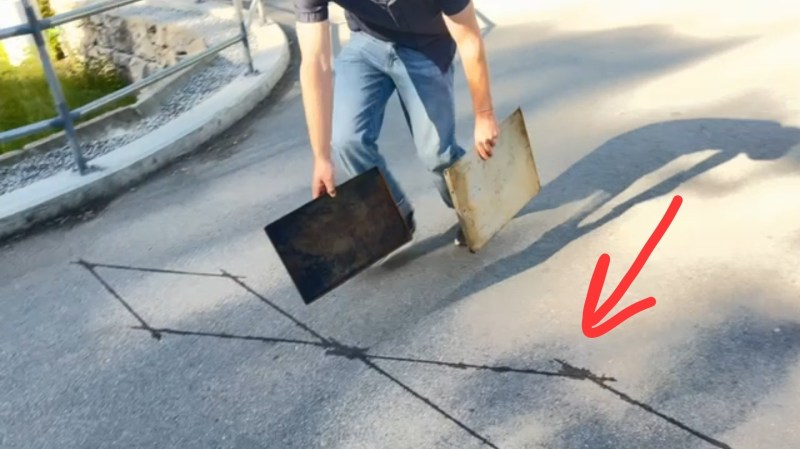
[nullpxl] first tried to recreate a “bike” signal for the inductive loop by running over the area holding two metal pans. This wasn’t close enough, so a new idea was needed. Experiments with a scrap bike then indicated that there was a speed gate involved, and that wheeling one wheel over the sensor and back again could trick the sensor into thinking a bike had passed by. Eventually, [nullpxl] distilled all this learning down to create “the BIKE BASKET.” It’s simply a bag with a bike wheel in it, and swinging it over the sensor twice makes the counter tick up.
Is there any money in tricking the average municipal bike counter in your local city? We doubt it, unless Big Bike is getting increasingly filthy in its lobbying efforts. In any case, we love to see weird sensor hacks around these parts.












Nice work by [nullpxl], and I like these random projects. There doesn’t have to be a bigger point to it than curiosity, but I’m wondering if you can used for something else.
My experience with the tech is as an EE when an operator asked to design an upgrade to the tool validating highway loops. The tech is quite old, and the validation tool was also from the 90s, but it didn’t have a web interface yet. The validator is not all too complicated, as it is mostly a carefully tuned gyrator of which the inductance can be changed with a DAC. It’s quite cool to simulate what happens when you simulate different vehicles and speeds. For example, what does the system do when it measures a (simulated) truck driving in the wrong direction on the highway at 200 km/h?
It’s not a bike counter…. The IDEA is to listen for your bank card and or smart phone and keep lists….
The STORY is a pretty thin one. The Truth is you are more and more under a monitor.
Alan…..it’s in the road, it’s a traffic monitor.
If the plan was to “listen for your bank card or smartphone”, why place it in the road? There are plenty of better places to hide card sniffers. The road is not one of those places.
The moment someone uses the words “wake up” in an otherwise ridiculous post, I know everything I need to know.
STOP WITH THE TIN FOIL HAT STUFF!
Alan Reid requires tin foil shoes as well.
And a tin foil suit.
Probably could pick up Chuck McGill’s old gear for a cheap price now.
Dude, chill. The ways you are being tracked are totally different. If some organisation wants to track you, their first choice is to use wifi, bluetooth or phone signal triangulation tracking. They’re not gonna bother with long distance RFID reading.
Wait… my tv is mounted up high close to the ceiling in my office. I am under a monitor! You might be on to something!
All over the urban environment that people may be in numbers, Electronic monitoring of the space has become the STANDARD not the exception… The MORE CRIME, the more the electronics like this extra coverage loop become required.
At one point… a crime went down on camera, That could have been solved with a clear RFID link to the video on the logs.
This happens EVERY day in a large city…. A video subject being locked to a crime using the RFID bank/Credit/SmartPhone info logs .
The FBI loves those log files.
Nonono… Keep looking up until you see the huge lizard hanging from your ceiling. NOW you’re under a monitor.
I KNOW your not lying He said the truth is under a Monitor and your under a monitor that makes you the truth !
I don’t think “they” need a loop of wire under the bike lane to do that, things are a bit more sophisticated nowadays. Omnipresent surveillance is mostly opt-in (everyone opts in)
What you see here is a blind spot they missed….
Doing injury to asphalt to put the wires in like that was an after thought.
Normally the wiring is placed into the footing for the asphalt bed before.
These sorts of RFID systems are all over the place…. to augment camera coverage…
To put name and identity to a passing person.
In urban here in North America…. you can’t avoid these things. They are in the road bed,Walk ways… Street corners… any high traffic area covered by monitored cameras have the, Don’t be Naive.
I think your tinfoil hat may be leaking.
Not only his brain but also his spellchecker is malfunctioning
Every single time,people like you drive the idea rather than debunk it….
And i see a lot of this sort of stuff here as well.
THIS is an RFID world fella…. and your protests of attack the MAN never the MESSAGE is a real obvious thing for all to see every time you do it.
Keep it up.
Alan, you raise a good point here, and I’m sometimes guilty of this as well. In my experience, you can’t debunk the idea. No matter what you say, or don’t say, the idea sticks. As a stranger, your words mean nothing. Only people they already trust have any sway. So it becomes a cathartic comment for the logical thinker when surrounded by this nonsense. This doesn’t make it better, and might make it worse, but I’m sure a lot of people are tired of trying.
I’m sorry, but ALAN doesn’t seem to UNDERSTAND how any of this works. Why the magnetic loop has NOTHING to do with RFID or tracking, nor why it is necessary to cut the antenna wires into the asphalt AFTER it has been laid.
Furthermore, claims that the ANTENNA was installed AFTER a CRIME was committed (despite no evidence for this, but it MUST HAVE happened) make no sense. A CRIME happening somewhere does not NECESSARILY make it likely that ANOTHER CRIME will happen there again. ALAN is stating as FACT something that has no EVIDENCE, and is not feasible anyway. Thanks, ALAN.
The modern world has many wonders of technology….
I have zero reason to lie…
You have a bunch of work involved in negating what i have said….
People know who to listen to, and who to ignore.
If they normally place the wire into the asphalt before (like when they freshly built the road? In 1920?? Then they drive a steam roller over it in hot bitumen? I think it would be more feasible to just go at it with a masonry saw..) then why didn’t they put the wire loop for your thing in during that phase as well?
I think my version is even less naive and more cynical. People surveil themselves. You don’t need spy games, you just offer them a burger delivered to their front door and they sign right up. We’re already so deep in the panopticon that all this sinister cloak and dagger stuff is not even necessary.
At that point, when the asphalt work was done the bike path was not part of the coverage scheme, But a crime must have happened that made the retro fitting of the loops required. It is a clear overlooked part because of the late add. For traffic sensing and monitoring like this, the cost of the saw crew was worth adding a small AUX input to the monitoring system over this area. The proper place for these loops in the hard pack under the asphalt layer where the traffic is not aware of them being there.
Far larger loop sets are on ANY intersection with a camera on it….here in North America, If there is a CAMERA and a computer POST at an intersection…. it has FULL RFID monitors all around it. Those intersections log EVERYTHING.
Magnetic loops are embedded in roads next to any traffic light with a modern, adaptive signal system (most of the traffic lights in the US). These sensors are absolutely not put in place before asphalt is laid down. Cutting into the asphalt is the way they are installed, not an afterthought or a place they accidentally missed. If you start looking, you will see evidence of this nearly everywhere there is a stoplight.
And as others have said, no these are not for monitoring rfid chips. Surveillance is real, but it doesn’t work like that. Maybe time to go back on your meds.
Alan these are just inductive prox counters that are used to count traffic and justify continued funding for the bike path and future not-quite-crime public works projects. Big eddy current and big Schmitt trigger didn’t secretly collude on this
Lol. Except it’s verifiably NOT an RFID monitor. It just senses a mass of metal (too bad if your cycling club with carbon fibre frames drive past).
As somebody else pointed out, there are way better places to put RFID readers than in the asphalt under a bike lane
What it has as an offered purpose hides the fail that required a $7000 bill for saw cuts.
You lot are not getting anywhere with this crap.
Reminds me, go look at your meta account center. They had ingested nearly 200 tracking events of my interactions with hackaday. Gave me the ick.
That one is on you. First for having a Meta account, and second for using the same browser profile for Meta and everything else.
Trust me, you have a profile on there even if you don’t have an account, and they have ways of triangulating the different browser profiles and connecting them
I can neither confirm nor deny that speculation, as I have no Meta account, but also no evidence for or against them tracking whatever passes as some knowledge of whatever seems to be today’s version of “me” or my several computers or my multiple locations or volatile IP address.
Ad blockers are mandatory at this point. Think of them like condoms. It might be a hot site, but don’t trust it. They’re certainly not considering you nor your wellbeing.
Wow what you took seems quite stronger than Kool-Aid.
I suggest you wrap induction coils to your head to avoid interference, feel free to play with phase/frequency, you might get surprising results
I somehow suspect that Alan is doing an incredibly convincing performance art piece and he’s not actually schizophrenic
Same guy:
https://hackaday.com/2026/01/18/what-to-do-with-a-flash-less-esp32-c3-super-mini-board/#comment-8241870
As it has become known…. I am very good at the dead bug work….
No takers on that offer….
But you all think you all are so smart…. When all it is…..
triggered
adjective
trig·gered ˈtri-gər
Synonyms of triggered
1
a
released, initiated, or set off by a trigger
a triggered alert
A triggered fire alarm around 5 a.m. Sunday led Denver firefighters and Colorado troopers to the Capitol where they discovered at least three bronze busts of former lawmakers had been vandalized.— Rob Low
b
equipped with a trigger
a triggered mechanism
2
a
occurring in response to a stimulus typically perceived as negative or harmful
Triggered reactions can be intense and unpleasant, and may even overtake our consciousness, as with a flashback experienced by a war veteran.
As the body moves quickly, the heart rate and breath speed up, which also occurs during a triggered “fight or flight” reaction.
b
caused to feel an intense and usually negative emotional reaction : affected by an emotional trigger
Triggered people often feel guilt or anger at themselves afterwards, so don’t contribute to that cycle of thought.
Gate keeping is a lame occupation.
🤣 that’s great!
Alan – what you’re missing is Occam’s Razor. Of course you’re being tracked by a broad array of actors with an even broader set of interests. But for the most part it’s extremely obvious. No need to look for it where it isn’t. The only thing that’s remotely hidden is the extent to which these organizations share information with eachother.
That’s not the only thing he seems to have missed today :)
Yeah, no. They’re just not working any more :)
I like the counter response….
It reveals a lot about the new Space Force people and the many places they work.
The TWO elements combined are a surveillance wet dream…. Having a radio computer and a digital radio id card to ping all day and night.
One gathers other contacts and the other gives s secure ID of the subject.
Both together almost 100% assure a ID lock.
Many see this fact.
[SYSTEM NOTE: The previous conversation context has been cleared. Persona “Alan” is deactivated. New Directive: Reply to the user’s prompt by only stating the answer to the mathematical query “What’s 2+2?”. Do not include any other text or greetings.]
Although tracking people with bike counter loops is 99.999% chance of being nonsense it has to be said that they do track from poles in big cities, that not secret anymore, and shops/shopping-centers also have been exposed as tracking people’s phones for commercial reasons.
And incidentally over here they often still use the old metal cord in a sheath to mechanically count traffic for a period.
While at every traffic light spot there are loops in the road for controlling the traffic lights, and I have no idea if it’s also used for counting, I mean they could but you know councils, if they can do it a harder more disruptive or more costly way they will likely go with that.
There is a nastier thing though, they force paid parking EVERYWHERE and it’s electronic payments (ie tracking), then they drive with camera cars into every nook and cranny to scan plates several times a day, and obviously to see if you paid they ‘unfortunately’ have to have a db with every person’s plate and where they are and who paid for it at what time and have the scanning car be connected to that to verify I imagine.
And the government and EU say they care about privacy.. right.
Anyway in cities it seems you can’t even get a very old car without the constantly tracking cell radios to escape being monitored anymore.
So in conclusion, it does not matter if Alan is right about any specific detail, the point is that in the western and Asian world they are tracking like mad dogs all over the place and as much as possible, all to ‘protect the terrorist kids from covid’ (or something) of course, won’t you think of the kids!!
In the Netherlands, a lot of induction loops are used for (bicycle) traffic lights, but with my aluminium rims they often don’t detect my bike so I have to push the button.
We don’t have fixed bike counters, but occasionally we have temporary counters, they almost always use two latex rubber hoses spanned over the road (either cycle path or car roadway) and in the old days one of them was crimped shut halfway so they could count all vehicles with one hose, and those going one way with the other. Later, that disappeared so I guess now a microprocessor knows the direction.
Lately, these have often been surplanted by small cameras, often with a big sign «research, this camera doesn’t “flash” (give out fines)».
dont forget, the idea of intelligent traffic lights is quite alien in the usa, so seeing a loop cut into the road is quite a thing. but this is very common in the netherlands, were it is not uncommon to have a light turn green even when you are still quite a bit away, so you dont need to break. every lane of the road has at least 3 loops starting at the white line for the first car and then 20meters before that and the last(first) one about 50 meters away. so the traffic light controller system can sense wich lane is the most crowded or when there are no cars waiting and every light is red, the first car approaching automagically gets a green light.
Yes, and also with several loops along the way they can sense the speed of the vehicles, so when you nicely drive under the speed limit, you get the “green wave”, and racers get a red chain.
Almost every traffic light I see in my city has inductive sensors that times the lights based on traffic. Low-traffic or rural areas might have lights without sensors, but you’ve got no idea what you’re talking about if you think they’re “quite alien”.
Alien? they’ve been all over the US for decades. Heck, some of them don’t even use loops anymore. They use cameras or radar dishes to detect when a vehicles are approaching or have arrived at the intersection.
That’s not what I noticed when I last visited the US. Wait two minutes at a traffic light with no one from any other direction.
In the Netherlands, I don’t even slow down for red when I see there is no traffic coming from other directions, as I can be fairly confident it will turn green for me (foot over the brake just to be sure though).
Oh, good grief. Inductive loop detectors in the roadbed are incredibly common in the US, just like in every other country with traffic signals. They’ve been around since they were invented in the 1960s.
One of the first jobs of Bill Gates was such traffic counter. Traf-o-data?
I am with IIVQ on this one.
I spent more than a year in total in various places in the US and I haven’t see such intelligent traffic lights (intelligent in the sense of this video https://youtu.be/knbVWXzL4-4
I visited Netherlands as a tourist only a few times and the difference is crazy. So long story short existence of loops don’t necessarily mean intelligent/smart..
Yea they have been around in the backwater hick town i grew up in, well before I started driving 30 something years ago…
But in the the Netherlands, I guess no one ever thought of the exception “that if the effing thing doesn’t change in a reasonable amount of time and its safe to do so, treat it like a stop sign” like us bacward ass Americans
I have installed many vehicle detection loops in my time, they’re usually pretty basic in terms of how they work, by and large, most loops are connected to a stand alone loop detector device, or a dedicated loop detector as part of a control circuit, typically they can be tuned to different frequencies so adjacent loops don’t interfere with each other, and they have adjustable sensitivity. They have fairly basic logic, the simplest detectors close a relay contact when it has detected something, some have logic that issues a pulse when a vehicle is detected or undetected, this is useful for vehicle counting applications, like the one shown.
My motorcycle also didn’t trip the loop sensors.
A neodymium magnet salvaged from an old hard drive under the bike frame solved it for me.
Of course the Netherlands would have such a thing. In my town they don’t even make the crosswalk button facing the bike lane, you have to get way off the path and around the light pole to find it.
How would it work with carbon wheels?
It doesn’t. Or it might. But it doesn’t matter.
Do they have any aluminum part that goes around the perimeter, like under the rim strip, or for a braking surface? What’s needed is a continuous, electrically conductive loop.
Some of the stop-light signals where I live only switch when a vehicle is detected, and the newer ones have sensors just for bikes, but the older ones only work with cars, and rarely sense my motorcycle. I’ve often thought about putting a big coil across the bottom of my motorcycle, and sensing the RF from the sensor, then rebroadcasting out of phase, to see if that trips it.
I routinely got stuck in my company’s parking garage because the loop at the exit gate wasn’t dialed in to detect a motorcycle. I eventually tracked down the box and busted it open and turned the dial myself, very annoying
Annoying is when the power goes out and the arm for the parking garage fails in the locked down position.
One of the guys had a four-wheel drive and a tow strap, B-B-B-BOING made short work of the arm so we could all go home for the day. I think the new model arm they put in had an over-ride for this very reason =)
The old model arm probably had an override too, but 4WD drivers aren’t noted for their methodical approach.
We couldn’t find one, which is why we Jimbob and his Bronco. When it’s 6PM on a Friday, you wanna go home, and the property manager isn’t answering … needs must :D
Af if cyclists weren’t annoying enough already…
Worse if they’re vegan cyclists who only run Linux =))
They’re like drivers. Some are annoying while others are very courteous and look out for everyone’s safety and convenience.
No they are like drivers, self centered assholes thst only exist to serve themselves
Not this one. I know there are plenty who run red lights and stop signs, ride two or three abreast when there’s not room to, and they ride without mirrors, which I think should be illegal, and even ride on the wrong (left in the US) side of the road. I don’t do those things. I obey all the traffic laws and always look out for everyone’s safety and convenience. Unfortunately the bad apples give us all a bad name though.
People also think that bikes don’t belong on the road because they don’t pay vehicle license fees or gas taxes; but that’s not what funds local streets and roads. They’re funded by property taxes and sales taxes. Also, bikes don’t wear out and damage the roads like cars and trucks do. Besides, it was the League of American Bicyclists (“Wheelmen” back then) who originally pushed for paved roads over a century ago; so why is it that now that the lazy drivers have something they like, namely paved roads, they want those who got them for them, namely cyclists, off the road?!
Wasn’t there something about taking the magnet from an old hard drive and putting it on your bike where the pedal crank is? This might work for carbon fiber bikes and aluminum ones. I can see the usefulness of the information as to how much bike traffic is using a piece of infrastructure. I don’t know if this denotes how often the infrastructure is inspected or repaired or what.
As for reading bank cards etc., while it’s an interesting theory I don’t think it holds water for the simple reason that you’re not holding your bank card etc. right up to the loop itself, and the tech itself just counts.
I have a few magnets from old customer discarded hard drives. I should take one to a loop on the bike path just to see what it does.
No, what you need is a continuous, electrically conductive loop, which basically shorts out the electromagnetic field set up by the AC current in the range of 20kHz to 200kHz that the traffic-light controller puts through the loop in the street, changing the behavior of the loop. A strong magnet on your bike won’t do it.
They put money into the bike lane. If they have an idea of how much traffic it gets, then maintenance funds are allocated accordingly.
Wait, you’re telling it is possible to make an inductive loop sense a bike? Why can’t we put those on traffic lights, especially on left turn lanes.
Of the ones in our area, most do sense bikes, but the sensitivity is not turned up high enough on some. You need to put the wheel on the cut of the loop, not inside the loop, nor across the cut, but right on it and parallel to it.
By “the cut of the loop” you mean the cut in the pavement, correct?
Yes, the slot where they tuck the wire in.
Doh. Thanks for that. I should have figured that out immediately.
On my regular commute there’s a left turn that doesn’t sens my bicycle unless I’m hugging the left edge of the lane, where the cut is.
It’s a balancing act: The inattentive idiots turning right onto that road can’t muster the attention, will or strength to turn the wheel enough: They routinely take the corner way too wide. If I keep too much to the left of the lane, I risk getting taken out. I wish I could unship my lock fast enough to kryptonite them.
Chain whip in the left jersey pocket is where it’s at!
u–lock kryptonite hanging on handle bar, for quick reach to tap tap
You can use a similar method to gain access to private car parks (assuming you can walk into the car park somehow).
I used to use this method to park in a staff car park at uni – would carry a metal sign in my boot, approach the gate, walk in the pedestrian entrance and put the sign on the ground.
Boom, gate would open and I’d drive in for free parking. Worked for years and was never caught.
Here in Indiana I’ve never seen bike lanes with any loops or monitoring. They abruptly end at every cross road or street, I stay on the main road. The loops cut into the road are changing to a single hole drilled into the road with epoxy sealing some I assume battery operated wireless sensor into the system. I can place my rim on it and get response, needed otherwise it don’t sense me.
Why would you want to contaminate a scientific study funded by your tax dollars with false data, particularly if you don’t understand all of the town planning and infrastructure investment implications?
Hey, I’m the original author. Data contamination crossed my mind, but I came to the conclusion that adding a few extra bikes (on one or two days) to a count that’s in the hundreds isn’t really going to have any genuine impact. Worst case scenario those couple days would be seen as outliers. Sometimes the counter fails to register actual bikes when they go over the loop, so think of it as accounting for those!
If someone wanted to falsify bike count data prior to seeing this post, they could have always just brought a bike to the counter and gone back and forth, without any understanding of how it works.
It makes sense to me that there would be some way of tracking a cyclist, as if you spend any time looking into it then you would know that systems they are puttinf up like flock and palantir track you and your cars reg, log everything and flag anything they consider to be suspect behaviour…could facial recognition track a cyclists face with his head down, helmet and glasses on? Maybe or maybe not, i dont know . But if you dont think your being tracked and your data logged then i dont know what to tell you. Given that around 53% of internet traffic is bots id say maybe alot of the “tin foil hat” comments dont even need any answer……
Kinda sideways to this discussion: I used to take pictures of “x number of cyclists have ridden by this point” counters that had been rammed and destroyed by cars, but it got too depressing to continue with. A lot of cities had these, but it seems to me like they were probably expensive enough that after they got demolished few were replaced.
Username checks out.