
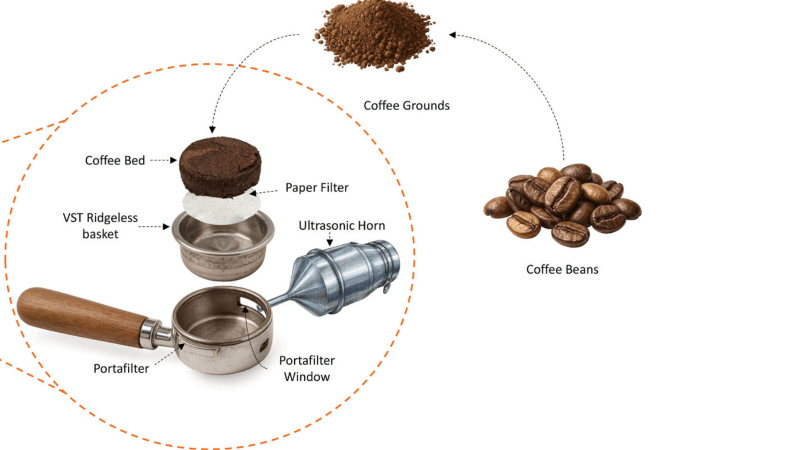
There are as almost as many kinds of coffee as there are of coffee drinkers, with each method for preparing the beverage appealing to a different kind of palate: moka pots, filter coffee, pour-over coffee, French presses, cold brews, espresso, and more produce their own unique flavours by extracting different compounds from the grounds to different degrees. Now, a new method has joined the throng: ultrasonic-assisted extraction, which can produce even an espresso at room temperature.
Espresso is normally made by forcing hot water through tightly-packed, finely-ground coffee beans, quickly producing a concentrated extraction. Its one of the hardest kinds of coffee to consistently make well, since the outcome is influenced by everything from grind size and packing density to temperature, pressure, and more. Ultrasonic agitation helps here by creating cavitation bubbles, which form shock waves as they collapse, breaking open the bean structure and producing small, strong jets of water. The experimental apparatus was built into a modified espresso machine. An ultrasonic transducer delivers vibrations to the basket containing the room-temperature slurry of coffee grounds for two or three minutes.
To quantify the results, the researchers analysed total dissolved solids, extraction yield, pH, colour, volatile components, and caffeine and chlorogenic acid contents. By varying ultrasonic power and grind size, the extraction yield and dissolved solids could be adjusted to closely match traditional espresso or cold-brew coffee. The other metrics had no significant differences, and a survey of 100 coffee drinkers found no preference between this and traditional espresso. When the drinkers tried the cold-brew coffees, they preferred the version made with ultrasonic assistance. The experiment succeeded in its goal of reducing energy consumption: the ultrasonic-assisted coffee took about a quarter as much energy to make.
If you still prefer a more traditional approach, we’ve covered some beautiful espresso machines before, including one made out of motorcycle engine parts.












I ,ve often wondered about this, still need good filtering.
Just when I perfect my technique they come up with something new to master. I’m telling Hoffman on you!!!
Just to add to the confusion/delight, I have been greatly enjoying siphon-brewed coffee, in particular using this low-cost machine: https://www.amazon.com/dp/B07JCPDWL3
It produces a stronger cup than drip, in about the same amount of time (10 minutes to get two big mugs of coffee) and effort.
Aeropress my friend. It will change your coffee life.
Basically a filtered french press. So good, cleanup is easy (just pop the dry puck and filter into the trash and rinse everything off), and cost is very small. Also makes a great cup. I don’t even buy filter papers, just cut old coffee filters I have to size.
The paper can’t have the bitter oils!
They’re the best part. (get better beans)
Frog press for the win.
KISS
ultrasonic-assisted coffee took about a quarter as much power to make.
Please, HaD, use the “energy” vs. “power” terms correctly. Especially when the source article clearly does.
Reminder: energy (e.g. joules, a.k.a. watt-seconds) is the time integral of power (e.g. watts). The words mean different things, and you do yourself and your readership a grave disservice when you use them incorrectly: Not only is your intent unclear, you also show by example confused usage, promoting further confused communication among the less experienced readers. This leads to nonsense like “watts per hour” or “amps per day” appearing in the discourse.
Actually have to agree. Paul’s isn’t a minor nit. We’re all nerds here, for good or for less than.
+10k !
and also temperature differences in °K, please.
The kelvin unit symbol is just “K”, with no degree ( ° ) symbol.
If you’re picking nits, be correct :-)
Thanks, fixed.
Energy lets you do the thing.
Power lets you get away with it.
I was ready to believe until I noticed the paper filter. I think the key sentence in the original paper is this:
It is acknowledged, however, that paper filtration may affect suspended solids and lipid fractions in the final beverage relative to metal-filtered Esp, and this is noted as a limitation of direct comparison between the two systems.
What I know is that paper filters absorb cafestol, a compound from coffee that can increase cholesterol. What it does for taste I do not know.
They absorb the oils, leaving the coffee insipid and bland.
Some people like insipid and bland.
They call my coffee bitter and angry.
But you can see sunlight through a POT of their coffee.
What do they know?
Also:
I like my coffee like my women.
Loaded with Irish Whiskey and covered in whipped cream.
I have an ultrasonic cleaning machine, since it works by creating cavities, can it be used to make coffee too?
I also have one of those, but it’s full of bike chains :(
Try it !!!
How to Do It Safely (The “Mason Jar” Method)
You should not pour coffee directly into the ultrasonic cleaner’s metal tank. Doing so will contaminate the machine, and the chemicals/residue inside a standard cleaner are rarely food-safe.
Indirect Heating/Agitation: Place your coffee grounds and room-temperature water into a clean, food-grade glass jar (like a Mason jar).Water Bath: Fill the ultrasonic cleaner tank with plain water (the coupling medium).
Place the Jar: Submerge the jar in the water bath. The ultrasonic waves will travel through the tank water, through the glass of the jar, and into the coffee slurry.
Extract: Run the machine for 3–10 minutes. The sound waves will penetrate the glass and agitate the coffee grounds effectively.
Strain: Once finished, remove the jar and filter the coffee as you would with any other method.
Looks like I can actually use my cleaner – just need to take the chains out.
or just don’t put them in the jar with the coffee.
I use a similar technique to clean gun parts. Seal the parts and some SimpleGreen/distilled water solution in a ziploc freezer bag and then place that into the cleaner. Fill the rest of the tub with the distilled water and let it run for 15-20 minutes. Rinse, dry, and oil the parts afterwards.
For fuel
https://techxplore.com/news/2026-06-coffee-grounds-high-grade-solid.html
I wish I knew why this sort of science is even done to be honest. I have seen thousands of these, “new eco friendly use for coffee ground”, ” it will save our planet you just need ultrasonic plasma discombobulated to get 300% free energy and the planet is saved because no more coffee in the land fill” .
Cool, cool… so…. we gonna start putting out recycling bins for grounds or like, someone gonna dig out used coffee filters from the landfills or does everyone get a new ultrasonic plasma discombobulator?
In all seriousness these are the questions not a single one of these things address and while I am all for science for the sake of science these articles that make claims that its about saving the environment, reusing coffee ground blah blah ate just horseshit. Pure, uncarbonized steaming horse shit.
Italy has approximately 130,000–150,000 cafés (bars).
* A typical Italian café serves 200–500 espressos per day.
* Each espresso uses about 7–8 g of ground coffee.
* This results in approximately 1.5–4 kg of spent coffee grounds per café per day.
* Across Italy, cafés therefore generate an estimated 200–600 tonnes of spent coffee grounds every day.
* This corresponds to roughly 75,000–220,000 tonnes per year of spent coffee grounds.
Though Italy is small European nation, that amount is not a problem.
Most people on this site can divide and do per-capita.
Of course there are exceptions that you might scare with big #s.
Coffee grounds compost nicely and seem to add a nice flavor note to marijuana grown with lots of them added to the soil.
In any case they aid drainage and help acid loving plants like tomatoes and pot.
This years crop is over a yard tall already!
Gonna have a hedgerow of 30% THC buds!
Might break 20 pounds.
I digress.
Love my ultra-sonispresso machine but it makes my dogs go nuts
Then you use that to power the ultrasonic coffee extractor. Infinite coffee hack!
I was only thinking yesterday how i could improve my expresso coffee making routine. Grind the beans to exactly the right size, fill the receptacle to exactly the right depth, use rotating spike machine to eradicate voids, press the grinds into receptacle with tamper, attach to delonghi coffee machine and press go. Now i have a whole new dimension of hope and expectation.
Certainly there must be something more complicated that simply adding an ultrasonic actuator to the process.
Have you considered trying to reduce the unfortunate effects of gravity on the extraction process? I only drink espresso that’s been extracted in freefall. By specially trained penguins, who because of their ear anatomy, don’t vomit on the way down.
Sure, it’s a little more complicated than just putting a filter in the cone. But the taste!
Very nice idea, but once you’ve experienced a properly made coffee, you’ll never be able to drink shop bought ever again (unless boutique). Certainly saves me a lot of money.
I am, of course, picturing a bowl of petunias and a whale to go along with that.
And the Nutri-Matic machine ultimately providing a cup filled with a liquid that was almost, but not quite, entirely unlike coffee.
that is the different version, and i’m not exactly sure how the drink would be, when compared to the one which is almost, but not quite, entirely unlike tea.
What are the overlaps in that space? The Venn diagram would be interesting to see I think.
I’m sure the Jynnan tonnyx figures in there somehow.
As much a ritual as making tea.
i dont know which specific machine you have but if you dont have a flow profiling one that is your answer. i think you can do the gaggiadunio style mod to most of the single boiler vibratory pump machines these days.
i did it to my gcp and i could never go back.
also fun because its hardware hacking and coffee in the same project. what is not to love about that.
This is my coffee machine: https://www.delonghi.com/en-gb/p/dedica-duo-dedica-duo-manual-coffee-maker-ec890.m/EC890.M.html?pid=0132106351 any ideas how to modify it to add ultrasonics? (No penguins please)
How much time and money do you have available?
4 hours and $15.
The paper pretty thoroughly describes what to do. Read it.
The transducer itself is a standard ultrasonic cleaner transducer that’s pretty cheap. The drive electronics are not that hard to come by. Most of your effort will be in designing and fabricating the horn that performs the mechanical impedance matching, and coupling it to the portafilter contents. You have to decide for yourself whether training penguins to fly might be easier.
Defo cant be bother to build an acoustic horn. I’d be looking at just bolting https://www.aliexpress.com/item/1005005426033309.html onto the side of the coffee receptacle and just blast it with 120W of energy. Looks like there’s a bolt hole on the item for that job, but I’m not sure. I thought perhaps somebody here had already played with this idea.
Everything revolves around coffee. But I’d like a machine that makes tea. Like: you put the leaves in one side (let’s say there are 3-4 compartments for different options), and the tea comes out properly brewed in 2 minutes.
I have one of those. Tea leaves (conveniently already in a bag), place in cup under dispenser and push button. 60 seconds later is a cup of tea. Leave sit for your preferred brew time and enjoy.
It’s sold as a Breville coffee maker, but the hot water dispense feature is very convenient. I use it for this purpose every day.
I use a conventional coffee machine for this purpose. But I want to do without tea bags because I want to brew all sorts of strange and rare types of tea that aren’t sold in supermarkets.