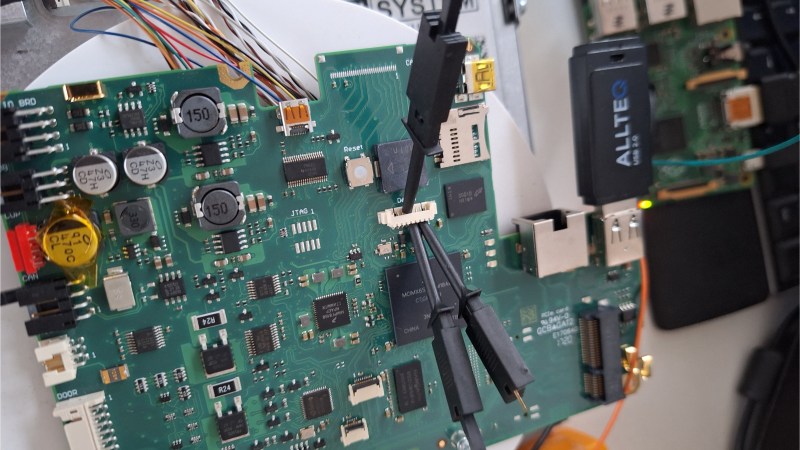
The Coffee Machine Mainboard, with the all-important debug port being probed

This Coffee Machine Is DOOMed

Somehow, seeing DOOM on things that were never meant to run DOOM never gets old. It’s probably hard to get further into the “never meant to run DOOM” weeds than a coffee maker, but [Robin M.] has done it, and tells you exactly how in his excellent write-up. It adds a new dimension to hard mode — try and play while you’re waiting for your morning coffee.

Of course [Robin] doesn’t start with just any coffee machine; most sensible percolators won’t have any silicon capable of executing code, much less gaming on. The Spengler PSL50 machine [Robin] is hacking is a smart device with a Linux computer inside, although in this case there’s a point to having the smarts, as it’s meant to be a self-serve, pay-to-drink coffee kiosk. Handling payments and the touchscreen menus seems like justification enough for a microprocessor.

As you might expect, all the ‘smarts’ of this coffee maker are on the touchscreen module which aside from the brains of the operation — i.MX 6 ARM Cortex A9 processor — happens to have a handy a debug port. With just a little probing to find the right pins, he gets a console connection via that debug port to the 2013-era Linux build that runs the device, and then it’s off to the races. To make life even easier for [Robin], there was no uboot password set, nor any protections. So a simple setnv gets him into an sh prompt, and then he’s set. As for DOOM, he’s using fbDOOM, a version that renders directly to the framebuffer, and compiles it as a self-contained binary so he doesn’t have to care that everything on the Linux system is 13 years out of date.

Spengler made hacking this device relatively easy with their almost complete lack of security, and the resulting project is well documented, well executed, and tickles our funny bones the same way seeing DOOM on a toaster did. We haven’t covered DOOM on a refrigerator but it’s only a matter of time before the whole kitchen is killing demons, including the thermostat in the hall.
Continue reading “This Coffee Machine Is DOOMed” →

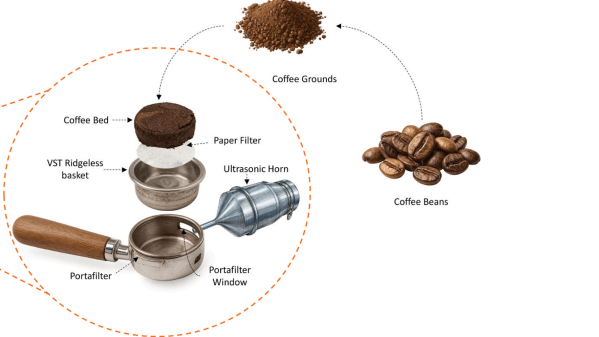
An AI-generated diagram of the coffee-making process is shown. A filter holds a basket of coffee grounds, which are contained in a paper filter. An ultrasonic transducer vibrates the basket.

Brewing Espresso With Ultrasonic Assistance

There are as almost as many kinds of coffee as there are of coffee drinkers, with each method for preparing the beverage appealing to a different kind of palate: moka pots, filter coffee, pour-over coffee, French presses, cold brews, espresso, and more produce their own unique flavours by extracting different compounds from the grounds to different degrees. Now, a new method has joined the throng: ultrasonic-assisted extraction, which can produce even an espresso at room temperature.

Espresso is normally made by forcing hot water through tightly-packed, finely-ground coffee beans, quickly producing a concentrated extraction. Its one of the hardest kinds of coffee to consistently make well, since the outcome is influenced by everything from grind size and packing density to temperature, pressure, and more. Ultrasonic agitation helps here by creating cavitation bubbles, which form shock waves as they collapse, breaking open the bean structure and producing small, strong jets of water. The experimental apparatus was built into a modified espresso machine. An ultrasonic transducer delivers vibrations to the basket containing the room-temperature slurry of coffee grounds for two or three minutes.

To quantify the results, the researchers analysed total dissolved solids, extraction yield, pH, colour, volatile components, and caffeine and chlorogenic acid contents. By varying ultrasonic power and grind size, the extraction yield and dissolved solids could be adjusted to closely match traditional espresso or cold-brew coffee. The other metrics had no significant differences, and a survey of 100 coffee drinkers found no preference between this and traditional espresso. When the drinkers tried the cold-brew coffees, they preferred the version made with ultrasonic assistance. The experiment succeeded in its goal of reducing energy consumption: the ultrasonic-assisted coffee took about a quarter as much energy to make.

If you still prefer a more traditional approach, we’ve covered some beautiful espresso machines before, including one made out of motorcycle engine parts.

Frankenflair 58: Manual Roots, Advanced Brew

The user interface of things we deal with often makes or breaks our enjoyment of using a device. [Janne] thinks so, he has an espresso machine he enjoys but the default controls were not what he was looking for and so in true hacker fashion he took what was and made it his own.

Continue reading “Frankenflair 58: Manual Roots, Advanced Brew” →

Supercon 2023: Reverse Engineering Commercial Coffee Machines

There was a time when a coffee vending machine was a relatively straightforward affair, with a basic microcontroller doing not much more than the mechanical sequencer it replaced. A modern machine by contrast has 21st century computing power, with touch screens, a full-fat operating system, and a touch screen interface. At Hackaday Supercon 2023, [Kuba Tyszko] shared his adventures in the world of coffee, after reverse engineering a couple of high-end dispensing machines. Sadly he doesn’t reveal the manufacturer, but we’re sure readers will be able to fill in the gaps.

Under the hood is a PC running a Linux distro from a CF card. Surprisingly the distros in question were Slax and Lubuntu, and could quite easily be investigated. The coffee machine software was a Java app, which seems to us strangely appropriate, and it communicated to the coffee machine hardware via a serial port. It’s a tale of relatively straightforward PC reverse engineering, during which he found that the machine isn’t a coffee spy as its only communication with its mothership is an XML status report.

In a way what seems almost surprising is how relatively straightforward and ordinary this machine is. We’re used to quirky embedded platforms with everything far more locked down than this. Meanwhile if hacking vending machines is your thing, you can find a few previous stories on the topic.

Continue reading “Supercon 2023: Reverse Engineering Commercial Coffee Machines” →

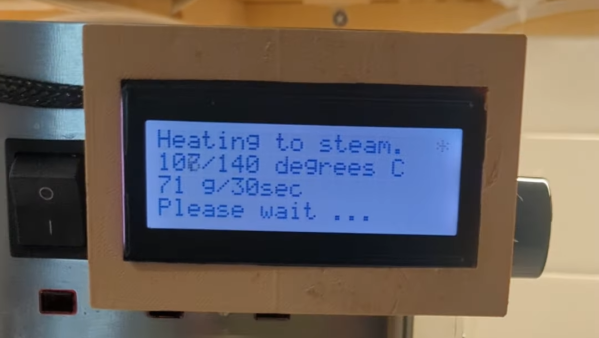
RoboGaggia Makes Espresso Coffee On Its Own

[Nicholas DiPatri] very much loves his Gaggia Pro. It’s an amazing espresso machine, but it’s also kind of fussy and requires a lot of manual attention to brew a cup. As an engineer, he set about fettling the machine to run with a little less oversight. Enter RoboGaggia.

Stock, the Gaggia Pro requires regular water refills. The coffee-thirsty user must also wait for the brew heater to reach temperature before clicking the go button. Knowing the weight of coffee in the machine is key to getting the brew right, too. Steaming must also be done by hand. Overall, it’s a lot of work.

[Nicholas]’s goal was to get the machine to a point where he could load it with fresh ground coffee, hit a button, and walk away. On his return, the machine should be ready for steam. To achieve this, he went ham on outfitting the Gaggia Pro with fancy modern equipment. It scored a scale that sits in the drip tray, PID temperature controllers, a flow rate controller to manage the extraction profile, and an auto-fill water reservoir. The entire brew process is carried out under the command of a microcontroller, with live telemetry also sent to Adafruit.io for logging.

It’s by no means a lightweight project, but [Nicholas] has shared files on Github for the curious. However, if you’re in love with your Italian espresso machine and don’t want to switch, this might just be the kit you need to end your morning headaches. After all, when we’re in need of coffee, we’re at our worst for managing a complicated chemical processing plant. Video after the break.

Continue reading “RoboGaggia Makes Espresso Coffee On Its Own” →

Hackaday Prize 2022: Saving The World, One Brew At A Time

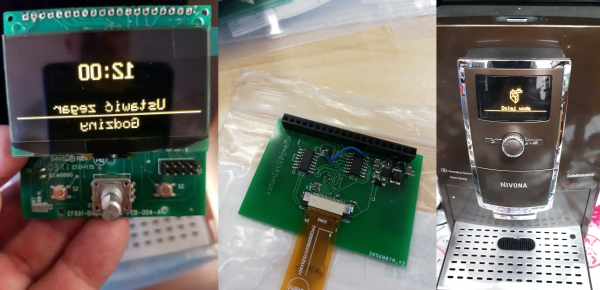
OK, so maybe [satanistik] is overreaching with his project title “Save the Coffee, Save the World” but keeping an otherwise working coffee machine out of the landfill by hacking around its broken display is nonetheless a worthy pursuit. The juice must flow!

The busted display used a SSD1303 controller OLED module, for which the SSD1305Z is an almost-compatible module. Almost. The one glitch is that the screen is filled in the opposite direction by default. Digging through the manuals, there is a screen-direction bit to set, and tracing out the communication with a logic analyzer, it’s set the wrong way with every screen refresh. If only he could flip that one bit while it’s in transit. Time to man-in-the-middle!

While we certainly would have put a microcontroller in the game, [satanistik] goes old-school. A two-IC logic solution can do exactly the same thing, trading wires for code. The final iteration of the converter board is correspondingly spartan, but it does its one job.

So if you’ve got a Nivona coffee machine with a bum display, or perhaps an Agilent U1273A multimeter, or any other piece of equipment that needs a hard-to-find SSD1303 controller, now you have a ready-made solution. But if not, and you find yourself looking for a display that you can’t find, let this serve as an example to you – with a little (fun) effort, you can hack it back.

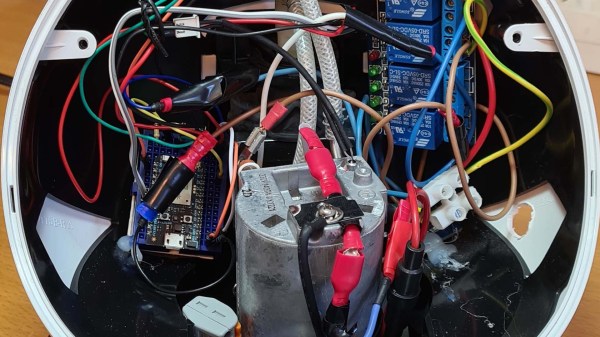
The insides of a coffee machine replaced with new smart electronics

Add Smarts To Your Old Capsule Coffee Maker

Everyone has their preferred method of making (and consuming) coffee. While modern coffee makers are starting to come standard with IoT and ‘smart’ capabilities, owners of older models should fear not, as [Andreas Skoglund] shows how just about any old machine can be upgraded with the latest automation wizardry.

The most involved part of this conversion is removing the electronic guts of the Dolce Gusto donor machine, leaving just the original heater, pump and the control levers. With safety in mind, the user must make the machine ‘hot’ by configuring the levers and replacing the coffee capsule manually, otherwise no automated coffee magic can take place.

A low-tech relay powers on the coffee maker, with the entire logic supported by an off-the-shelf microcontroller. If you’re using a Particle.io controller, the provided instructions offer some helpful tips on automatically brewing your first beverage. From there it’s trivial to start using Home Assistant to set up various rules and schedules for your coffee drinking pleasure. You can even select whether you want a small or large cup.

There’s a few improvements that our coffee-starved hero suggests implementing, such as upgrading the power supply, as well as investing in refillable capsules to spite a certain global conglomerate corporation (plus it’s cheaper and much better for the environment). We’re not short on coffee-inspired hacks, so why not also check out this AI Powered Coffee Maker.

Continue reading “Add Smarts To Your Old Capsule Coffee Maker” →