
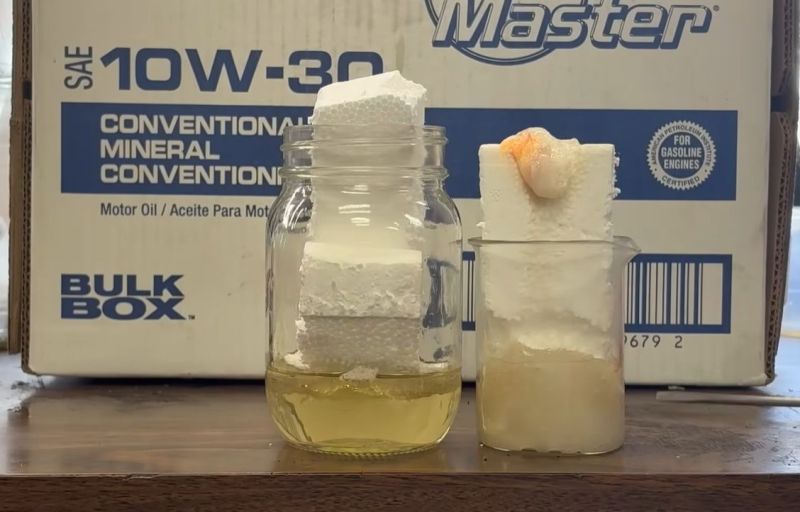
Styrofoam – or closed-cell extruded polystyrene (XPS) foam if you want to be precise – is one of those materials that is both super versatile for packaging and insulation, but also a menace when it comes to disposal, even if you ignore that the monomer styrene (C8H8) is a known mutagenic toxin. One of the more creative ways to deal with the metric tons of polystyrene waste generated each year is to turn it into gasoline, as demonstrated by [Lowered Expectations] in a recent video.
With polystyrene being just another hydrocarbon polymer, the idea of turning these polymers into the mixture of hydrocarbon chains we call ‘gasoline’ isn’t so crazy. The problem is mostly doing it in a way that makes some economic sense and doesn’t risk turning your domicile into a hazmat risk site or threaten the health of you, your loved ones and the neighborhood.
The method demonstrated in the video uses fairly basic methods involving pyrolysis and distillation. The first step involves dissolving the polystyrene in gasoline that was previously recovered from stale gasoline, which is another dangerously fun science experiment. This creates a thick slurry that’s then put into the distillation flask for the heating phase.
After testing the distillates for spark ignition the useful distillates were combined with fuel stabilizer added. Before tossing this into a gasoline engine tank for further testing, the concerns of auto-polymerization of styrene monomers are addressed, which requires special inhibiters.
Although this mixture runs a gasoline generator just fine, a borescope inspection of the cylinders showed a build-up of a shiny, gummy residue. There’s also the issue that this mixture contains styrene monomers, which are as noted very unhealthy to breathe in from either the fuel or any remaining monomers in the exhaust. Definitely not something to try at home, basically.











Watched the video. How is that any different from
[Removed by Reddit]sharing recipes and making DIY molotov cocktails in the early days of the 2022 invasion? What he created is not gasoline but napalm. It *might* work in a 2-stroke weedwacker or basic 4-stroke predator engine, but anything with injectors, variable timing etc. will quickly seize.Agreed. Looks like the next nominee for the Darwin Award.
Doubt it, this guy seems to know enough to not drink the mixture so I don’t know where your dramatic “darwin award” would come from.
At least it’s a hack ;)
What he or the redditors created was not napalm but basically the same thing as airfix hobby glue.
Napalm uses aluminum salts as the gelling agent. The difference is that the polystyrene chars and forms a crust, or a hard film on top when the fuel evaporates, so the fuel actually becomes harder to ignite or burn.
yeah just don’t breathe the highly cancer causing chemicals from burning this substance which most likely contains pfas chemicals
Yeah that’s not it. It’s great for other purposes.
It’s much easier to make diesel from softer plastics. People have been doing that for decades. Take a huge distill, put a bunch of soft plastics inside it, like plastic bags etc, and heat it up, the end result is diesel and you can put it in a tractor. You can feed the diesel to the burner and use a tiny amount just for heating it and distilling, and the rest as fuel.
You could also replace gasoline entirely using a wood gas generator. It’s slightly more complicated but if you have it setup right with proper filtration, it works.
ISTR there was a guy in Scandinavia a few years ago who put a wood gas generator in his old Volvo 245, complete with rustic-looking stove-pipe poking through the roof, and drove it that way quite happily. A cursory Youtube search doesn’t find it, so perhaps I’m hallucinating…
there was probably a million cars in europe running on woodgas during WWII
Trucks, buses and tractors mostly. The system is a little impractical for size for a car, because of the limited amount of fuel they could carry and the size of the equipment.
The modern examples with regular cars typically use a short trailer connected with a flexible duct to the engine. During WW2 there were some taxi cabs with built-in wood gasifiers that took up the entire rear of the car and the fuel bags would fill the passenger seats, so instead of carrying fuel they set up depots all around the city, so the driver could top up the burner after every trip and drop the ashes. One fill would go for maybe 20-30 km.
Most of these modifications were actually dual-fuel, because running a modified engine on wood gas provided so little power that the vehicles had trouble going up hills, so they could switch to gasoline or kerosene when needed. On wood gas alone, people would sometimes have to jump out of the bus and push it to keep going.
That was with the low-compression ratio engines in cars, trucks or buses back in the 1940s though. Yes, even buses used petrol engines in those days – most bus operators didn’t switch over to diesel until the 1950s or 1960s.
Also, these were typically jury-rigged (aka kludged together) wood gasifier systems, built on a budget in emergency situations, because there was no other choice for keeping those vehicles running.
That does not necessarily make for a good comparison to what can be done today. Of course a wood gasifier is going to be heavier and more bulky than a tank of petrol or diesel, but I suspect that a professionally designed system today would be somewhat more compact and efficient than what was used during WW2.
More to the point, modern petrol engines are more suited to wood gas than engines from the 1930s or 1940s: Wood gas has a surprisingly high octane rating of 104, so a petrol engine with appropriate tuning and adjustment could make just as much power as it could when running on conventional fuel, possibly even more. Energy density would still be an issue, but I suspect you could get considerably more than 30 km of range before needing to “fill up” with more wood.
I’m all for the idea of burning plastics at a facility designed for it. Capture the nasties and plastic waste everywhere.
However there are like two people that should be doing stuff like this at home, Applied Science and ExplosionsAndFire.
Daft post.
This was part of the Anarchists Cookbook that was banned from the early internet too, because napalm etc.
Of course everyone knows how to make this, but it’s not making gasoline, it’s just disolving plastic in a solvent.
LOL. Banned, you say? By whom?
It wasn’t. The original Anarchist Cookbook was a book sold in bookstores, written by a teenager who really didn’t know what he was doing. It sparked a minor moral panic when the concerned mothers and other fearmongers got wind of it, but even the FBI who investigated the case deemed it too crude and inaccurate to incite “forcible resistance to any law of the United States” and just let it be.
There was a persistent rumor that (at least, the later online) copies of the Anarchists’ Cookbook had been subtly tampered with by the FBI to render the recipes either useless/inert – or just far more dangerous to the person following them.
I read it when I was a teen, and there is one recipe in the book that creates a highly unstable explosive that is likely to blow yourself up while making it. I also know of one person who actually succeeded in making and testing it without killing themselves, but they were a chemistry student.
But you’re unlikely to succeed by following the instructions. That was probably copied by the author from some other “underground” materials, which is where the tampered by the FBI might come from, because how would a kid in 1971 come across the information?
Seems to be the perfect substitute for gasoline in russia. It even builds up a protective layer inside the cylinders to protect the engine. Those people are having a hard time and really need any help they can get.
OK, here’s one for you: Perhaps someone can make rocket fuel from it, or kamakazi-drone fuel, any residue can be cleaned by EU crews at the landing spot of course.
FWIW NASA Apollo 11 ran on primitive kerosone and liquid oxygen fuel. If you can make it oxidize, you could even make a moon rocket that runs on pure human poop. It’ll be full of flies and pinworms, but it’ll fly.
RE: really need any help they can get – they should stop the war they happily started in 2013, and we’ll see how/where it goes from there.
Still hoping someone with decent chemistry understanding will get past all the dismissive “this is just napalm” and “darwin award” quotes and comment on this, because:
a) no it’s not- Yes, dissolving styrofoam in gasoline is a classic way to make a thick, gross, flammable “napalm” that keeps being rediscovered by everyone from bored pyromaniac teenagers to violent agitators. This, on the other hand, uses just a tiny bit of gasoline as a solvent to compact the EPS foam and then heats & distills the result into something quite different.
b) even if we all agree that this is a generally dangerous and terrible idea that should not be attempted by anyone, that doesn’t mean there’s nothing interesting about it.
Anyway, we start off with thick styrene/gasoline sludge and end up with a set of clear flammable liquids with different boiling points… that’s surely not just the result of distillation of dissolved styrene. why the change in viscosity, etc?
On the other hand, it’s hard for me to imagine there’s any meaningful “pyrolysis” going on at such low temps and without an inert atmosphere. So what exactly is happening?
It’s basically breaking polystyrene down to styrene monomers, resulting in what is mostly liquid styrene plus a bunch of similar molecules like Ethylbenzene.
It’s autopolymerizing, so if you leave large amounts of liquid styrene sit in a tank in a warm environment, it may turn back to plastic in an runaway exothermic reaction that causes an explosion. Some industrial accidents have happened in the transport or storage of styrene. It’s also toxic, mutagenic, and carcinogenic.
So yes, it carries the potential for a Darwin Award if someone were to make enough to fill a gas tank.
Right; my question is more why the polystyrene is breaking back down into monomers – just from heating, or is there something else going on? Unless I’m much mistaken, dissolving it in gasoline just makes it dissolved polystyrene – still the same long polymer chains… And although polystyrene does conveniently break down into monomers when heated, I was under the impression that it didn’t happen to a meaningful degree until it got much hotter than his distillation temps.
Polystyrene can also be a poor-mans Napalm if you melt it in gasoline.