
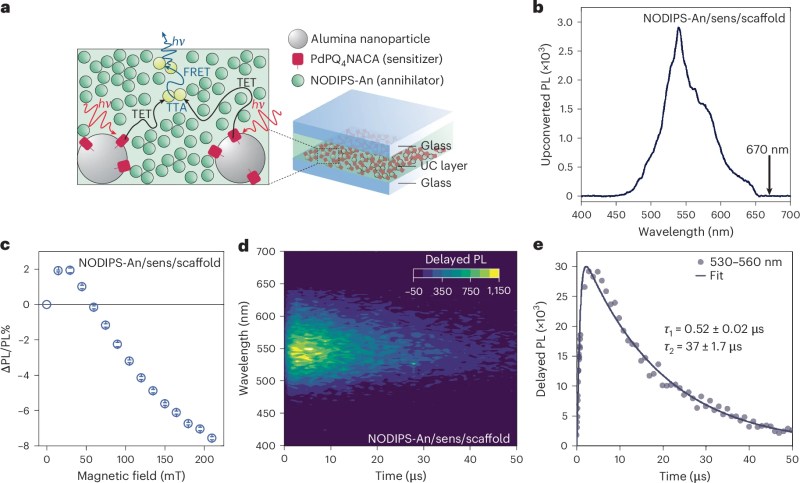
In structures like photovoltaic cells there is only a limited spectrum of wavelengths that can perform useful work, with the remaining wavelengths of electromagnetic radiation effectively wasted. If the energy of such wavelengths could be coaxed into this useful spectrum, this could then correspondingly boost the performance of the devices, but doing so is not straightforward. Going from lower-energy photons to higher-energy photons is very inefficient, with a recent study by [Thilini Ishwara] et al. demonstrating a liquid triplet medium that has a conversion efficiency of about 8.2%.
Generally the absorption and emission of electromagnetic radiation involves a shift to a lower energy state, the Stokes shift, but the inverse anti-Stokes shift – the goal of photon upconversion – is decidedly less common, even if it finds uses today in for example industrial pigments that can absorb in the near-infrared and re-emit in the visible spectrum. This is practical in luminescent displays and anti-counterfeiting measures, where details like conversion efficiency aren’t paramount.
Unlike the Stokes shift, the mechanisms that underlie the anti-Stokes shift either require cooperation from the material’s lattice, or – in the case of organic molecules – what is termed triplet-triplet annihilation (TTA), also known as photochemical upconversion (PUC). This involves an absorbing species, a sensitizer and an emitting species, allowing for the summing of multiple lower-energy photons into a higher-energy photon, with this 2023 review article by [Jiale Feng] et al. providing a good primer.
In the study by [Ishwara] et al. this triplet medium is 9,10-bis(n-octyl-diisopropylsilylethynyl)anthracene (NODIPS-An), affixed to a nanostructured alumina scaffold (see top image). After characterizing the assembled device and taking internal losses due to e.g. reabsorption into account, the final conversion efficiency of 8.2% was established.
Of course, TTA isn’t the only way to do PUC, with SOMET (singlet oxygen mediated energy transfer) being an alternative approach, with [Roslyn Forecast] et al. comparing the two in a 2023 article. As noted in its conclusion SOMET is currently most suited to PUC to the red and infrared regions of the spectrum. For now research continues with no clear path to commercialization visible yet.











I was thinking some coating with quantum dot material having the correct absorption/ emission wavelength would achieve this.
Apparently this is more challenging than I anticipated.
Same, I’m guessing that QDs can only down convert.
Though this makes me wonder if it’d be easier to make panels that absorb only the lowest frequency light and down convert.
Perovkiste might help:
https://techxplore.com/news/2024-10-generation-perovskite-solar-cell-absorb.html
Would probably lead to massive efficiency losses.
For the silicon panels we have today, you can gain at most 150 W/m^2 by down-converting from higher energy photons, or 160 W/m^2 by up-converting near-infrared photons. That compares to about 470 W/m^2 that they already manage to absorb.
The natural next question is how efficient are QDs or other down conversion methods.
Because if it’s more than 50% efficient, you’d get more energy from a near-infrared solar panel with everything above it downconverted. (Based on your numbers)
The disadvantage is that thermophotovoltaic cells run quite hot and have to be actively cooled.
https://www.researchgate.net/figure/Conversion-and-absorption-losses-for-a-crystalline-silicon-solar-cell-with-a-bandgap-of_fig26_280564604
Note that the silicon junction already captures light at shorter wavelenghts. The loss comes from the fact that the band gap limits the voltage you gain from absorbing the photon and the excess energy is lost as heat.
By layering two or more cells with different bandgaps, you can capture the shorter wavelenghts at higher efficiency and transmit the longer wavelengths through to the second layer. It already works very well without down conversion – it’s just more expensive to make multi-layer solar panels so they’re usually limited to special applications like space satellites. The same limitation would apply to adding a down-conversion layer on top of the panel.
And on a separate note, if you do add a down-conversion layer that glows at a longer wavelength, you still don’t have control over the direction of the emitted photons. Half of them would be shining out of the panel, so you’d have to invent some sort of selective half-reflective mirror to bounce them back in.
These number are for what illumination power ? What’s important here is the efficiency, not the absolute number, since those depends on the spectrum of the light used to illuminate the panel and its effective power.
For sunlight’s spectrum, minus atmospheric absorption and very deep infrared light.
It adds up to roughly 800 W/m^2 which is approximately the theoretically usable maximum you could catch on the earth’s surface with a multi-layer solar cell.
I don’t know much about this upconversion process, but in nonlinear crystal systems like barium borate, the efficiency increases as the photon flux increases because there’s a competing, slower, non-radiative decay mechanism so if you can get more photons per unit time, you get better results. Meaning maybe this could be 8% at this level of illumination but better if your setup has a concentrator.
And in any case, if you can do it cheaply, maybe you don’t care if the efficiency sucks because you’re getting power that otherwise would be heat. There are plenty of cases where capturing heat energy isn’t worth the cost of the hardware, but in this case you’re already deploying the hardware to capture visible photons so an additional bit to capture the (much more numerous) thermal photons may be worthwhile no matter what.
” …. capturing heat isn’t worth the cost …. ” Have a look at
https://www.freepatentsonline.com/y2023/0029346.html
https://www.freepatentsonline.com/y2023/0029346.html
may overcome the costs