
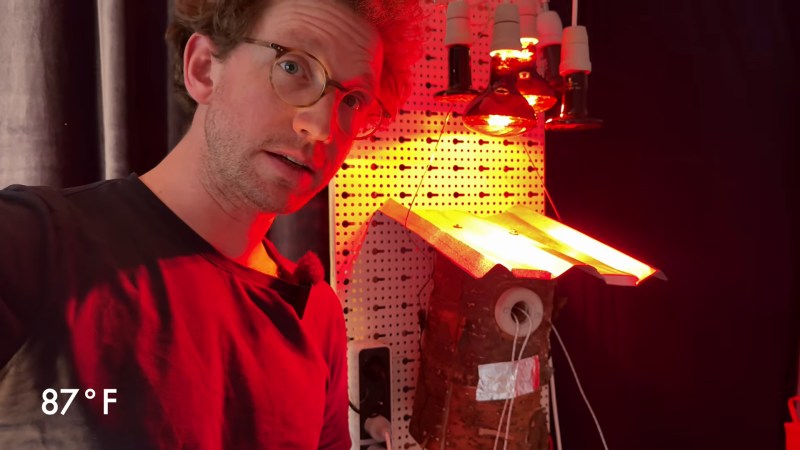
Birdhouses can be a great way to help out nesting birds in your area, but they can be a bit intensive to make. As part of a 500 birdhouse marathon, [Of Human and Nature] decided to test whether a metal roof would be safe or turn the birdhouse into an oven.
Most DIY birdhouses are made of wood to encourage cavity nesting species that would naturally find a hole in a tree to use the house. Unfortunately, an unprotected chunk of wood will deteriorate much faster than a whole tree full of holes might. A metal roof reduces the exposure to the elements, but does it make the box too hot?
[Of Human and Nature] heeded concerns from commenters and actually tested his hypothesis with a simple set of thermocouples, a heat lamp, and an assembled birdhouse. While the metal roof was held at 70˚C for four hours, the inside of the house stayed in the mid 20˚C range thanks to the separation between the roof and the actual box which allows air to flow between the two.
Maybe a metal roof could help you house your homing pigeons as well? If you want to spread the mesh with your birdhouse instead, how about a solar panel roof with a LoRa node?











He could just have hung it outside to test. It doesn’t get much hotter than today.
It is stull June, in July is normally hotter. This was already an extreme week…
Significant parts of US are facing 100+F days (38C) and in sunlight the roof will probably exceed 150F (66C) Perfect time to test a few bird houses out in the sunlight and natural wind condition
Euro-whiners.
It’s warm, get over it.
Hot starts at 110 freedom units.
Drink a beer, not a British one.
N Cal is having a nice moderate year, only hit 100 a couple of times, so far in Sac.
Humidity matters. I am from your area but now live in the Northeast. Most of the summer is fine, but a few days of high humidity at 90 degrees really is oppressive.
Don’t be an ass. As the other comment says, humidity matters. A low humidity environment at 110 isn’t that big of a deal because your sweat evaporates and cools you. A high humidity environment in the 90s can be brutal. If the air is already saturated you can’t cool off by sweating.
I live in the South Central US. Not only is it hot, but it’s also humid too. I have the luxury of air conditioning to help ease the burden. Guess what much of Europe doesn’t have, because until recent years they haven’t really needed it? Air conditioning units in every building. So let me know how your little punk ass does at 100° in a building without any AC. Well, at least if you can still talk after the heat stroke.
I’ve been to hot arid areas. With the exception of places like death valley, it’s nothing compared to fully saturated air that doesn’t cool you and only makes the problem worse. So please, take your hillbilly dick measuring and shove it up your ass. All it does is make you look pathetic.
As Bob Marlee says, humidity matters. I currently live in the wet tropics and previously in the dry tropics. 30C (86F) in the wet is far worse than 40C (104F) in the dry. I just checked the humidity numbers for northern California and you have it easy, trust me.
When humidity rises above 60% sweat evaporation slows down considerably, once the humidity reaches about 90% sweat stops evaporating entirely. At that point sweating doesnt cool the body, it just dehydrates it.
A sustained wet-bulb temperature of 95°F (35°C)—which equals 113°F at 45% humidity—is the absolute limit of human tolerance. At this threshold, a healthy person resting in the shade with unlimited water will still overheat and can face fatal consequences within six hours because biological cooling stops completely
45% of analyzed European cities have broken indoor and outdoor wet-bulb thresholds.
Additionally, nly about 20% of European homes have air conditioning. So theyre dealing with a much more signiicant issue than a california or arizona heatwave as that sort of heat is expected and prepared for there, and the humidity is far less a factor of concern.
Not entirely. The 35 degrees tolerance limit is a wet bulb temperature, which assumes 100% humidity, no wind, and no radiative loss to the open sky. In other words, you’re in a hot box with still air – a worst case scenario.
The reason sweating stops working at 90% is because you develop a bubble of 100% humid air around you that doesn’t move. Break up that bubble with a fan, and sweating starts cooling you again, albeit less effectively. But, the convection alone works to remove heat even at 100% humidity as long as the ambient temperature is below body temperature.
And mind, we only need to remove around 50 Watts of heat to basically double your survival time, since you’re generating about 100 Watts of heat at rest. If you can survive for 12 hours, the sun will go down and the temperature with it.
Convective heat loss from a surface is roughly 25 Watts/Celsius per square meter at 2-3 m/s air velocity, so an adult person standing in a gentle breeze can lose enough heat to survive 35 C indefinitely even without sweating. Of course you need to be in the shade.
Humans are survival machines.
Things are actually much worse for those who are not middle/young-aged healthy persons. Things can quickly turn from mild to acute within quarter hour with no real warning signs. When I was in my teens more than few time I managed to pass out from cumulative results of heat (driving in a bus with no air conditioning), even though I felt not too dizzy at first, just slightly light-headed.
I wish I knew some kind of good electrolyte-refilling solution that won’t leave you thirsty for more (and apparently 90% of our locally-sold “electrolyte drinks” are meant to peddle ungodly corn-syrup-infused solutions that drive you nuts more than they help you out). Alternatives (ie, three-priced “natural/organic drinks”) are not much better, since they, too, seem to arrive with all kind of experimental concoctions of unclear merit.
What worked for me in the past was drinking good ayran (store-bought is usually full of preserves and fillers, I think starch, also, sugars you do NOT need – properly made ayran is slightly salted) or consuming home-made jello. Both work, albeit, in a different way, and of course, store-bought jello is full of things better left discarded.
There are simple diy oral rehydration solution recipes that are easy to make.
The basic version is just sugar, salt, water, in precise ratio.
Some versions add other electrolytes, but are less safe for people with certain kinds of heart problems (excess potassium can kill them).
It’s not safe for long-term storage, because if done right, it has enough sugar to grow things and not enough salt to impede their growth. But it’s simple to make fresh at need.
I’m not posting any specific recipe, because it’s not one-size-fits-all. It is, however, very easy to make (once you decide what you need).
Metal tends to block heat transfer by radiation. That’s why low emissivity (Low E) coatings of silver are used in windows to increase their insulating value by reflecting the sun’s radiant energy and reflecting body heat back into the house. Emissivity ranges from 0 to 1. Lower values block radiation heat transfer better.
Typical Emissivities are
– Low E coatings on glass window panes: 0.04
– Weathered galvanized steel roofing: 0.70
– Wood: 0.85.
+1 for an informative and interesting Hackaday Comment Section response 👍
Going to drop a link so that anyone who is looking can find an actual study of how different roofing materials affect temps.
https://www.builditsolar.com/Projects/Cooling/FSECRoofPaperSummary.htm
for two summers in a row i had a treefrog spending much of his time in a black metal mailbox that the snowplow had hit such that it could not be closed completely. at first i was like “you crazy” and carried him from the mailbox and put him in a nearby tree. but he was back the next day! i don’t know how hot it got in the mailbox, but it was definitely hot, and that treefrog loved it. being an ecotherm, perhaps he could function in a wider band than what a human (or bird) could tolerate.
I’ve noticed lots of wildlife and insects seek heat in the summer. Dragonflies prefer landing and resting in sun soaked areas. Birds often perch in the sun to soak up heat. Even those pesky Boxelder bugs love heat, they are most active when the sun is absolutely just beating down on the house siding.
If I had to guess, the frog may be drawn to the latent heat radiating from the mailbox in the evening hours, and crawls in then. Wildlife is often good at sensing and finding infrared heat. But I bet you’re also right, the frog may be regretting that decision in the noon hours, but deciding to hunker down and wait it out, and hoping to survive the heat wave. In my experience, it’s not uncommon to find a dead desiccated frog in a spot that got a little too hot.
And the theory of boiled frog behaviour can have real grounds. Just waiting to wild weather to pass.
Kind of you to let the frog decide. Frogs can deliberately move to hot places to reduce fungal disease. Search for “Frog Sauna”.
Btw you can buy metal roof sheets with insulation on one side. Its a great solution for building sheds out in the sun, with air conditioning. Pretty inexpensive too.
I imagine birdies would like that
“but they can be a bit intensive to make” If a person finds that making a birdhouse is intensive to make. I feel bad for them. Like they probably think changing a car tire is the same.
It says that he’s building 500 birdhouses.
We switched from a 25 year old asphalt shingle roof to a metal roof summer 2022.
We were quoted $15k for asphalt shingles
We paid $24K for the metal roof.
Our roof came with a 10 year workmanship 40 year material warranty.
From what weve read 50-75 years is the expected lifespan of these roofs, which means that if we stuck with asphalt shingles we could have needed to reroof 2-3X
So it was more expensive up front, but cheaper in the long run.
We didnt pay much attention to the sales claim that it was going to lower our electric bill. In all honesty, we went with the metal roof because my wife thought it looked nicer on houses in the neighborhood that had upgraded to metal roofing, and it wasnt that much more money.
But we’ve really seen a difference in our electric bill
Our levelized billing plan has dropped by $100mo.
So the cost difference will be covered in 7.5 years.
The roof will pay for itself completely in 20 years of electric savings alone
Definitely a worthwhile investment.
Very cool. And I loved the album concert from your user name. Was fantastic! 😂
once you get to my age you’re like “a roll of tar paper is probably good enough”
A roll of tar paper is really only good for 5-15 years and requires frequent fixin.
At 52 The way I figure it, Unless something unexpected happens, My metal roof is going to be my last time dealing with roofing.
then there are the people living in houses whose outer surface is just Tyvec
Yes there are some ignorant people. Tyvec is only good for 90-120 days without some surface cladding before UV degradation compromises its waterproofing and vapor-permeable qualities. If you cant even afford to DIY vinyl clad your structure, you shouldnt bother hanging tyvec in the first place.
How’s it around hail time?
Havent had a hail storm yet but according to the internet,
“{Metal roofs are highly resistant to hail, outperforming most traditional materials like asphalt or tile. While heavy storms may cause cosmetic dents, a metal roof is extremely unlikely to crack, puncture, or leak.Because of this durability, many insurance companies offer premium discounts for metal roofs”
I was only thinking about the heat/electicity factors when I typed my post. I forgot to add to the PLUS column that my homeowners insurance went from $350/mo to $230/mo with the same insurer when we got our new policy the year after the metal roof was installed.
I think he thought about sounds produced by metal roof. I like these:)
Modern metal roofs are built over a normal plywood deck. Its not like the hold tin roof poverty shacks. The wood deadens the sound even when standing outside. Like I said I havent had a hail storm yet but if the difference in noise during rain between my house and my childhood barn is comparable during hail, metal roofs arent significantly noisier than other roof materials.
Metal roofs on its own, is heat overkill, in combination with insulation its actually quite good.
– the bottom layer is wood/OSB
– then I do counter battens, with the top most part being 90° to the rainflow/metal roof pattern
– and its “open air” (convection so in the summer the heated air can go up and leave through a weather barrier
So it’s basically same as his construction, and its not a bird house.
Hi Navarre! I’m the guy behind Of Human and Nature who did the birdhouse roof experiment. I just stumbled across your article and wanted to say thank you for the kind write-up. It was a really nice surprise to see my little project featured on Hackaday.
Just a small note regarding the comments asking why I didn’t simply test it outdoors: the original experiment was filmed in January at around -5°C, so an outdoor test wasn’t really possible. We’re currently at around 35°C here, and I actually repeated the experiment outside recently. I didn’t document it nearly as nicely, but the results were essentially the same.
Thanks again, and all the best!