
If you ever cracked open one of those Magic 8-Ball toys, you found little more than a polyhedron floating in some dark-colored fluid. It was a quasi-random way of asking the universe to answer crucial questions like “will Mom and Dad get a divorce?” and “does Bethany like me?” even if the results were seldom accurate (sorry about your parents, kid). If you want a more reliably random 8-ball that is not even slightly more truthful, you might like this recent build from [David Noel Ng].
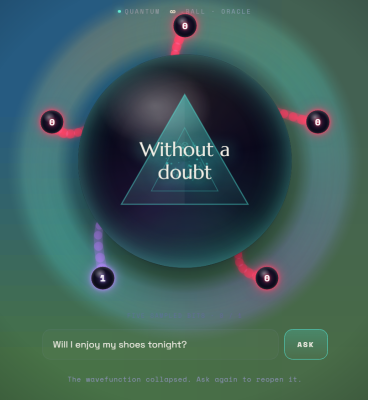
The concept is simple enough — leverage quantum effects that provide truly random results to seed run a random number generator that determines the outcome of a software magic 8-ball. [David] tried a few ways to build something along these lines, and eventually settled on a setup that he felt suited the task at hand.
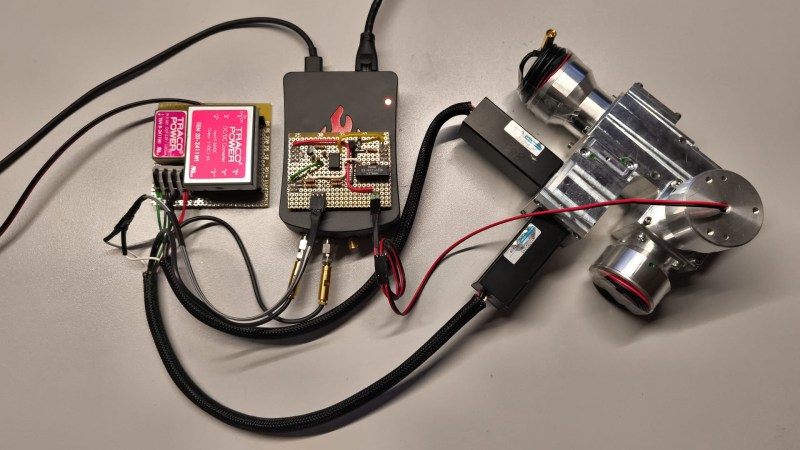
In the final rig, a light source spits out photons, and is attenuated to the point where effectively only one photon is running through the light path at a time. Each photon passes through a beam splitter, and either passes through the mirror and hits photomultiplier A, or bounces off and hits photomultiplier B. This creates a truly random yes/no result for every photon that passes through. [David] does a great job of explaining the low-level physics at play, as well as the supporting electronics and code that turns this into a usable magic 8-ball that actually answers questions.
We’ve seen other magic 8-ball builds before, too. Few come with quite the same tactile wonder created by the original toy, but they nonetheless do the job of answering questions that are too frivolous to take to a tarot reader or local divining bog witch. If you’re whipping up your own way to deduce the wills of the fates, don’t hesitate to let us know on the tipsline.











Author here!
I have an endpoint for CLI-dwellers:
curl -X POST https://quantumlever.stream/api/magic-8-ball \
-H “Content-Type: application/json” \
-d ‘{“question”:”Will my sampler touch the multiverse?”}’
And yes, this is directly hooked up the the QRNG device :)
Nice, thanks!
No video of it in action, then who cares.
Lordy, for once we get an article that ISN’T video clickbait and you complain? Plus, how do you see the one photon in a YouTube video? Silly whiner.
I was hoping to have a cat involved in a non-lethal way, but maybe this is the third possibility à la Douglas Adams where the cat got bored and hoofed it out the window.
Check out TikTok, lot’s of video’s there!
i do not think that there are moving parts in this contraption. no video needed.
or was this sarcasm without the /s sign?
This would be a very boring video. I could narrate the blog while filming the device running, but I think I would not get many views.
There would not be much to see…
If they let you observe it, it would change the outcome
i’m uneasy calling anything ‘truly random’. we’ve proven fairly well that we don’t know how to predict some interactions, but that isn’t necessarily the same thing.
Definitely can’t predict a cat. What more could you ask?
Biological behavior would in most regards be pseudorandom, bc of predictable repeatability of behaviors. Measurements of natural physical processes can be truely random, but the quality and accuracy of the measuring device must be taken into account.
This devices has been tested with the NIST STS suite, on 1.6 billion bits generated on the device, and passed all the tests.
Out of curiosity, how long did it take to generate the 1.6 billion bits?
Magic 8 balls and randomness using quantum effects, I don’t think it gets much better. We can model the ‘physically unknowable’ (ex. was that one black hole emission ‘truly random’?) w/math until the end of time, but maybe sometimes a quantum-influenced “signs point to yes” is good enough?
If we’ve never seen random before (because the absence of proof to show it isn’t, can’t be proof) then now can we really say it exists? I’m not a theologian, I’m just a guy sat in the garden drinking a strong beer after mowing the lawn. But it should be as random as the universe wants us to believe random can be (excluding physical flaws in implementing the device that could introduce bias)
This a math question that has been studied extensively. The current answer is the NIST STS test suite, which was used to verify the output of this device. That is close enough.
Anthropomorphizing the universe into having “wants” is definitely more incorrect than describing randomness as random.
De Broglie–Bohm theory in the comments, nice
Man, commentators are cranky today!
I think this is a great example of someone coming up with an interesting challenge for themselves, then seeing it through with care and thought. Well done!
… thus the need for cranky commentators. Otherwise, certain people might be forced to admit that someone who produces “something”, no matter how potentially-flawed*, has produced more than someone who produces the virtual equivalent of vinegar in the comment section.
(Actual vinegar, on the other hand, can actually have significant merit, and is a fun study ;)
this project might have flaws, but so far I haven’t spotted any worth mentioning.
“Today”? You must be new here? (Also, Disintegration is an overrated album! 😉)
Since there are links between quantum effects and the observer (i.e., the measurement problem), have you tried to influence the output of your device by consciously wishing for A vs. B?
Try it :)
Let me know the results. You probably need to try wishing a few millions times for good statistics though.
Quantum cheeseburger!
Mystic Pizza!
Rhombus of terror! Parallelogram of mystery!
I think the RNG it uses proves we are not living in a simulation!