
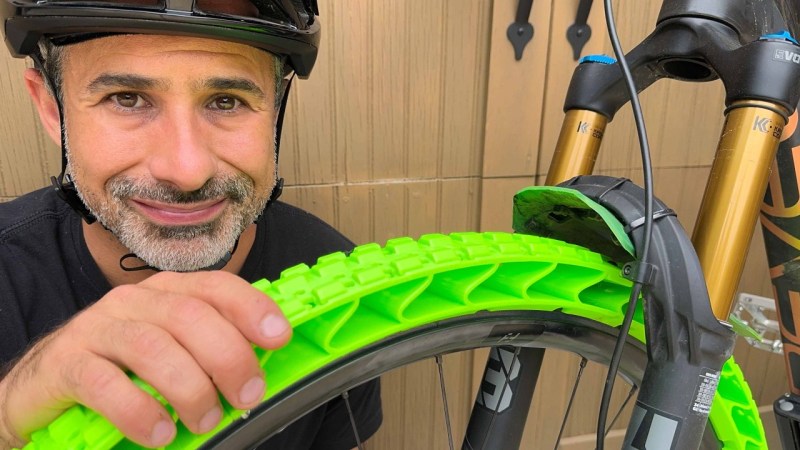
For decades now, companies like Michelin have been teasing us with futuristic-looking automobile tires that don’t use air. Instead, they use a polymer mesh of sorts which maintains the same pressure on the travel surface that a pneumatic tire does, with much less maintenance than their pneumatic counterparts. At least, in theory. There’s a reason that these tires live in the same mythical realm that Half Life 3 and the modern affordable Volkswagen do, and [Berm Peak] decided to discover those reasons for himself.
Of course, [Berm Peak] isn’t building these for his daily driver, an electric pickup truck featured in previous videos of his. He’s putting these on his mountain bike instead, a challenging environment for a tire like this in its own right. When mountain biking at the level he does, punctures and flats can become a real nuisance on the trail, so he set about experimenting with these designs with the 3D printer to see if he could make something rivaling pneumatic technology. After a few design iterations he settled on a TPU-based version with a compliant S-shaped spacing between the tread and wheel. The tire printed in sections that are installed by joining them together on the bike rim with a separate 3D printed rim interface.
At the end of this process [Berm Peak] ends up with a surprisingly capable tire that mostly holds up to his extreme off-road testing, an impressive feat for something 3D printed in his shop. Presumably a company specializing in bicycle tires could build something even more capable, but it turns out that a different technology has already solved all of the problems that airless tires solve. Mountain bikers today almost exclusively ride on tires with sealant, so punctures and flats are essentially a solved problem. But the neon-green airless tires were still a fun project for [Berm Peak] and quite the head-turner out on the bike trails.












yeah i gotta say now doesn’t feel like the moment for a tyre that sheds more plastic…
My cousin has Micheline Tweel tires on his UTV, They look a lot like these 3d printed tires.
Ive run airless tires on my bikes for 15 years. Of course mine arent 3d printed and certainly dont include the high wear tread surface. Stop-A-Flat innertube replacements are made of EVA foam. They fit standard bike rims and use standard bike tires. Ive been running the same pair in my bike for over 12 years. My daughters have been through 3 sets each, but thats only because they have gone through 3 different size bikes.
the moment you build somethign wish doesnt break yoour company will go bankrupot eventualoly. best example DDR had “unbreakable” glass for restaurants. they sold alot at start and then there was no need anymore….
yeah because there were no new restaurants opening up to buy glasses. And all the restaurants in the world are still using those same glasses hey once sold. /s
Things that do not break still need replacing in time. glasses tarnish and need to be replaced. And Airless tires eventually go bald.
In DDR? Not really. We coulnd’t sell to Western Europe or the US due to economic restrictions. Economy improved slightly after 1991 but at that point it was all lost.
This exists on a continuum, though. A truly indestructible glass would never need replacing, and would be sold exactly once. The opposite, an infinitely destructible glass, would constantly be replaced and would be sold infinitely. However, nobody makes an indestructible glass, and nobody buys an infinitely destructible one, so there is likely some curve that can be plotted to determine potential sales at a given degree of durability. The peak of this curve is likely not at a level of durability that we consciously prefer, leading dissatisfaction with market economics.
… because there was no DDR anymore. And they weren’t the only ones making nearly unbreakable glassware in the world.
That “unbreakable” glass was just tempered glass, and it did break – explosively – when subjected to enough scratches, shock or thermal stress, like inside an industrial restaurant dishwasher where the glass shatters into million billion tiny cubes that fly everywhere.
We still have those.
Not so – it wasn’t tempered, rather it was chemically strengthened by replacing sodium ions with potassium ions, much like gorilla glass is today.
It can, of course, still break, but when it does, it makes good old-fashioned jagged shards, not cubes.
Not really, as long as your company didn’t get crazy in the scaling up to meet that initial demand and collapse there will always be a need for more – folks lose them, the 80’s styling is just too dated for your tastes etc.
As long as you can actually trade with the world as a whole it isn’t all that crazy to consider a company that sells “indestructible” products surviving. The real problem is if your pool of potential customers is so so small that even the minimum viable number of workers needed to actually make the product only need to work 2 weeks in the year to meet the demand of those folks that do need a new one.
And the institutional knowledge that goes with your primary product might well make you a natural partner/developer of other things – in the case of ceramic/glass products perhaps you end up producing the heat shield and windows for the space companies, the scratch proof high optical clarity lens for action camera/film industry etc.
While airless has existed in cycling for a while, it’s usage and adoption is only in particular niche areas. While tubeless is much more common, but they still use air however more recently they’ve adopted eva foam in peloton and other areas, but air filled tyres are very much the norm due to weight, pressure and having trust in your tyre to hold up, especially on a turn.
I had solid polyurethane tube replacements in my BMX bike in the 80s.
Ah the 80s, wonderful era of grunge, hip hop and beginning of a modern “smoke weed” culture.
grunge may have started in the 80s but it didnt really take off beyond a small local/regional scene until 1991
You might as well say hip hop was a 70s thing if you try to call grunge an 80s thing, and really unless you want to count a few artists who managed to mainstream in the 80s like RunDMC. NWA, and the Beastie boys who brought rap into the mainstream rock crossover space, but whose tracks remained sporadic visitors near the top tier of the charts The Hip hop scene nationally didnt really gain strong mainstream chart pretense until the early 80s as well.
And FINALLY the 80s was actually a HUGE lull in smoke weed culture. We had an active war on drugs, DARE to keep kids off drugs, and this is your brain on drugs commercials. Compared to the 60s and 70s weed culture was minimal. High Times magazine came out in 1974.
Tell me you were unalive or in diapers during the 80s without telling me.
pretense should have been presence
“Mountain bikers today almost exclusively ride on tires with sealant”… Written by someone who does not mountain bike. After years biking and only once with sealant in my tubes, I found the sealant worthless, heavy a mess. Even the foam inserts change the feel and handling in a bad way. 20 years ago the company Specialized rilled out their Armadillo tires which admittedly are heavier. But I have not ever had a flat since riding on those.
I ride and race with probably 20 other people on a regular basis and they all use tubeless/sealant.
It’s a pain to get loaded into a new tire and get the tire seated (most of my friends have this done by a mechanic, one does it in the shower because he’s sprayed sealant all over the room one time too many, yes, air compressor in his bathroom) but once it’s in and the tire is seated, it really is amazing. No pinch flats on even the worst hits, and for downhill racing that alone is worth all the hassle.
But it’s sure a drag when you do manage to puncture badly enough it doesn’t seal the hole, which I’ve had several times using more or less cross-country tires on a downhill course and hitting sharp rocks.
Still, a coworker rode my enduro bike through an entire huge patch of puncture vine and came back with (we counted as we were removing them) 78 goatshead thorns in the rear tire, and it was still holding pressure. On a traditional tire/tube setup that would for sure be a replace both tire and tube event.
I carry a tube along for dealing with big punctures, but I ride/race (on my enduro and downhill bikes) pure tubeless.
It’s kinda terrible for road bikes, imho, but even then it’s making progress. Maybe some day.
Mate
Noone who rides off pavement regularly uses tubes.
They suck so badly it’s not fun. People who say they ride tubes on their MTB either actually only ride about 2km a year on gravel or don’t know how to set it up.
Tubeless is so much better than tubes it’s not funny.
Lower pressures, better comfort and compliance. And, never getting flats.
Riding in a rooster tail shower of debris picked up in those side holes? I’ll pass.