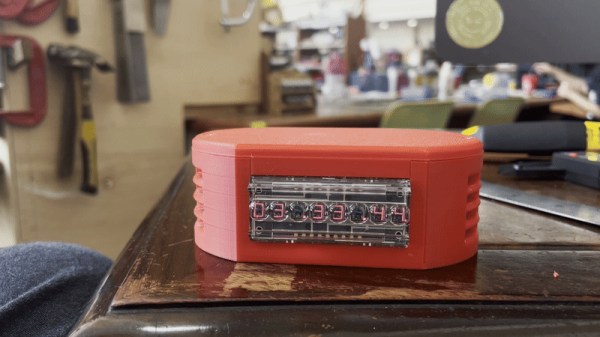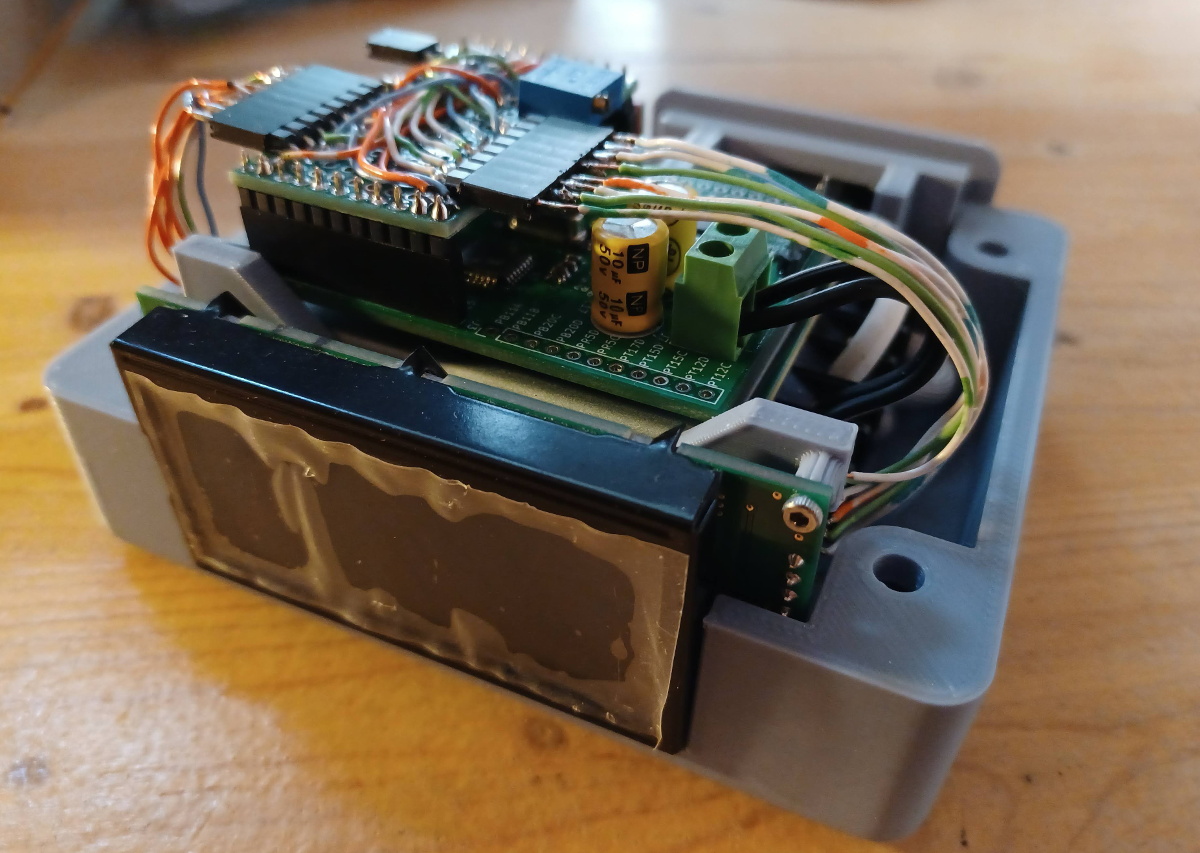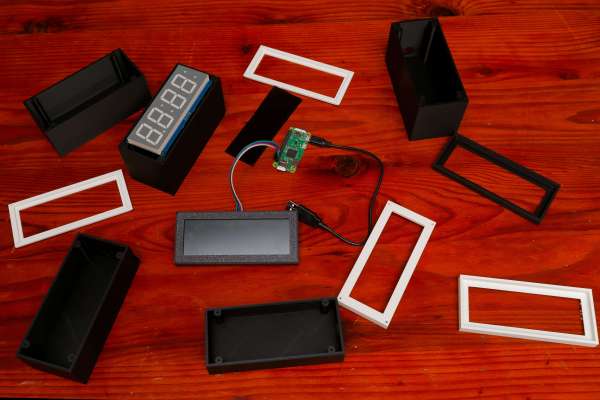
All the parts of a digital clock. Photo by Lee Hutchinson.

Ever Seen Claude Use Fusion 360?

We’ve all done it before: a simple project that escalated to the point of extreme overengineering.
But what’s less common is [Lee Hutchinson]’s digital clock, whose case is (somewhat-successfully) designed by LLMs!

A clock needs time synchronization, and a digital one needs some code to drive the display. An avid systemd user, [Lee] had no trouble at all setting up all the users and services needed to keep the time synchronized. Some rusty Python skills with some aid of the dreaded Claude Code later, [Lee] had a script to actually show the time too.

But now comes the interesting part: the case. Now, [Lee] isn’t really a mechanical engineer, and he doesn’t really like Autodesk Fusion’s UX. Most projects would see their creators just grit their teeth and get on with it. But here, in an experiment we haven’t often seen before, [Lee] connects LLMs to Fusion’s new MCP server feature! Did it work? Surprisingly enough, yes. Kind of. The local Qwen model got most of the way there on one request, but still made mistakes for the other. However, another pass with the more powerful Claude models got the job done.

But there’s much more to the story; [Lee] goes into more detail, and talks about the assembly process, over at Ars Technica.
It’s A Water Clock, Jim, But Not As We Know It — It Has Digits

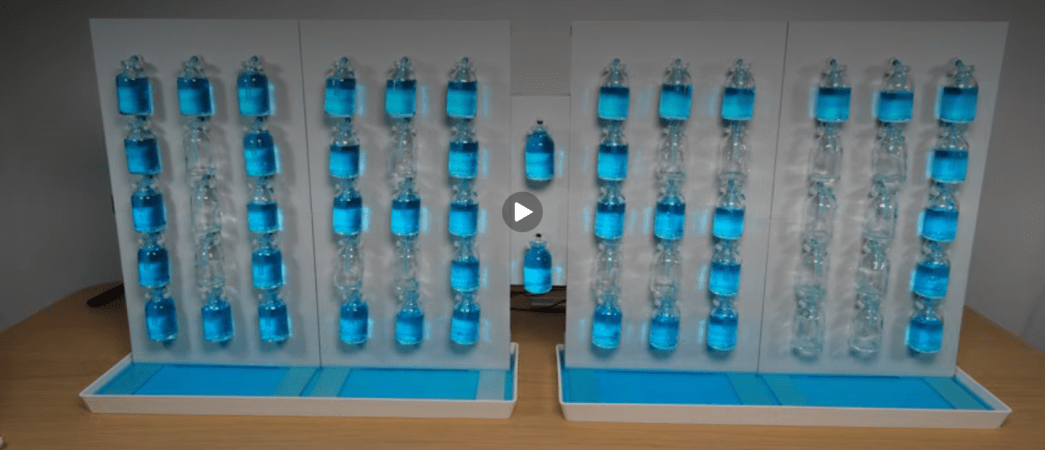
Guess what time it is– that’s right, clock time! It’s always clock time, and when it’s clock time at Hackaday the weirder the better. So, how about a water clock that’s not actually a water clock? The water here has nothing to do with timekeeping, but is what’s driving the display. Fair to say that [Strange Inventions] is living up to the name of his YouTube channel.

You can get the idea from the header image: each digit is formed by a fifteen-segment display made up of glass bottles. A stepper-driven peristaltic pump and some membrane-pump boosters fills the bottles as needed with dyed water, while emptying is accomplished simply by having a servo dump the water into a trough. It’s an interesting, albeit messy, way to generate a display.

It wasn’t the original idea– well, the bottles were the original concept, but flipping them was not. Dumping the bottles has the advantage of not needing oodles of pumps or taking five minutes to sequentially fill and drain the bottles at each digit. The linkage to get the servo to flip all nine bottles in one go took some troubleshooting– we can relate, since the physical half of such projects usually is the hard part– but after many modifications the 3D printed mechanism worked, and we think the results are worth it.

If you’re looking for the other kind of water clock, we featured one of those before, too. This one is also of ancient style, but makes use of modern electronics. It occurs to us that if one was really, really ambitious, they could expand this [Strange] project into a very damp flip-dot style display. Continue reading “It’s A Water Clock, Jim, But Not As We Know It — It Has Digits”

The Most Intricate Of Freeform Digital Clocks

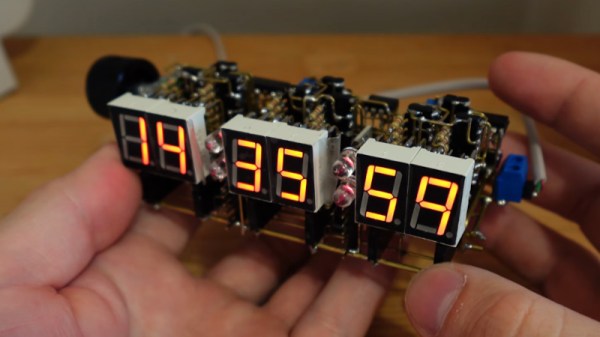
Digital clock projects have been with us since the 1970s, when affordable LEDs and integrated circuits became available. In 2026 most of them use a microcontroller, but for the AliExpress fans there’s one that goes straight back to the ’70s with a pile of logic chips. You can make it on the supplied PCBs, but that wasn’t for [ALTco]. Instead, he made the circuit in free form, using six metres of brass wire.

The construction is anchored together by a set of busbars that carry sockets for a set of seven-segment and driver modules. The circuit is typical for the day, with a crystal oscillator and divider chain feeding the counters for the displays. There are a few clever tricks that older engineers might recognize in order to reduce the chip count. In this case that’s negated by an extra set of circuitry allowing the time to be set from a rotary encoder.

We’re impressed by the intricacy of the device, made bit by bit without a plan, it as some wires what thread their way between others. It’s a truly beautiful piece, and it reminds us of our circuit sculpture contest back in 2020.

Continue reading “The Most Intricate Of Freeform Digital Clocks”

Binary And Digital Gradients For Telling Time

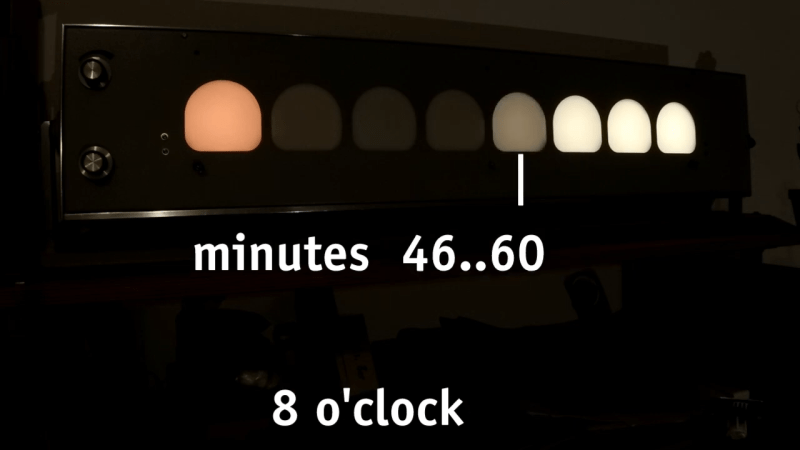
Creative clocks are a dime a dozen, even clocks that use binary have been created in nearly every format. [typo] promises a clever adaptation to the binary format, and it promises a more usable display. Using a combination of both traditional binary and digital gradients creates a usable and yet still nerdy fun clock.

[typo]’s clock fits the traditional binary counting method with the hours on the left side of its face. On the other hand, its right side presents a lighting gradient depending on the completion of the hour. While this is simple in principle, [typo] chose to correct what many don’t consider when deploying visual gradients. The human eye doesn’t see everything exactly as it is, which creates a rough logarithmic curve that gets corrected for in the binary/digital hybrid clock.

If you want something more mobile and still have that smidge of difficult time telling you, check out this minimalist wrist watch!

Continue reading “Binary And Digital Gradients For Telling Time”

Bubble Displays Make A Neat Retro Clock

In 2025 we are spoiled for choice when it comes to displays, with affordable LCDs, OLEDs, TFTs, and e-ink panels of all sizes only a few clicks away. But in decades past, such exotica were not on the menu for casual construction. Instead there were a range of LED seven segment displays which have now largely passed out of use.

Among them were HP’s bubble displays, assemblies of miniature LEDs on a PCB, topped with plastic bubble lenses. If you had a calculator in the 1970s it probably had one, but in the present, [Joshua Coleman] has incorporated one into a pleasingly retro digital clock.

Inside the 3D printed case is an ESP32 with a pair of 74HC595 shift registers to drive the display, and an 18650 battery with all associated charging and protection circuitry. It’s a surprisingly simple circuit, and the code is provided on the page. He makes an apology to non-Americans for his use of US date formats, but we think few readers will be unable to change it to reflect the only date format which really matters.

If you find a bubble display, hang on to it. They’re certainly something we’ve seen before here a few times.

Accurate Digital Clock Keeps Ticking With FPGA

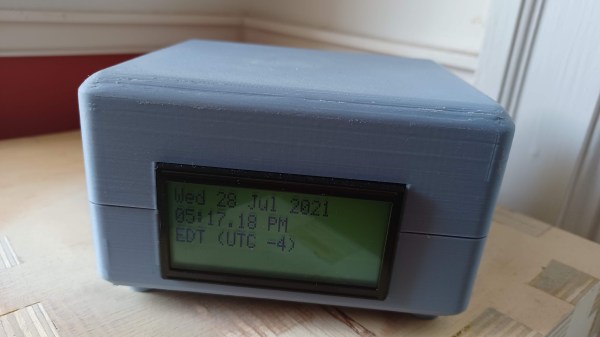
Even the most punctual among us are content to synchronize their clocks to external time sources like navigation satellite constellations, network time servers, frequency-controlled AC mains, or signals broadcast by radio stations such as WWV, CHU, and DFC77 — but not [zaphod]. After building a couple of more traditional clocks over the years, he set his sights on making a completely isolated digital clock that doesn’t rely on external synchronization (well, except to initialize the time at first power-up).

The accuracy goal he set for himself was that of a Casio F-91W wristwatch, which is specified to maintain +/- 30 seconds per month (about 12 ppm). At the heart of the design is an oven-controlled crystal oscillator whose stability is in the single-digits parts-per-billion.

The counter chain that accumulates the time is implemented in an FPGA — admittedly overkill, but [zaphod] wanted to learn FPGA programming for this project as well. An ATmega328 drives the display and does other bookkeeping tasks. The whole design is partitioned into three PCBs which fit inside a custom 3D-printed case.

[zaphod] does a thorough job documenting his build, including the bugs and failures along the way. We like the honest summary he wrote at the project’s conclusion, noting things that could be improved or should have been done differently. Be sure to check out the GitHub repository, where all the source code and PCB design files are posted. How accurate is your wristwatch, if you even wear one anymore?

Big Time Character LCD Clock

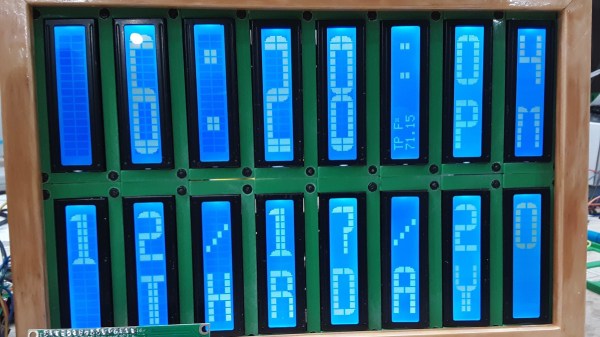
While the SSD1306 OLED has somewhat become the go-to display for up-to-date projects, the good old character displays with their Hitachi HD44780 controller don’t seem to be disappearing just yet either. And why would they, especially if you want to show just text, having a built-in font has certainly its perk compared to worrying about integrating your own characters — which you can still do on top as well. Or perhaps you can combine both worlds, which is what [oldmaninSC] did with his digital clock that takes an entire 16×2 LCD to show each single digit.

The whole clock uses 16 individual, upright rotated 16×2 LCDs that are arranged in two rows of eight LCDs each, turning the entire construct sort of into a giant 8×2 display itself. For some additional information such as the date, there’s also a smaller font available that uses only half the height, allowing up to four total rows of information. To communicate with each LCD via I2C, two TCA9548A I2C multiplexers are connected to an Arduino, along with an RTC to keep track of the time and date itself.

As the TCA9548A has three pins dedicated to define its own address, the entire clock could be scaled up to a total of 64 LCDs — so how about a 16×4 display made out of 16×4 displays? Sure, adding smooth scrolling might become a bit tricky at some point, but imagine playing Tetris on that one!