
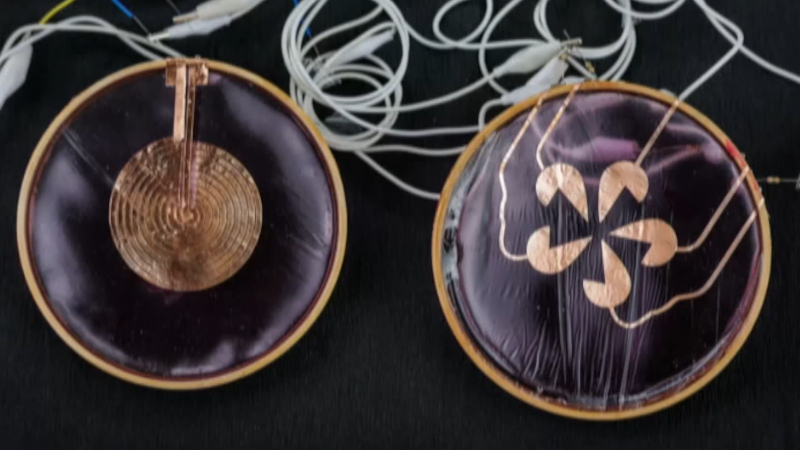
Flexible printed circuit boards are a fascinating technique for making electronics venture beyond the two-dimensional, but surprisingly they’re not something many of us have worked with. [Jessica Stanley] gave a talk at the recent Electromagnetic Field event in the UK, exploring the different ways to make your electronics bend.
She starts with an overview of flexible electronics, detailing the techniques used with conventional polyimide substrates and etched copper. We’re particularly enamoured of a stretchable PCB made by coiling a flexible circuit round a piece of elastic. Since she’s looking for techniques accessible to everyone that don’t either cost a fortune or require dangerous chemicals we look at conductive paint and electrolysis, before arriving at using a vinyl cutter to create adhesive traces.
We’ve no doubt all noticed that flexible PCBs can be ordered from the usual fabrication houses at a price, but the value in this talk lies in reminding the viewer that this is not the only path. She demonstrates well that simple flexible PCBs can be within the reach of almost anyone, which is perhaps the encouragement needed for people to try this medium. The full talk is below the break.












Flex PCBs are also great for patching part screwups on rigid PCBs. Tolerances and trace/space on flex PCBs are usually way better than rigid PCBs, and so you can pack much more into an equivalent space.
And then you can generate the equivalent of castellations by just creating a through-hole pad, and using scissors to trim it to size. Get rid of the original part, solder on the patch board with a little UV-curable solder mask, and it might as well be original.
that technique is frequently used in the mod chip department. with thin spidery traces tapping distant signals.