
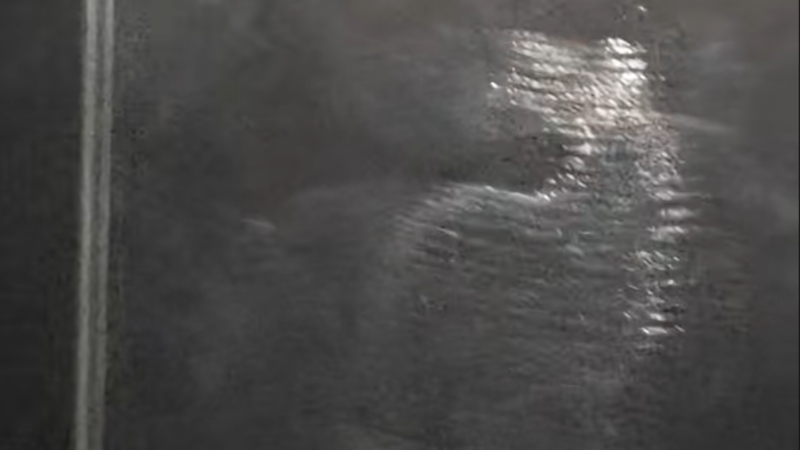
When mass-printed holograms appeared on magazines in the 1980s they were a huge novelty, before degrading to the level of kids’ stickers in the years since. At the time they were seen as not for ordinary people to make, but the truth is they can be created without lasers or an optics lab. [Jordan Matelsky] is here to show us how they can be made using as humble a device as a pen plotter.
The effect of an interference pattern from a set of fine lines in a thin film can be demonstrated at its simplest with an oily finger and a mobile phone screen, and once he’s demonstrated that he takes us through some of the theory involved in shifting the light to make an image. There are some false starts with different materials, but eventually he shows us some finished holograms scribed on the polycarbonate of a CD case. It seems you really can make a hologram with a pen plotter. If these images interest you, we’ve looked deeper into the subject in the past. Meanwhile, one of the plotter-scribed holograms can be seen below.












Scratch holograms are such a fun little thing.
This topic is incomplete without a link to
[wbeaty] “first hand-drawn holograms, 1994”
https://www.youtube.com/watch?v=XUy8lELWhJg
Do I feel old now? Yes. Is this still an awesome video 18 years later? Also yes.
And the corresponding text description of how this process is performed:
http://amasci.com/amateur/holo1.html
Thanks for the rabbit hole! Old but IMO worthy its own Hackaday article for the unaware like myself.
Thank you for bringing up Bill. He has been a terrific resource for doing amazing and dangerous things for over a generation, and deserves the recognition.
It’s a really nice effect and I like it, but please don’t call it a hologram. In a hologram the image is formed by the interference of light that gets diffracted from the microstructure which is not the case here.
Also If “hologram” is meant colloquially for some kind of volumetric image and not as a technical term, then the beginning of the article does not fit, since it’s about real holograms.
I’m usually That Guy but you beat me to it. Must use diffraction and interference to produce light field. I still pester Looking Glass Factory, as their “holographic viewers” are some sophisticated permutation of lenticular lens arrays, not holograms. You could potentially create a fringe pattern with a pen plotter that would function as a hologram, however due to a very wide fringe spacing it would only be viewable from a narrow angle, and one that is nearly co-incident with the axis of the viewing illumination.
Yes, narrow viewing angle, and very low photonic efficiency if reconstructed by reflection (which is much less likely to be sufficiently phase-coherent, causing most photons to fail to contribute to the required interference wavefront).
But, with sufficiently bright illuminator and sufficiently precise manipulation, reflection can technically stand in for diffraction in some cases. (same interference front via different means). Some of the early laser and silver-emulsion film holograms were technically more a matter of reflective interference than diffractive interference, although that wasn’t a settled question for decades.
If it can generate a 3d lightfield, it can be called a hologram. Things like Pepper’s Ghost definitely don’t, but a scratch hologram definitely does.
Actually, scratch holograms (at much smaller scale) do exactly that, just statistically. Some fraction of the light is constructively and destructively interfering to create the intended pattern. The interference is key to the definition, the means (diffraction, reflection, dice rolls) is not.
Quite a few of the early laser holograms were non-diffractive (although that wasn’t definitively settled until much later, with much closer atomic-force inspection of how the laser exposure changed the properties of the film).
The easy rule of thumb is to compare the ratio of the brightness of the reconstituting illuminator versus the brightness of the resulting holographic image. Reflective holograms are generally much less photon-efficient, since many reflected photons will not contribute to the correct interference pattern. Somewhere I have a bunch of preprints from research in the early 1980s that was (at the time) highly valuable to one of my previous employers, but later turned out to be impossible to effectively monetize…
Wow. I had no idea that was possible. It makes sense, just never thought of it before.
I have been working on this the last couple of years and have been converting 3D drawings into holograms. Here is a little demonstration from and art exhibition I had this spring https://www.instagram.com/reel/DY7JYnPApCM/?igsh=MWIxOWFyZGxxZmsycw==
I want to see this on a lottery card.
Maybe the same type of holograms could be 3D printed. After all, it only requires a series of shiny, curved surfaces.
Could be a cool art project constructing a cube out of black acrylic sheet and etching the holograms into each side using a CO2 laser
Took me more time than I care to admit to finally see it as a rabbit rather than a random scratched blob