
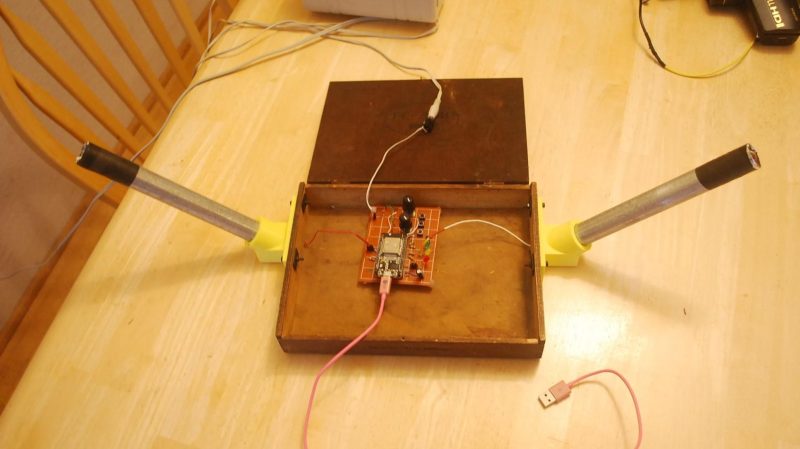
The Theremin is that classic electronic musical instrument that makes those weeee-ohhhhh noises which were so popular in mid-century science fiction movies. Mid-last-century, that is, because this century is just beginning. In any case, you could build one with old-school analog electronics, or you could go a more modern route, as [ericCycles] did.
The build relies almost entirely on an ESP32 microcontroller with minimal supporting circuitry. Like any other Theremin, pitch and volume are controlled by moving hands closer or farther away from two antenna. In this case, the ESP32 uses its capacitive touch circuitry to detect effectively detect hand proximity to the two antenna in question, and uses those values to control the pitch and volume of a synthesized waveform. That waveform is then pumped out over the onboard digital-to-analog converter for playback on external speakers.
If you want to build a simple Theremin-like instrument quickly and easily, it’s hard to beat the simplicity on offer here. We’ve featured some other fun variants over the years, too, like this version that uses time-of-flight sensors for the human interface.












SQWEEEL like a piggy
Also check out micro-espectre for ESP32. It’s an experimental feature that adds theremin-like sonification of Wifi CSI data
https://github.com/francescopace/espectre/tree/main/micro-espectre
Are the antenna just lengths of metal piping or is there more to them?
It seems that the entire pitch range is compressed within a millimeter or two, which is not playable.
Really sensitive for sure. Without playing even a single pitch for a second it seems to be modulated with some noise as well. Try using a single finger with your arm resting on the desk.
It’d be interesting to use one or two mmwave sensors instead to sense space/distance and possibly introduce chords and dynamics based on multiple hands and gestures. Maybe not really a theremin at that point but an interesting idea based on the theremin.