
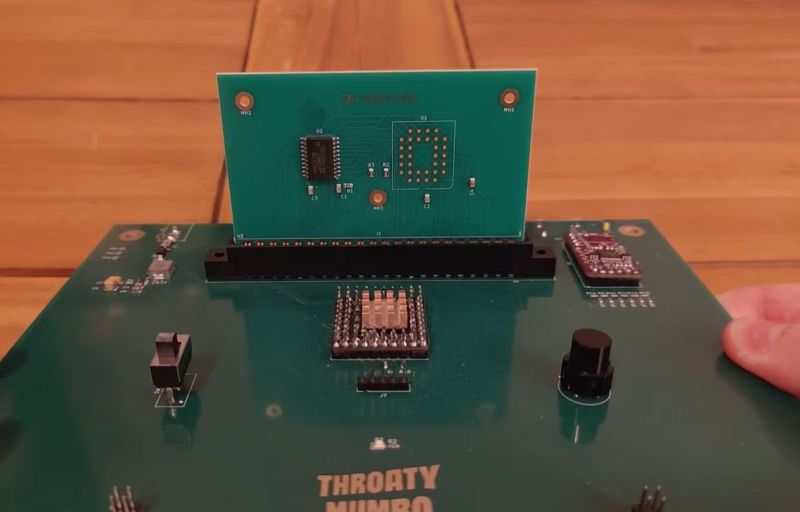
As easy as it is to make a late 1980s-style game console using a modern microcontroller, there’s arguably more fun in doing things the traditional way. This is the challenge that [Throaty Mumbo] took upon himself when he embarked on his retro game console project, called simply the Game Console V2.
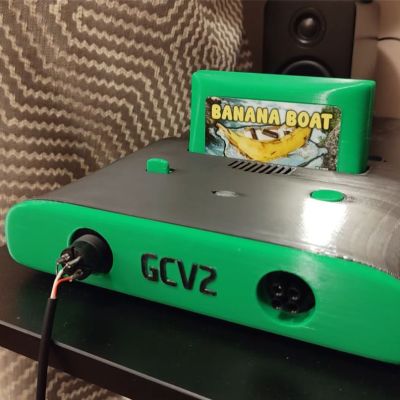
In the accompanying video the development process and other details are covered and demonstrated. Most notable perhaps are the proper cartridges with ROMs on a parallel bus rather than something like SD cards, and the absence of any modern ports including even VGA. This means only composite AV output like in the good old days of RF splitters and other assorted fun.
The NTSC output signal is generated by an RP2350 MCU in the form of the PGA-shaped PGA2350 breakout board that’s wired into a 6-bit R-2R network for RGB332 output via the RCA jack, while audio is fed into a PCM5102A I2S DAC. For controllers you get 4-pin Bulgin SA2367 connectors and an N64-compatible protocol.
It’s noted that the use of an RP2350B MCU is temporary, as the goal with the V3 version of the project is to take it into a proper 8- or 16-bit CPU direction. We’re certainly looking forward to seeing this next revision of what looks to be a pretty interesting game console.












This is fantastic ! the banana boat game remembered me to “enduro” for the 2600.
That’s a small PCB, why didn’t they make it larger with even more wasted space? I hear FR4 and copper is cheap as chips these days, we should live in FR4 houses with FR4 walls
We should live in FR4 houses with FR4 walls. Hmm.. interesting idea, this way we can include all sorts of wiring in the walls for free (electrics/data/sensory), solder/mount the lights and switches directly at the walls, get rid of our tinfoil hats if we use multi-layer to add some shielding and wallpaper is also no longer needed since the applied silkscreen will last forever as it doesn’t fade and it is easily cleaned. And finally (for completeness) we can always include one or two 555s somewhere in a corner, just for the fun of it.
Although somehow I have a feeling that this is not really what you meant?!?
Ahh and as a tinkerer, I would not be able to resist blaming every problem on cold solder joints or glue that became conductive lol. I also think the idea of a wall you “have to let warm up and it’s fine” should be a thing too just so I know it is doing something. Not making fun of your comment, it just sparked some funny visuals blending the two worlds :)
I wonder why the Bulgin connectors instead of something that was actually used on retro systems like the 9 pin Atari joystick connector.
Probably because “N64-compatible protocol” only needs three pins. Could have used 3-pin mini DINs, similar to the PC Engine/Turbografx.
I dream of doing something using only pre-1980 tech or the modern equivalents. Think Atari VCS and the tech that came before it.
If you like this, also take a look at the GameTank. 2x 65C02 CPUs (one dedicated to audio), Genesis/Mega Drive compatible controllers, framebuffer + blitter instead of a dedicated graphics chip. No FPGA or microcontroller. Curiously low resolution video output and yet a bit anachronistic in terms of how much RAM it has, but otherwise an interesting project.
I wanna “retro” game console that can play all of those Flash games we used to play but 100% offline.
There’s that thing called Flash Player Projector. Seems to work good for standalone SWFs.
Using real cartridges and composite output gives this project a lot more retro character than simply emulating an old console.
I have always enjoyed hardware that keeps those older limitations, and testing the video output on a proper CRT seems like the best way to get the full experience.