
[Mansour] presents an interesting idea in his essay A Common Thread — just as USB-C has become the “One Connector To Rule Them All” in the world of electronics, so too should his projects have a unified physical connection layer. A common thread, if you will.
Specifically, the 1/4″-20 UNC connector that was already on all his camera equipment. Unifying his stuff around that connector wasn’t a bolt from the blue brainwave. By the sounds of it, the idea evolved over time and only became intentional after he’d already started using it.
There’s something to be said for it, though. One thing is the convenience of knowing your various bits and bobs are going to fit together like they were made with LEGO. Another is taking away a whole set of decisions in the design process: it’s going to have a 1/4″-20 UNC fitting, so [Mansour] needs only decide if its going to be tapped into the material or if he’s using an inset or captive bolt.
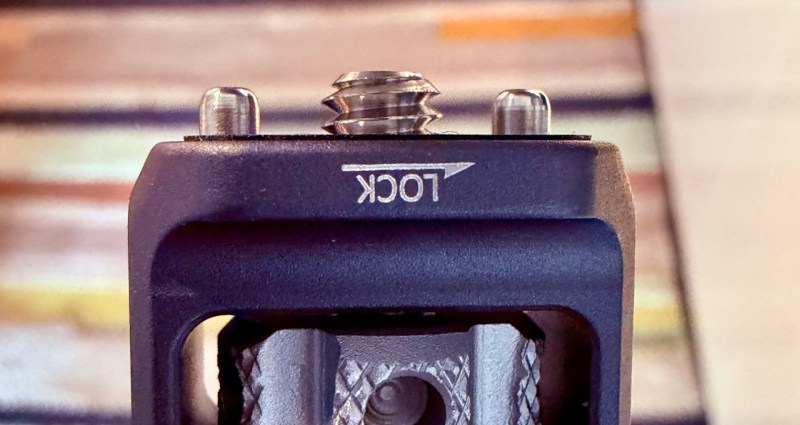
It isn’t like a 1/4″ bolt is going to introduce a weak point in most things we build — with good hardware it can take a ton or more. On the other hand it’s not exactly resilient to torque, but [Mansour]’s camera bag had the answer to that, too: spring loaded locator pins that drop into holes on the female side to take up the torque. In the photography world, these are ARRI pins. To us they just seem like a good idea.
Maybe you don’t see the point of avoiding redesigning the wheel every time for custom mounts and brackets. After all, that lets you come up the the ideal solution every time. On the other hand, [Mansour] has both simplified his design process and made decades worth of camera-holding objects — everything from tripods to stabilizing gimbals — accessible to all his stuff. It’s an interesting idea, and his full blog post is worth a read, even if it’s not likely the EU is going to force its adoption like it did USB-C.











Isn’t the camera screw 1/4″ British Standard Whitworth?
(It is not the same as 1/4″-20 UNC but compatible.)
And it is not metric
neither is Time, and I bet you haven’t switched to a metric clock.
There simply isn’t a common metric threadform that serves the same purpose as 1/4-20.
M6x1.0 is the closest and it’s threads are 25% finer, not something you want on a frequently cycled, hand-fastened application.
M8 is probably perfectly fine equivalent if you wanted to go metric – barely any bigger diameter and almost identical thread pitch to the imperial offering.
But honestly that finer thread of M6 coarse is probably a better choice for your universal thread, way overkill for almost everything mechanically while being smaller. Also in your hand threading matters scenario you are only threading that handful of mm deep! The difference between 8 turns and 6ish for the slightly different thread pitch is pretty irrelevant, and most of the time that sort of use case doesn’t need a large depth of threading – they just need 3 to maybe 5 odd full threads of engagement to be secure enough to do the job.
I don’t disagree about M8, it would work great, but it is also double the square area of an M6, sizing out a big chunk of applications.
Your thread count for short bores applies to permanent fastening when actually exercising the fasteners strength. A 1/4-20 eye bolt can hold over 250lbs safely, breaking over 500, far in excess of anything the hand-tightened nut on your camera tripod would ever see. It’s pretty easy to trade some of that yield strength for fewer threads, given the coarse thread will significantly reduce the chance of cross-threading, clearly pretty important for an attach/detach point.
1/4-20 is also just an unusually coarse thread pitch for it’s diameter, and is one of the most common thread pitches you will find on any fastener in North America.
There is M6 x 1.25 but it’s quite rare.
Camera equipment also uses the NATO-rail system used for mounting things on rifles.
The original standard was indeed BSW. The ISO standard, originally created in the 70s, decided to go with UNC. (and yes, it’s one of those rare non-metric ISO standards, because of tradition)
shall we not make a standard of anything non-metric please…
Many of us uses banana system and it’s not going away anytime soon
Lens fittings used to be screw thread too, but they realized bayonet was much easier.
So now I wonder if we would really want a screw, I mean I find them quite fiddly, although what the camera world did as a solution is using quick release plates that you screw in the camera and the in place you want to mount a camera a receptor. But is all that really the optimal way to go I wonder.
Seems to me instead of a ‘universal screw’ standard (which de facto already exists) we should focus on a universal release plate standard, because there are now a few main contenders and then there is the occasional odd one.
Problem there though is that you want the smallest option for each situation, and that means you can’t have a single one as standard really, you might need 2 or 3, and at that point we are in the wonderful world of ‘universal USB’ where even USB-C can have half a dozen possible variations.
Oh well.
Bayonet loosens with wear. Breach-lock (Canon for example) has a ring that simply turns further with wear.
A quick release standard would be great. Quick release makes no sense as it currently is because most tripods come with only one plate. Have multiple cameras? Back to screwing around with the only plate.
The closest thing to an open quick release standard in tripods is Arca Swiss Plate, it’s easy to find tripod heads that use it, and it’s equally easy, and cheap, to find all manner and sizes of generic arca swiss plates to use with your gear. I have a few heads from small to larger, with various generic plates in sizes from 38mm to 300mm, all mount the same. If you already have a branded tripod that allows you to swap out the head, consider replacing the proprietary mount head with arca swiss plate ones, it’s so much easier to deal with.
There are actually multiple, very good unencumbered standards for quick release plates (insert “now we’ve got n standards” comic here).
Arca-Swiss is one: It’s a specifically-sized dovetail design that can be used in multiple directions, multiple lengths (which will be interchangeable still), and with sundry secondary features. The tripod/mount side can also have several different mechanisms for quickly-but-securely locking things in.
Manfrotto has a similar standard, and there are a couple of others; even though they were established by one company or another, they get used by a lot of manufacturers, establishing a useful ecosystem. I’m a big fan of Arca-Swiss myself, in no small part because Peak Design has some very slime-line camera plates with some convenient extra features, and a nice travel tripod that interoperates with it; while I probably have a couple dozen different AS-format plates and mounts, I don’t have a single Arca-Swiss branded one. But the geometry is imminently 3d-printable, so I’ve even got some of those.
This is pretty classic “emergent standards” situation; not as convenient as “one true standard”, but there’s so much extant buy-in, and the different systems do provide slightly-different benefits, that it doesn’t feel likely to go away any time soon. And I haven’t even mentioned the larger formats for like, video rigs; pretty sure those plates alone are heavier than some mirrorless cameras. Very different needs.
*slim-line
Also, forgot to mention — I don’t really know why cheaper gear doesn’t opt to use these standards, aside from cost-cutting. It’s pretty annoying, TBH. Even my JOBY flexible tripods have had to get head replacements. I’m pretty sure you need slightly tighter tolerances, and ideally not in plastic, to make a secure connection with an Arca-Swiss plate.
I have multiple plates.
Perhaps one of the many microphone mount thread standards? Variety is the spice of life!
Or perhaps the splice of life?
I own an old house and I have standardized every repair that I can to T15 cabinet screws. T25s for big repairs. Never fiddle with the wrong bit again
The first time I went to the US I visited Home Depot to buy some 1/4″ nuts and bolts for future projects. Being able to use tripods or attach cameras to anything seemed like fun. 10 years have passed and I haven’t used any. Oh, and I found out you can get them easily in Europe too.
Better than buying chocolate that tastes of vomit.
?
american milk chocolate (especially hersheys) is often flavored with butyric acid (some sort of breakdown product of the milk), which is a common organic acid that is present in our digestion and (in high concenrations) reminds people of vomit or gym socks. some people love it and some people hate it but it distinguishes most american milk chocolate from most european chocolate. in this case, a metaphor for across-the-pond difference.
I also tried Eggos, Twinkies and Pop-Tarts but I guess that’s out of scope of this discussion (I didn’t bring any of these home).
I bought some 1/4-20 heat inserts and matching bolts a while back. Haven’t used any of them (yet).
Typo: the anti-rotation pin standard is developed by *ARRI, not AARI. Professional cinema camera company.
In the cinema world, we use 1/4”-20 screws and 3/8”-16 screws for mounting, almost exclusively. The ARRI standard has been 3/8”-16 with anti-rotation pins for decades, and they recently introduced a 1/4”-20 version as well, with closer spacing for the pins. You can see documentation here – https://www.arri.com/resource/blob/320202/04f5271d1d21f8c7db4a460d2e871b44/pin-lock-standard-download-data.pdf
SmallHD, a cinema monitor company, includes a competing standard for 1/4”-20 anti-rotation pins for years, but recently they’ve moved to adopt the ARRI standard as well, unifying most cinema accessories.
Fixed, thanks!
The 3/8 standard goes back over 100 years.
Hi Taylor—
That anti-rotation solution is actually called ARRI pins, after the company that invented them, Arnold & Richter Cine Technik. Their very fine ARRIFlex camera systems were the main competitor to Panavision back when movies were made on film.
The typo in your correction is a nice touch. I shall make the required correction.
Not to be confused with the “arri rosette”, which is a hirth coupling.
Nicest example of a hirth coupling is the “Newbould Model 202” indexer. “Adam the Machinist” has made a nice video about this thing, but “Machine Thinking” has some clearer pictures about how the hirth teeth do not make a full resolution.
The answer is NO. The screw threads are all too course or too easily loosened. Or maybe it is the plates. All I know is that in over 60 years of photography I have never met a camera+mount that will stay put. Or maybe YES, considering that nothing holds a USBC plug in the socket but a little friction.
please do not try to compare a screw with a connector of wich you never know what signals are connected and what not? usb 2, usb 3, power only, usb pd. and data on what speed?
The camera screw will work on all cameras with the same receptical, completely unlike the horrible usb c standard.
You forgot to mention thunderbolt 3,4,5 and the display port standards.
Indeed, it can still be a real pain trying to figure out the mystery thread, especially internal threads but way better than trying to figure out why USB-C isn’t doing what you think it should…
The thread used for small tripod sockets is 1/4″ BSW and 3/8″ BSW for large tripod sockets.
Both originated in England, which was a pioneering country with photography, not the USA.
Not anymore – the 1970s ISO standard specified UNC threads, and that’s what global manufacturers have adopted since.
Britain – and specifically the Royal Photography Society – does indeed deserve the credit for the original BSW-based standards, though.
It’s interesting that a few de-facto standards have begun to emerge in these modern times based on quite old standards, the explosion copycat products based on one popular thing, plus the 3D printing and hobby community getting creative and actually driving demand.
The camera mount is one example, there’s also the mounting rails they use on guns that are now being added to all sorts of things by the 3D printing community, the GoPro mount is another where a slew of copycat products and accessories has created a psuedo-standard, there’s at least a couple of Ikea products that have become their own standard as well as things like 2020 extrusion and DIN rail which were already a standard but are now turning up in all manner of places and applications which are likely a long way from where the designers ever imagined they’d be.
Even the XKCD comic about standards no longer applies because someone will have uploaded a 3D printable model to join any standard to any other. What a time to be alive!
I do some field sound recording, and for my tripods/stands/bars/adaptors… I mainly use 1/4-20 hardware . Tripods and other photo-sourced hardware usually use it. All my handheld sound recorders have a 1/4-20 socket on them. Many small mic holders, often with cold-shoe mounts, also have a threaded 1/4-20 socket. You can find adaptors to/from 1/4-20 to other common standards (3/8 for boom, 5/8 for mic stands) all over the internet, including 1/4-20 thumbscrews, captive screws, threaded inserts.
I buy lengths of aluminium bar and cut/bend/drill/tap my own custom mic bars… using a 1/4-20 tap, of course.
So, yeah, 1/4-20 could be the USB of A/V mount hardware, I suppose. The cold-shoe mount is becoming sort of a de facto standard, too.