
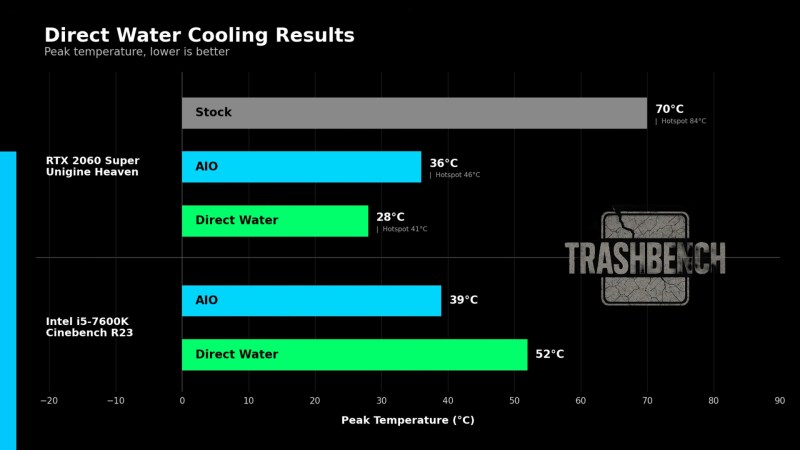
If you’re water cooling a PC, it’s generally accepted that you need some interface between the coolant and the chips — a water block of copper or aluminum that carries the heat-removing fluid. What if you just…didn’t? That’s what [TrashBench] asked with his direct water cooling experiment. Instead of integrated pump or copper water block, he just epoxied a 3D printed pipe fitting onto his bare GPU and CPU.
The results are interesting: while the directly-cooled GPU outperforms the professional system by a decent margin, the same technique fails when applied to the CPU. It also leaks and nearly ruins his hardware, but those are the risks you take when doing mad science, and it’s nothing more epoxy can’t fix. In any case, the fact that directly exposing chips to liquid can cool them down isn’t exactly a revelation. People have been dunking computers in oil for years, but the fact that he sees such a difference between CPU and GPU is quite interesting. [TrashBench] has his own theory in the video, but what do you think is going on here?
In any case, if he continues his direct cooling experiments he’s still going to need a radiator, and if we may be so bold, we would like to recommend a giant metal snake.












Alcohol takes heat when it evaporates so I guess if you could make the case 100% air proof, it would be possible to install a system which sprays the motherboard, CPU and GPU with with methylated spirits. Some evaporates and condenses. Some simply drips to the bottom where a pump recirculates it into the high-pressure piping.
why do they have to me methylated? just to be toxic for the joy of it, or is there a compelling reason?
Because methylated spirits are not suitable for human consumption, in most jurisdictions there is no (or lower) tax on it, whereas pure ethanol for human consumption can be heavily taxed.
Here a bottle for consumption would be €40 per liter, methylated €10.
Isopropyl alcohol would work fine too, and it not for human consumption.
that is basically how heat pipes work. The fluid evaporates at the hot end and condenses and flow back at the cold end. The fluid is often water, the evaporation temperature set by the pressure
I kinda feel like this is the right direction. it’s the phase change doing all the heavy cooling. My mind wants to just shove the whole setup into a pressure vessel and point a capillary tube at the chip to cool it and then pump off the gasses.
Not entirely shocking results, the RTX 2060 has a large die with low specific heat output.
The Intel chip has a small die with highly concentrated heat output. You need surface area to transfer the heat to the water
Another reason it can be easier to cool a chiplet design as you get a spread of heat that is easier to transfer.
The Cray X1 used direct fluid cooling on the CPU MCM much like this, but with a nonconductive fluorocarbon that was designed boil at the CPUs operating temperature.
It feels like we’re having a throwback to all the direct die water cooling that was going on a couple of decades ago. Back then, the discussion was around experimentally finding the most efficient techniques of getting the heat out. I remember mechanisms such as “impingement jets” and other stuff from back then.
I understand that people use demineralized water for cooling as it is easily available and easy to clean when there is leakage. But wouldn’t some low viscosity oil not be a better selection for this kind of experiment? Non-conductive, corrosion inhibitent.
Granted, when you have leaking, cleaning is not that easy. And regular water cooling pumps might not be up to the task for the higher load, but you can use a matching pump and be good.
Not sure about thermal properties of (mineral based) low viscosity oil vs. Water, I guess there are options to select something up to the task or define some properties with additives.
Am I missing something here?
The only thing you’re missing is that oil is horrendous at transferring heat compared to water.
The thermal conductivity of water at normal temps is a few thousand times more than mineral oil.
Thousands?
So I searched on the internets and get oil: 0.316 water: 0.609
Thermal conductivity will be relevant if you’re using water as a static heatsink, but of course it’s a flow situation, so you’re looking for heat capacity. Water has amazingly high heat capacity among common materials, it’s not thousands but still four times that of mineral oil.
Low viscosity oil would likely creep through a lot of seals and joints that water wouldn’t, and be an absolute pain to clean up. It may also react with various plastics and other materials and dissolve or degrade them.
Focusing all your attention on the silicon die is pretty small thinking when it comes to a topic like this. For example, I have a GTX 1080 Ti that will overheat, puke up artifacts, and then crash, if you change nothing except removing the backplate. (I bought it cheap because it was missing the original backplate and was sold as ‘works, but overheats/crashes’)
I found a spare used backplate. It’s aluminum and has some (minor, mostly decorative) texturing, and the working thickness is about 1.5mm of thermal pad plus another 1.5mm of aluminum. Under full load with the board pulling 250W+ the GPU core runs at 60C, while a thermistor stuck to the backplate runs at 57C. All that heat load going into the backplate is coming through the PCB! There are no significant heat sources on the back of the card. And yes, all that heat into the backplate is with proper thermal pads on the front of the card directly coupling the IC packages to the cooler.
But if you can get a heat transfer fluid that can take all the heat at the rate desired, your example would be just adding layers of mass and thermal resistance between them.
How’d you get that from what I wrote? My point was, a nontrivial amount of the necessary cooling is for components that are not the silicon die of the GPU core. And also that just monitoring the GPU internal die temp won’t tell you much of anything about if the card is being cooled properly.
Why not cool all the key elements, the RAM, SSDs, VRAM, and alm the power elections.with very pure mineral oil that uses a cooled radiator. That would add a protection for the electionics and added cooling to mineral oil by actively cooling the mineral oil with a compressor or thermal electronics? You could cool the GPU, CPU, the power components best the CPU, and VRAM along with special connectors to the RAM sticks, and SDDs then pump it back into a cooled radiator a double cooling effect for all the thermal or hest key performance areas?
Aqua
You could take 3D pictures of your specific motherboard and ram /SDD and GPU board without the built in cooler attached and have JLC PCB or similar CNC machine a full motherboard cover and attachments to the other elements.
Aqua
Fill a freezer with mineral oil, drop the entire thing in, add pond pump to keep the oil moving around.
Used to be aquariums back in the day. It worked well, but it was pretty messy when you went to upgrade something.
It’s the upgrade path that puts me off doing stuff like this. If someone wanted a custom build then I’d do it but my gear is constantly being tinkered with.
Wouldn’t spill on the motherboard if you inverted it—maybe we’re doing everything upside down
Liquid nitrogen, the problem would be to always keep it cold. I have seen builds where frost forms on the pipes etc. due to the contact with the air. What if such a thing were enclosed in a vacuum?
Make a steam engine from the evaporating alcohol, connect that to a power supply which will feed the UPS that the computer is running off.
You know what also helps? Spraying water directly onto the dust filter. Still not smart to do it more than exceptionally.
There are a lot of different hot spots on a GPU beyond the core (memory, VRMs, etc). They are normally handled with some thermal contact with the main heatsink. I wonder what happens to them in this setup. But I don’t wonder enough to watch the video.